
Ingersoll’s studio from 1885-1890 located on 40 E. Third St. (just off the corner of Kellogg and Cedar now) would have been torn down to make way for a view of the Mississippi in the early twentieth century. It’s a fine view, really.
Category: tPA 4
Shopping Lists
Further thoughts on the Trimbur Carnival.
I teach with lists, not shopping lists, but rather lists in general as a means of understanding the difference between form and content. Unlike Trimbur’s “student-centered” approach of simply directing the students to a text and asking them what they think, my exercise is carefully framed. I don’t explore “how to write a list.” I explore how to avoid writing a list.
First framing question: “How many people in this classroom read the telephone book for fun?” Then, I open discussion of the reasons why/methods for using a directory list such as a phone book. The ultimate resolution is generally to agree that lists are useful if you know what you are looking for, and much less so if you are looking for stimulation—though sometimes they make an effective brainstorming tool. The arc (on the first day of class) is to work towards interviewing a classmate and then reporting the findings in an “introduction memo” which the rest of the class might find interesting. Using lists as a gateway allows me to get them to not just spit out a boring set of facts in a form that follows a typical questionnaire—to look more deeply for patterns, motifs, and organizing strategies to introduce a person without being boring.
During the second class, the students swap papers and read memos totally unrelated to them. They read another person’s introduction of a third person. We try to examine just how the piece of writing has been composed and make judgements on how effective this particular effort to avoid presenting a list has been.
Later, during the unit on composing instructions, we discuss the parameters for effective lists, such as chunking instruction groups together and optimizing their length. Visual elements are involved as well: How should a list be placed on a page so that people can follow it effectively? At no time have I had a student complain about the simplicity or relevance of lists (grocery or otherwise) in a class in technical communication, because my forays into lists are always carefully framed. But this is of course, a special case of “writing studies”.” I really liked Jenny’s brainstorming on just what “writing studies” might do:
– emphasize an historical understanding of how certain genres, expectations, and literacy customs came to form in the ways that they have
– help students to understand the connections between cultural ideology and literacy (the English-only debates, for example)
– provide a knowledge of developing media and the cultural changes that such media are creating (think Web 2.0)
Writing Studies (2)
In response to Collin’s divergence from the Trimbur article, it seems productive (to me, not necessarily to the discussion) to rationalize why I am so put-off by the closing of Changing the question: Should writing be studied?. Collin was troubled by the simplistic depiction of what the discipline consists of; I’m troubled instead by dragging the history and social network forces of any discipline into the undergraduate classroom. My reason is simple: why should they care? To be fair, this is what Trimbur says:
If anything, I think it is reasonable to say that it has been precisely the historical and theoretical construction of the first-year course, with all of its debates about literacy, rhetoric, culture, and technology, that has laid the groundwork for a curriculum devoted to the study of writing. The achievements of the first-year course have made an advanced writing curriculum thinkable precisely to the extent that our knowledges of writing are too much for a single course to contain. Quantity turns into quality, and in many respects the work of theorizing and enacting the study of writing is to make transparent and teachable the social relations and bodies of knowledge that now silently underwrite the first-year course-to organize the study of writing as an intellectual resource for undergraduates.
For the last several years, my teaching has been focused primarily on third year “Professional and Technical Writing.” Approximately two in twenty-five will go on to graduate education in some form; the majority will enter the workforce almost immediately after taking the class. It’s an exit class—the last writing class most of them will ever take. I do my best to make it good, and by good I mean germane to their ability to write effectively in real-world (not academic) contexts.
Writing Studies
I’ve not entered into the carnival circuit before, but I would like to offer some thoughts regarding John Trimbur’s Changing the question: Should writing be studied?. Some responses (at least so far) seem to have relatively little to do with the substance of the article, but are nonetheless stimulating.
To begin, Jeff Rice conflates Trimbur’s arguments with his own argument about networks: “‘The social relations and bodies of knowledge’ are central to any ‘thing’ we name or categorize as ‘writing.’” Trimbur’s question is branded as “odd” because, (at least as I understand Jeff’s claim) writing cannot be “studied” without studying the surrounding networks/economies of production and consumption. This point is easily granted, but seems commonplace. More intriguing is his closing reflection on Barthes A Lover’s Discourse:
Each conversation brings an ordinary, insistent, or occasional relationship to the reading or writing. Those conversations, implicit and explicit, can occur in a shopping list (which is one example Trimbur provides from his textbook; a writing some students dispute and label irrelevant) or on a website or in an encounter, or in a book, and so on. This writing, however, is not, as Trimbur offers, symbolic. Its process or flow does not represent another experience or encounter. It is writing itself. The challenge is to ask: how does one generate or maintain such relations with references? How does one teach that writing within an already established network that poses references as proof or confirmation?
The conflation attempted here does not make nearly as much sense to me. The methodology deployed to explore the discourse of lovers is not even vaguely interchangeable with the context of academic writing studies. I am a huge fan of Barthes; the “process or flow” of the discourse of lovers does not represent another experience or encounter, but this is not equivalent to a lack of symbolic content. Indeed, such discourse is at its root symbolic in an iconic sense:
Inns of Court

Things look a little different at 3rd (now Kellogg) and Cedar these days. But maybe not all that different, really.
Data Mining
First it was tubes, now it’s pipes. I was watching a video from the New Media and Social Memory conference and feel as perplexed as ever about “folksonomies.” It seems natural that pipes (which obviously have walls as a matter of course) would reemerge as a useful construct to deal with the multiple types and pathways of information on the net. I think the difficulty of this conceptualization is the huge gap between thinking of pipes as vectors (a direction which information can be made to follow) and as physical “pipes” subject to the limitations of physicality—notions such as “bandwidth.” To consider a pipe without thinking of some limitations (as half-baked as Ted Stevens argument was) means that the meaning of “pipe” is akin to the concept of “vector” or “path” instead. I suppose I’d be much happier if Yahoo elected to call their approach “pathways” rather than pipes. But vector is really best of all, because a vector passing through any information cloud is sure to encounter information that has been mislabeled, or ultimately doesn’t fit. It’s the byproduct of aiming to universalize information.
As I was researching, trying to remember what was different about the programming concept of “pipe” and the physical one, I was sucked into a weird time loop. I haven’t programmed anything in decades—I started working with the 6502 processor in the early 1980s and then stopped completely about 1986. The 6502 is credited as having the first “instruction pipe,” but it dawned on me reading the wikipedia entry that it was actually more of a cache holding a single instruction ready to go. The Yahoo effort, and Apple’s automator (another “pipe” technology) are great if you already know what you’re doing. But the real hazard of these sort of vector approaches is that in order to be effective you must limit the array of available operations to a carefully controlled, universal vocabulary (or instruction set). This is not the same as tying the tubes (as Ted Stevens would have it) but rather a matter of charting only predetermined destinations—the path to the CPU, to another process, or to executing a complex query. In short, walking only in the ruts.
I digress. Back to the folksonomy thing.
Ingersoll’s Studio
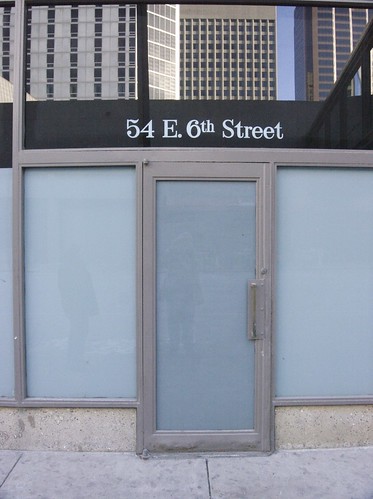
From 1897-1905, Truman Ward Ingersoll’s studio was located at 52 East Sixth, Saint Paul, Minnesota. Things look a little different now. 52 E. Sixth is now the exit from a parking garage.
The Wreck of the Daily News

Can I say damn?
Last year around this time, it was thieves stealing cars and smashing them into cigarette stores. Now, scrap metal seems to be the exciting commodity. Sawing up small children and melting them down—for shame!
May the thieves walk under the awning of the downtown library. An icy retribution is due.
Plagarism

I haven’t bought a print magazine in a long time, but I made the trip to get February’s Harper’s because of the article about Joywar. I’m interested in the ongoing debates about appropriation/plagarism, particularly as they relate to photography. If the 2005 Sweetland conference proceeding ever passes the UMI press editors, my first published paper will be on that topic.
Following the Joy Garnett/ Susan Meiselas piece, there is a long and somewhat tedious collage/article on plagarism (now available online, thanks Tom). Reading through the commentary at the end, it was great to find out about Graham Rawle’s Diary of an Amateur Photographer, I don’t really see collage/mash-up as the future of creativity (as some people people do). But it certainly is fun.
On a related note, the recent article on visual plagarism from Slate is pretty good.