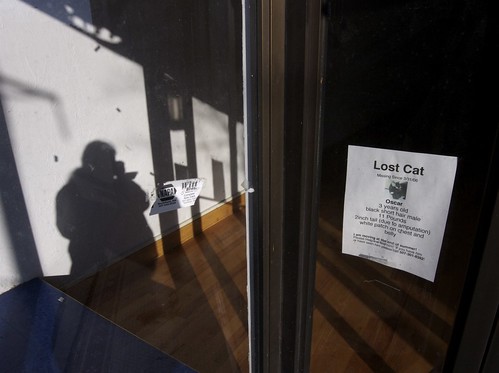
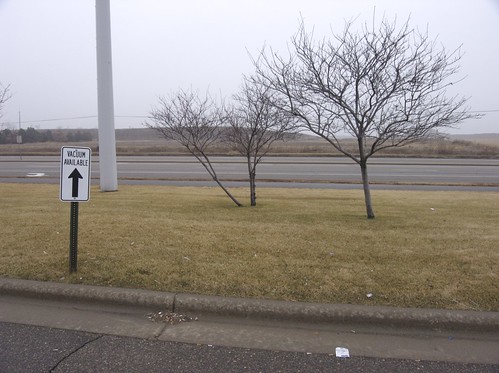
My bucket’s got a hole in it


Taken from Silver Cities by Peter Bacon Hales

I was thinking about this image this morning, while listening to Hank Williams singingMy Bucket’s Got a Hole in it.” I thought I had blogged the image before, and indeed I had.

Four years ago—the mind reels. I used to write about photography and stuff. I wonder what happened? I think it must have something to do with the process of graduate education. Now I really can’t buy no beer.

Morning Reading

I was impressed by Language, Truth, and Wine. I believe that I’ll use it in class this week. It seems like a good way to talk about the slippery nature of language. Last week, I used Dick Hardt’s Identity 2.0 presentation, as I have several times before—but this time what I chose to emphasize is the way that most technology people use ordinary language to describe complex technologies. The frustrating effect of this is that even if you understand all the words, you may still have no clue what the speaker is talking about. I assign a memo where they must describe what Sxip is actually selling, something that is not even brought up during the presentation. That’s the essential part, as far as I’m concerned. What are we being asked to buy in all this?

I used this movie about trusted computing to discuss the pathetic fallacy. Trusted Computing has nothing to do with trust in the conventional sense, and nothing to do with trust as a “personal relationship.” In the second article I read this morning, I find myself appalled by Lindsay Walter’s shallow reading of Moretti. Studying literature (as opposed to reading it) has nothing to do with establishing a “personal relationship” either. That’s why most people who love to read literature for its “aesthetic experience” need not bother with degrees in it. One cannot speak about literature as a form of knowledge without speaking about its currency, markets, or circulation. Walter misses that issue entirely:

What Moretti is advocating sounds precisely like what the doctor should not be ordering. In general in America, there has long been a movement by the leaders of various institutions, like corporations, to distance themselves from contact with the actual materials they sell or process. In mining or car manufacturing, that might be legitimate — I think it is not — but for teachers of literature the shift is deadly because, pursued systematically, it would ensure that professors of literature did not personally have aesthetic experiences of engagement with works of literature.

Distance, ultimately, is the way knowledge is created in the Western world. By distancing our understanding of common words, transplanting them into new contexts, we create knowledge. By looking at literature as a presence in a world which we no longer have access to, we can learn something more than just our personal reactions to it. To ignore that is ultimately pathetic. Experience can only be related by comparison. Comparison only within the present generates only evanescent snowflakes, not transmissible knowledge.

James Burke has a nice bit about the reason why the West utilized gunpowder in a different way than the East in the Connections episode I watched last night. Same point. Though aesthetic knowledge is important, it is hardly the only form of knowledge. More importantly, can a teacher really teach aesthetic experience? I didn’t think you learned experiences, I thought you experienced them.


Benchmarks for Rainbows

Although NCTE’s newsletter linked to a story regarding LeVar Burton’s departure from Reading Rainbow, there isn’t much information:

After 25 years as the executive producer and host of “Reading Rainbow,” actor LeVar Burton has announced that he is leaving the popular children’s television series. Burton says one of the reasons he is leaving is because the “Reading Rainbow” brand was sold to an education company, and the new leadership does not align with his work. Burton is the 1994 winner of the NCTE Literacy Award for his work on “Reading Rainbow.”

A quick search brought up interesting but unrelated stories from the Onion, as well as a CNN story offering some background. The core of the linked story was this:

Continue reading “Benchmarks for Rainbows”

Pilgrims

It has been really difficult to get into any sort of “groove” regarding reading or writing. Lucid moments have been few and far between. I feel a weird sort of tension, for no apparent reason. In the past, I would have tried to write my way through it. Maybe I should try it again.

I’ve been reading my mentor Michael Kleine’s book, Searching for Latini. Michael was the chair of my Master’s thesis committee, and a big influence. But it’s strange to read a work of “confessional” scholarship after being steeped in a more hardcore theoretical atmosphere. It isn’t that Michael is less rigorous, it’s just that the form of his writing matches the desired result—a shared reflection, rather than groundbreaking new data/theory—making it hard for me to follow. It’s more aligned with creative nonfiction than academic writing.

I haven’t read that much creative writing in the last while, and I think that might be part of my problem with “brain freeze.” I’ve got to get unfroze, because I have a paper to prepare for C&W 2007 regarding Benjamin’s Arcades and blogging, and that should be (if it’s going to be a good paper anyway) more on the creative/reflective side as well.

Continue reading “Pilgrims”

C Bush News

CBS News has been getting on my nerves. Each time a story breaks regarding the Bush administration, they carefully structure it in the most sympathetic way possible. Case in point, the latest speech. It’s subtle, but when the lead begins it’s worked before, but it didn’t work this time you’re left with the impression that this contrived rhetoric should work.

But behind the image, there’s something more insidious. The CBS photo (credited as a CBS photo, at least) is the officially sanctioned White House PR photo slightly cropped and lightened. There were no photographers allowed, and it doesn’t look like a frame grab. This PDN story has the background on the uproar—conveniently ignored by CBS, in the service of conveying the official party line.

Branding

“To find a new name for St. Paul’s RiverCentre Convention and Visitors Authority (RCVA), the city’s tourism and convention arm, officials are raising $76,000 from private sources to hire a Nashville firm that bills itself as a community branding expert.”
—StarTribune, December 11, 2006

The Rake is wary of this latest foray into “community branding”— especially after the Rochester Convention and Visitors Bureau spent almost a hundred grand on the slogan “Rah Rah Rochester: More Than You Know.” Herewith, we offer some suggestions to St. Paul, gratis.
. . .
St. Paul: A Hop Across the River from Sodom
St. Paul: C’mon in! (Just wipe your feet.)
St. Paul: 300 Statues of Snoopy Can’t be Wrong
St. Paul: That much closer to Wisconsin.
St. Paul: Come for the Fun, Get Home at a Reasonable Hour!
. . .
St. Paul: More History, Less Histrionics.
St. Paul: What Do You Say We Call it a Night?

from here

Noted in case it disappears. I live in a Saint Paul suburb, making these slogans even more appropriate.

Like Minnesota

The radar imaging system detected more than 75 dark patches in the landscape near Titan’s northern polar region, the scientists said in a detailed description of the find published today in the journal Nature.

The patches, they said, indicated smooth surfaces in an otherwise rugged topography, suggesting lake beds either partly dry or filled with liquid. These smooth surfaces, more or less circular and with diameters ranging from 2 miles to 40 miles, are associated with channels that appear to have been formed by flowing liquids, presumably tributaries to the lakes.

Methane exists in Titan’s atmosphere and, in the extreme cold of high latitudes, is expected to rain on the surface and be present as liquids in subsurface reservoirs.

The radar images, made on a close pass of Saturn’s largest moon by the Cassini spacecraft in July, “provide definitive evidence for the presence of lakes on the surface of Titan,” the discovery team concluded.

When the spacecraft conducted its first radar search above 70 degrees north latitude, Ellen R. Stofan, leader of the team, said in an interview, “We saw a huge swath of the surface just covered with lakes, like Minnesota.”

NYT

More from Nasa