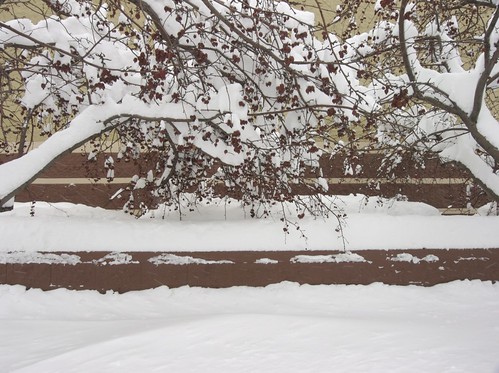
The snow finally stopped today– 14 inches from this storm, 9 from the week before.
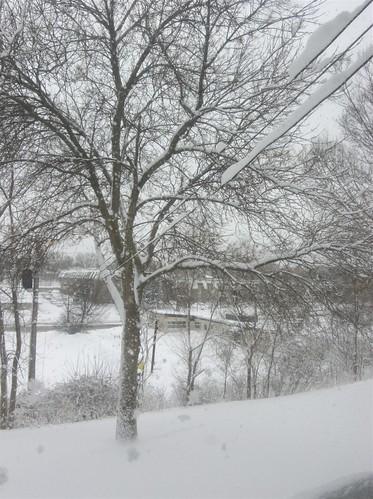
It’s still snowing, but the U is open today.

“Carlton,” of the Boston Journal, who accompanied the party who examined the route of the Northern Pacific Railroad in July, 1869, speaks thus of a portion of the same section of country:
“On our second day’s march we came to a section of country that might with propriety be called the park region of Minnesota. It lies amid the highlands of the divide. It is more beautiful than even the country around White Bear Lake and in the vicinity of Glenwood. Throughout the day we ride amid such rural scenery as can only be found amid the most lovely spots of England.
“So wonderfully has nature adorned this section, that it seems as if we were riding through a country that has been long under cultivation, and that behind yonder hillocks we shall find an old castle, or at least a farm house, as we find them in Great Britain.”
“I do not forget that I am seeing Minnesota at its best season, that it is midsummer, that the winters are as long as in New England; but I can say without reservation that nowhere in the wide world, not even in England, the most finished of all lands; not in la belle France, or in sunny Italy, or in the valley of the Ganges, or the Yanktze, or on the slopes of the Sierra Nevada, have I beheld anything approaching this region in natural beauty.”
“How it would look in winter I cannot say; but the members of our party are unanimous in their praises of this park region of Minnesota. The land is unsurveyed, and the nearest pioneer is forty miles distant, but land so inviting will soon be snapped up by settlers.”
T. W. Ingersoll retired to Dellwood, on the edge of White Bear Lake around 1915. I wanted to note this earlier description as contrast to the snowpocalypse outside right now. I’m about 30 miles from White Bear Lake, but the contrast between seasons is bigger than the contrast in geography.
Update:
U OF M CANCELS CLASSES, EVENTS FOR THURSDAY EVENING
MINNEAPOLIS/ST. PAUL – The University of Minnesota is canceling all classes and evening activities effective at 2:30 p.m. today, Provost Thomas Sullivan announced today.
“In light of current conditions and the forecast for severely worsening weather, this is an appropriate measure at this time,” said Sullivan. “The mid-afternoon closing of metro area schools, colleges and universities and other institutions made it even clearer that this is the right thing to do.”
This has never happened since I’ve been here.

The address printed on this stereograph (56 E. Sixth) does not appear in the Minnesota Photographer’s database as a business address for T.W. Ingersoll. However, the 52 E. Sixth address would only be a couple of doors down. I think it’s likely that Ingersoll occupied up to half of the block. According to an interview with his son from the sixties, Ingersoll employed up to sixty people at his studio in its heyday. This location, slightly off the main street in downtown St. Paul, would have been slightly after that time I suspect. The craftsmanship is quite crappy. Those splotches of color are intentional, and probably dashed on in assembly-line fashion.
There’s a bigger version here, and a photograph of 54 E. Sixth (present day) here.
If anything, I think it is reasonable to say that it has been precisely the historical and theoretical construction of the first-year course, with all of its debates about literacy, rhetoric, culture, and technology, that has laid the groundwork for a curriculum devoted to the study of writing. The achievements of the first-year course have made an advanced writing curriculum thinkable precisely to the extent that our knowledges of writing are too much for a single course to contain. Quantity turns into quality, and in many respects the work of theorizing and enacting the study of writing is to make transparent and teachable the social relations and bodies of knowledge that now silently underwrite the first-year course-to organize the study of writing as an intellectual resource for undergraduates.
tink . . . the pin drops.
Trimbur’s claim that “the work of theorizing and enacting the study of writing” is to render the social network/epistemology of writing studies “transparent and teachable” has stuck in my throat like a chicken bone. I cleared my throat once to no avail, and convulsively I feel like trying again. Quantity does not necessarily turn into quality. Sometimes it just translates into more quantity.
I’ve been alarmed about the corporate domination of the past, not only in regard to controversies like the Google book search, but in regard to the troubling “copyright” claims of image banks and historical societies. Should we allow companies (regardless of legitimate claims about the cost of historical preservation) to own huge swaths of image documentation as their exclusive property? In what way does this promote “progress in the useful arts and sciences”?
In the short term, the cost of digitizing, cataloguing, and indexing is staggering. To render these artifacts transportable and searchable is useful and certainly promotes progress. But what of the “term limits” of this sort of monopoly? Once the initial investment is made, should image banks be able to profit from them in perpetuity? This could easily become (if there is no term limit) the most profitable business venture ever, because access to the past will have a slow and steady demand from each successive generation. Who should own/control our access to the past?
A key distinction between Google and say, Corbis or Getty images, is that Google only controls the index it creates, not the artifacts themselves. The artifacts remain stuck in the dense amber of the “heirs and assigns” of individual creators. As far as I know, there is no search within Getty or Corbis for heirs and assigns. They claim all historic images as their property. Who can own the past? Only a corporation/trust/foundation that lives in perpetuity dare take things that far; mere mortals should not stake that claim (though they do).
The monster is strengthening its stranglehold, and is poised to be another ATT. Private efforts such as Corbis (in a striking parallel with Amazon’s early history) have yet to return a profit on their investments in images— but there is little doubt that they will. The question is, how can we ever “limit” this monopoly given the porosity of copyright. Should Getty own your grandmother and be able to charge usage fees for snapshots purchased from thousands of attics? Should they be able to do that forever? As the archival image business has crossed over a billion dollars in recent years, no wonder every archive wants to erect a fence in its yard.
I’m less scared of public institutional ownership (though it could easily be mismanaged too) than the corporate giants. But any way you look at it, the public trust (read: common stake) in preservation efforts is generally given little attention. This bothers me.
As our methodology developed, we discovered that each new picture, when combined with an earlier image, forms a mutually dependent pair with fresh potency. Viewed in the same context, both photographs seem to extend beyond their own time frameworks and refer to an intervening period without actually describing a specific course of events. Thus, they enact the potential for an unusual dialectic about a changing landscape, a discourse that may be continued through time, activated by repeating the first images over and over. The earliest pictures mark the starting point, but no one image, first or latest in the series, represents a definitive statement. Each is simply another perspective in an ongoing time-image network. (Mark Klett)
The idea of participating with a site was reinforced by coming to see how each place might variously be represented by the photographer. Each series of photographs I took reminded me of a phenomenological exercise in perception—as if I were moving from vantage point to vantage point asking perceptual and conceptual questions about the place and receiving an appropriate response each time in the form of the resulting image.
My experience at each site became an interaction, a kind of double funnel: a flood of awareness poured in from the site and my selected responses seemed to pour back onto it. My experience was both an exchange and interchange, an engaging and a blending, an agreement and an affirmation. (Rick Dingus)
Second View: The Rephotographic Survey Project (1984)
Few persons are aware of the extent to which this art is practiced, or how deeply it has interwoven itself with all social habits. From being an article of luxury the simple photograph has become by its inherent attractiveness and usefulness, one of the necessities of civilized life. It can be produced so cheaply that the very poorest can patronize it, and its best production so nearly approach works of high art as to make it welcome with those who value it only for its intrinsic merit. It therefore adapts itself to all the varying means and conditions of a society, and its cultivators find in every civilized community a means of obtaining an honorable livelihood. Granted that, as an artist, the photographer occupies a very humble position in the eyes of the public, yet the fact remains that not only in our large cities are there to be found prosperous photographic establishments, but our smaller towns also support them, and few large villages even exist but some adept in the art ekes out his means, if he does not entirely support himself by it. Nothing can, therefore, better prove how exactly adapted this singular art to meet a craving want of our common nature. In the smallest communities, long before the penny newspaper has arisen, or the railway station has made its appearance, the photographer will have established himself a “local habitation and a name.”
Jabez Hughes, “Photography as an Industrial Occupation for Women” Anthony’s Photographic Bulletin No. 4 (1873) 162-166
I become increasingly fascinated by the concept of the photographer’s studio as an outpost of culture on the American frontier. Saint Paul was known as “Pig’s Eye Landing” after a popular tavern until 1841. It was incorporated in 1849. The first business directory of St. Paul from 1850 didn’t list any photographers, but there numbers grew exponentially after Minnesota was labeled as a territory in 1852. Early studios were typically labeled as “galleries” and I’m sure that they provided a site for the exchange of news and views.
Whitney’s gallery, on yet another corner of Third and Cedar in Downtown St. Paul was across the street diagonally from the site of Ingersoll’s studio 1885-1890, and would have literally been next door (if it still existed—it didn’t) to the next incarnation of Ingersoll’s studio from 1891-1894 at 27 E. Third Street.
This corner, since 1966 at least, has housed the Crowne Plaza Hotel. Billed as “the place to meet,” I suspect that this intersection might have claimed that distinction since at least 1852.
Jeff Rice suggested that I revisit Roland Barthes’ work. I have, and I find that I really can’t connect with Jeff’s network. I find too much interference in Barthes’ texts.
To come to adopt a closed sphere of language under the pressure of all those who do not speak it, is to proclaim one’s act of choosing, if not necessarily one’s agreement with that choice. Writing here resembles the signature one affixes at the base of a collective proclamation one has not written oneself. So to adopt a mode of writing—or, even better, to make it one’s own—means to save oneself all the preliminaries of a choice and to make it quite clear that one takes for granted the reasons for such a choice. (Writing Degree Zero, 26-27)
In this passage, Barthes is specifically attacking the libratory potential of political writing (as a response to Sartre’s What is Literature). Most significant, I think, is the claim at the end of this particular chapter that “any intellectual mode of writing can only give rise to a para-literature, which no longer dares to speak its name” (28). In a direct sense, this is the discourse of professionals (politicians or scholars alike) that reify a mode of discourse by adopting it. Professional writing training cannot escape a particular “closed sphere of language”—a symbolic system not created by a student writer that they are expected to choose. In this arena, I doubt the utility of “student centered” or “libratory” pedagogies. I think political skepticism fuels much of Barthes’ early writing, and the mistrust of emancipatory schemes always comes back to the nature of language systems themselves.
An emancipatory sign system does not exist, but Barthes attempts to conceive of one in An Empire of Signs:
Text and image, interlacing, seek to ensure the circulation and exchange of these signifiers: body, face, writing; and in them to read the retreat of signs. (xi)
The perfect system in Barthes’ fictional Japan is an autodestructive (or autodeconstructive) one, not a system that forms professional or political systems:
