A month, another year.

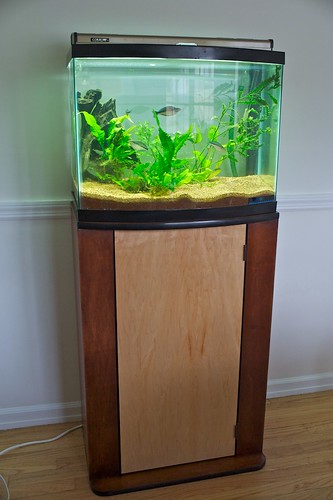
New 26g Bowfront

I really don’t have much to say these days. It’s been a month since my last confession… I finished the aquarium stand I was working on a couple of weeks ago, and I’m about halfway done with a pair of skinny end tables to go with the couch. But the real news is my new used machine:

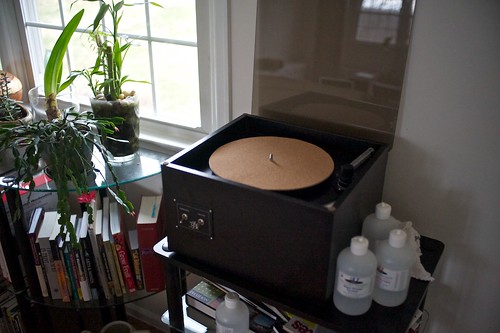
VPI 16.5 Record Cleaning Machine

I’ve wanted one of these things since they were invented. I have thousands of LPs, so it seems only sensible. I have been spending a lot of time listening to records for the first time in years. I found this bit of industrial decor used for a good price, and now I have to  engineer either a new enclosure, or a cabinet to hide it so that mi esposa learns to like it as much as I do.

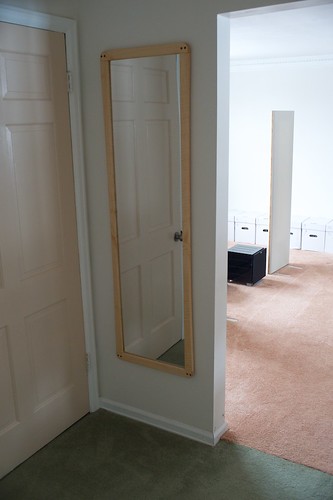
Wall mirror, phase 1.

Wall mirror
New wall mirror for the hallway

This project broke my heart a little. It was a gorgeous piece of wood before I butchered it. I love maple, and the figure/shape was fine. But I got overly ambitious with the through-tenons/pins at the edges, and split it a little when I was installing the mirror. Now I know what not to do next time.

I think I’ll make another one and move this one upstairs. But before I get to that, I’m working on an aquarium stand/top for a 28 gallon bowfront. The sofa arrived for the living room, and I have lots of tables and ottomans to build.

I guess it’s mostly the wintertime grey that makes staying in and working in the shop so attractive. I find it hard to sustain much of an interest in reading these days; I suppose ten years of reading everything in reach sort of burns you out. My reading has become a lot more selective, and every year I get a lot less interested in the internet/technology and more interested in craft and images. I’m trying to build the sort of space I once had, where the main thing to do was to look at things for long periods of time. Looking isn’t synonymous with reading.

More than anything else, it’s nice to touch things. That’s what I like about wood the most I suppose: it invites touching. Screens don’t.

Boxes, phase 2

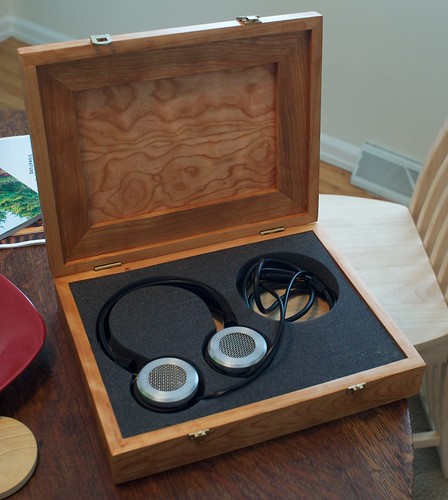
Cherry Box for Grado HF-1 Headphones

My second box was significantly more elaborate than the first one. I had intended to go on with practicing dovetails, but I just couldn’t bring myself to build a box just for the sake of building a box. It had to be for something. So, the only box I could think of a pressing need for was a fancy container for my limited edition Grado HF-2 headphones (terrific sound, btw.). The problem was finding the right piece of wood for the top. Nothing I had was really big enough. It turned out that dovetails just weren’t right for this box.

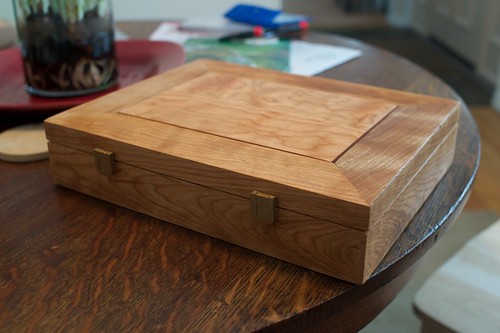
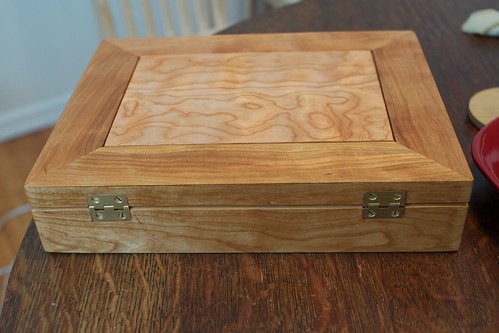
I resawed a highly figured piece of cherry, but the resulting piece was still several inches too small to make a one-piece top. So I ended up doing this box with a plywood bottom and a frame and panel top. I used another piece of cherry carefully sawn, rabbeted and mitered so that the grain would wrap around the perimeter and be continuous on the top frame, with a slightly outward bow to the grain. The box is nearly flat, with the center panel about 1/64″ proud— but it doesn’t look that way. It looks like the top angles up, making the entire 3″ tall box look much larger than that. I’m pretty happy with it. The center panel is floating, so the top should remain free from warps for a few years.

Cherry Box for Grado HF-1 Headphones

There are some tool marks that I couldn’t avoid, and I still round things too much when I try to sand them— but reading David Pye’s The Nature and Art of Workmanship has been a real eye-opener about flaws. I mortised the hinges, and nearly made them machine perfect except for some slight slips of the chisel. I can live with that.

Cherry Box for Grado HF-1 Headphones

I’ve been thinking through a lot of things that I should go into more detail about, but it is a lot more fun to do things than to write about them. But just as a brief note, anyone interested in Ruskin, Morris, and the whole Arts and Crafts thing really should read Pye’s critique. In brief, he argues that Ruskin’s aesthetic theory fails miserably in its attempt to embrace workmanship, largely because Ruskin was clueless about making things. Instead, he ends up promoting a “rough taste” without understanding why/how things are made either rough or smooth. Cultivating taste is an essential part of any sort of education, craft or otherwise. But it’s one thing to look at things and guess at their surface qualities and yet another to really design/make/use them.

I am particularly enamored of Pye’s insistance that photographs fail to convey any significant data about workmanship in its deepest sense. You’ve really got to touch things to get the feel for them, on multiple levels.

Cherry box

Cherry Box for Christmas 2010

We didn’t really do much for Christmas when we first got here in 2009. This year, we got a tree and the whole thing. Krista and I talked about it, and decided that we would just buy a few ornaments each year rather than a bunch of them all at once. Each one was sort of personal for us. In keeping with the whole improving my ability to work with wood thing, I decided I’d build a box to keep 2010’s ornaments in. It is my second stab at hand cut dovetails.

My first attempt was a tool caddy I built in my dad’s garage when I first got to Arkansas a decade ago. That one was done with scrap pine, and was a relative disaster. I left it in the garbage when we moved away, though I wish I had kept it for the old axe handle that I used for a carrying rod at the top of it. My dad turned the ends down for me and it was kind of sentimental even if my joints were crap.

This one turned out better, though it’s got plenty of flaws. I’ll probably make another box just to practice dovetails again soon. This one, though, is simply done. Before February even. Holds ornaments. Couldn’t ask for much more.

Cherry Box for Christmas 2010

Laundry Cabinet

Building for Clio
It is essential to match your furnishings to your cat.

I’ve been working on building this cabinet for a month or two off and on. It marks a weird shift in my way of doing things. I started completely without a plan and simply “composed” the cabinet as I went from hard maple and maple plywood. I got tired of feeling inadequate as a woodworker, and decided that it might be best to sort of “free write” a project with low stakes. It isn’t perfect; it’s simply a countertop to fold clothes on in the basement though, not “fine woodworking.” A sort of prequel to the sort of thing I’d like to build in the future.

After I started the project, I was reading Krenov and noticed that he actually recommended kitchen cabinets as a good starter project for furniture builders. As we often say around the house, “yeah, I meant to do that.”

My Craft Universe

ho-craft1022_kre_0499301458.jpeg
James Krenov

Many of us want to know not only what is being done here and there, but also how it relates to certain aesthetics and sensitivity, what some regard as fixed points in our craft universe [emphasis mine]. There are, and should be, measures by which we can honestly get our bearings. Some of us who write about crafts are not pausing to include these points of orientation along with our reportage, human interest stories, and awed attention to the eccentric aspect of woodworking. We are not doing enough for those who would excel anonymously or merely within a small circle. We don’t seem to know where these people are and what they need in the way of help and encouragement. Ordinary professional and craft information is only part of what they need. The rest is as yet rather vague but it consists of aesthetics, the integrity of material weighed against various methods— judged not with hair-splitting exactness, but in relationship to skill, intuition, and reverence for the life that is in the wood.

There is too little constructive evaluation. After the artiness has been aired, the exposition of clearcut rights and wrongs terminated, we should still have a lot to talk about, and share. (11)


James Krenov, The Impractical Cabinetmaker (1979)

I’ve been making photographs for about 35 years now, and when I first encountered Aristotle’s classification of rhetoric as a techné (about ten years ago or so) I immediately started drawing parallels between the two. It’s hard not to overlay what you feel like you know over the top of what you would like to know. Rhetoric, in the Aristotelian sense of being able to “see” the available means of persuasion in any situation is more than metaphorically connected with “art” — it is “art” in a quite specific sense. Although techné is usually translated as “art”, it is closer to craft. Casting aside the tiresome question whether photography is an “art,” the craft of photography (chemical or digital) is undeniable.

Woodworking is certainly one of the ur-crafts (arché technai). It is a new world for me to consider. Therefore, I cannot stop overlaying Krenov’s pedagogical imperatives on both rhetorical and photographic education. Many writing teachers stress correctness above all else, marking with enthusiasm the most trivial of grammatical or syntactical errors. I always thought of myself as a rhetoric teacher, not a writing teacher: historically, grammar is a completely different subject and it annoys me that “writing” tends to conflate the two. Writing education that starves out rhetoric for the sake of cold correctness serves nothing but the inflation of the teachers’ ego. Similarly, in arts education there can be a sort of smug emphasis on learning to identify “art” and its characteristics as a product separate from its procedures: a rating game akin to dick-measuring. As Chuck Close says (loosely paraphrased), once you’ve seen some art it’s pretty easy to go about making something that looks like art. Similarly, students of rhetoric have a tendency to compose documents that look like rhetoric, filled with specious arguments and flourishes that cloud arguments like dandelion fluff.

Krenov’s suggestion that once basic correctness and “artiness” are addressed the “relationship to skill, intuition, and reverence for the life that is in the wood” leaves an ample realm for discussion that seems deceptively metaphysic. I prefer to look at it in a more literal, physical sense. There are resonances of craft of woodworking that can be easily overlaid to other technai. There are also shared problems. As Krenov suggests, beyond “professional and craft information” the territory is vague; it would be easy to argue that “human interest stories” have no relevance to woodworking, photography, or rhetoric when they are conceived as craft (as opposed to art).

In assigning rhetoric the craft of “seeing” the available means of persuasion in a given situation rather than the ability to persuade itself, Aristotle makes all alternatives in a given situation proper material for consideration. This might be misconstrued as constituting rhetoric from/about everything, so it seems fitting that the first book of Aristotle’s Rhetoric contains a long discussion regarding “speaking outside the subject.”1 The “matter” of rhetoric is situational. Photography, at least in the variant that I have myself practiced, is similarly dependent on what is given by the world in a specific place and time. Any “craft universe” is necessarily a subset of the actual universe, limited to experiences with some degree of presence to the practitioner and their subjective concerns. By definition, these are matters of human interest— not as warm and fuzzy subjectivities, but rather (following Krenov) as “fixed points” whereby the craftsman can locate themselves.

The first problem in mapping the subject (either photography, rhetoric, or woodworking) is finding acceptable definitions demarcating the universe they occupy/participate in. Proclamations that “photography is dead”, for example, only ring true if you class photography within a single technology circumscribed within a narrow historical moment. For example, despite its resurrections, the daguerreotype is for most purposes dead. Silver prints are clearly an endangered species as well. However, these (in my mind) are forms of photography, not photography itself. Patrick Maynard sidesteps this problem by labeling photography as a group of technologies for marking surfaces— rather than the end products or abilities engendered by those technologies.2 Aristotle’s definition of rhetoric takes a different path. Rhetoric is not a technology of persuasion, but rather an ability to see the means of persuasion.

Definitions are slippery, and careful choice of terms is imperative. To step back for a moment to the definition of techné as a general field, it is helpful to note some points of evolution. My easiest and most precise recourse regarding exposition of Aristotle’s conception of techné is simply to quote Joseph Dunne:

In E.N. 6, techne is defined as a hexis meta logou poiētikē, a “reasoned state of capacity to make.” It is thus quite straightforwardly linked to making (poiesis), i.e., the generation of things whose source (archē) is in the producer and not in the product.” (Such things [poiēta], then, are different from natural things [phusika], which have the source of their generation in themselves, and from necessary things—the objects of sophia—which are ungenerated.) This efficent causality of the maker is an element in a process in which other factors are causally at play: the material (hulē), which gives the maker something to work on and gives the product the solidarity and durability to exist as an artefact in the world; the form (eidos), which is realized in the material and gives the finished product its specific character; and the end (telos) of the making which may be looked on either as the realized form itself or, beyond that, as the use it serves in people’s lives.

When the maker is able to bring these causal forces together under his rational direction he may be said to possess the relevant techne.—e.g., to building in the relation to making houses or of cobbling in relation to the making of shoes. Techne is not itself a useful thing but rather a generative source (archē) of useful things, a habitual ability (dunamis) of the maker through which he can reliably produce and reproduce them. (248)


Back to the Rough Ground (1993)

Tiptoeing gingerly around the issues of formal cause (eidios), efficient cause (hothen) and final cause (telos), what strikes me most is Krenov’s insistence on “reverence for the life that is in the wood,” the material cause (hulê) of woodworking. “Hulê” literally means timber or wood. In the most delicious convergence, Aristotle’s terminological choice for discussions of “material cause” is lifted straight from woodworking. Aristotelean material causality doesn’t refer to cause as in cause and effect but more fundamentally and arcanely: “what is it made of”?  What this provokes for me is a seemingly innocent question: What would the “wood” [matter] of rhetoric or photography be?

An elegant solution springs to mind in the case of photography: photography is “made of” light. Whether pixels on a screen or dye or silver on paper, light is the hulê (material cause) of photographic images. Light resides in its name, just as “wood” is the first particle in the compound “woodworking.” This makes for an interesting distinction between the two: the material of woodworking is (or arguably was) alive; light, obviously, is not.

I remember vividly a student wandering through the gallery at Bakersfield College where I was hanging an exhibition of my infrared bar photographs (Invisible Light) complaining “I just don’t hear the music.” I was puzzled; music is always alive but I never claimed that my photographs were alive. It seemed to me to be a category mistake: Alive? That’s impossible! I just don’t think it is productive to look for “life” in a photograph. Photographs may observed in life, but they are not of it. To speak of the “life in a photograph” is speaking outside of the subject. It’s been decades since that happened, and thinking through the material of photography clarifies the distinction considerably.

I do not mean to imply that photographs can not be evocative; far from it. It’s simply that what photographs can evoke are experiences of durable form residing in reproductions of space or texture. Form, and the spirit contained within it, are more complex. “Life” (as a proposition) is a missing element that must be supplied by the viewer; one cannot fault the photographer (or sculptor) for not animating the inanimate. Even if this were possible, the creation would be a soulless golem.

In rhetorical terms, photographs can be enthymatic, offering propositions of form and space illuminated by light. Only a viewer can supply any proposition of life. As Krenov asserts, wood is different. It grows and shrinks and warps and checks as the cells of its durable form surrender to entropy. Wood is alive, and does not require the intervention of an interpreter to supply life. Intuition, however, comes into play in determining the relationship between material and form and their suitability to purpose. In this, I think there is some parallel to photographic work— understanding the relationship of light to form is a hard won skill.

As this consideration should make clear, knowing the hulê (material cause) of something is necessary but not sufficient to defining the thing itself. Things with a durable physical presence are fairly easy to classify by hulê, but difficulty is encountered when the forms of a technai are compound or complex. In searching for the hulê of rhetoric, Alan Gross proposes that hulê can be classified as being composed of sensible matter, states of sensible matter, or intelligible matter.3 This excessively complicates determining the hulê of rhetoric— which Gross postulates without argument as a compound of intelligible matter, “thoughts and ideas” and sensible matter created by the vocalic apparatus and received by an aural apparatus (32). This conflates the efficient cause (hothen), which seems to me to be the thoughts and ideas of the speaker, with the formal cause (eidios) of their expression in speech to define their hulê.4

With much reflection in the past four days that I’ve been writing this, I believe that the most fitting hulê for rhetoric is breath. As such, it is indeed a manifestation of life. Without life, there is no persuasion or situation in need of it. As such, it seems natural to me to apply Krenov’s dictum and assert that it is desirable to discuss the life that comes from the breath of rhetoric.

These reflection on materials leads me deeper into these three crafts I love. The most exciting development in my thinking is discovering that both rhetoric and photography survive through ventriloquism because both are designed for reproduction. Reproduction is not a necessary state for woodworking, it is purely optional. While some forms of photography are not reproducible (monoprints and daguerreotypes), most are by design. For rhetoric, from rhapsodes to printing it has been by defined by its reproductions.

The light in which we view photographs as objects or on screens is not the same light which fell on the original scene, and the breath which reanimates a book from years or centuries past, or a recorded speech, is not the same breath that left the body of the speaker. But both can offer intimations of life, completed only in the reception of their products. 

In these examples though, only wood contains life.

1see Arthur E. Walzer, “Aristotle on Speaking ‘Outside the Subject’: The Special Topics and Rhetorical Forums” in Rereading Aristotle’s Rhetoric (2000)
2 Patrick Mayard, Thinking through Photography: The Engine of Visualization (1997)
3Alan Gross, “What Aristotle Meant by Rhetoric in Rereading Aristotle’s Rhetoric (2000)
4At some point, this all becomes mind-numbingly complex for a non-classical scholar like me. Gross defines the hothen (efficient cause) of rhetoric as a dunamis and hexis (an ability and habit); he also claims that dunamis and hexis are the psychological processes necessary to understanding a techné, making the definitions invoked essentially circular— it is defined by what it is? Uh, yeah. I fall back on my limited understanding of efficient cause as cause in the cause and effect sense. Having thoughts and ideas causes their expression in rhetoric, which generally takes the form of speech.
Object-oriented


My way of working is just a long series of personal discoveries. I can’t give anyone any secrets, something that I promise will work, because, finally, it depends on one’s skill and intuition, and other things. But I can give hints, the benefit of some experience in the things that have happened to me. . . .

Many people don’t realize these truths because they have never been close enough to real wood, beautiful wood in its natural state. They’ve seen veneered surfaces; they’ve lived with wood secondhand, and they are just not aware of the richness that is to be found in individual pieces, logs, and planks. So part of my struggle through the years, both with visitors in my shop and in some of my brief writing, has been to remind people of these things, to tell them not only about the richness of the material, but the connection between the material and how some few people, a very few people, work. In a way I can prepare them to receive these objects, or to meet these objects, and expose themselves to them with a degree of sensitivity which these objects, I hope, deserve. (A Cabinetmaker’s Notebook, 12-13)

I have been building a basement wood shop for about a year now. I have little to show for it in the manner of objects (save shop fixtures and jigs), but the philosophy has enriched me immeasurably. I suppose it began when I moved to the village of Fayetteville, one of the centers of the Stickley universe. The Arts and Crafts Movement coincides with the historical period that fascinates me in photography though prior to locating myself here I had never really thought much about furniture design. I was immediately drawn to the beefiness and practicality of the Stickley designs, but wasn’t really quite sure what to think about Krenov’s spare bird-like pieces.

What becomes instantly apparent when you read much woodworking literature is that it is dominated by machine expediency. The philosophy of people like Gustav Stickley is stripped away in favor of quick-and-dirty methods of replicating the Arts and Crafts look. One has to search pretty hard to find Stickley’s thoughts on craft and life, but it’s findable (though a subject for another day).

Reading Krenov has been a revelation. His thoughts on originality, composition, and materials are first rate concepts for consideration for anyone considering matters of craft. In making sense of things, I cannot help but compare Krenov’s concepts with the craft I dedicated such a huge swath of my life to: photography.

This might seem a bit forced, given that wood is an organic material and photography is currently dominated by talk of megapixels and evanescent virtual bits, but I think that the real gist of photography is just as organic due to the shaping of its human subject. The materials that all photographers work with are primarily time, space, and light.1 The education of a photographer should always begin with a sensitivity and embrace of those three essential elements.

Fall Drive

I am reminded of an incident shooting outside CaTony’s diner last week.

A woman (perhaps “Cathy” of CaTony’s) came out and interrogated me: “What are you taking pictures of?”

“The light, mostly. Isn’t it beautiful?” I answered. The blank look on her face just broadcast suspicion and a complete failure to grasp what I was saying at all. Most people aren’t all that sensitive to light, I guess. If I had answered that I thought her ice-cream shaped lights were distinctive and novel, I might have gotten a more collegial response; it was as if I was speaking a foreign language to her.

Photography is most easily understandable when it addresses the novel, the unusual, the out-of-the-ordinary (celebrity, unusual natural phenomena, etc.). The actual materials of it are subsumed in searching for matters of more impressive visuality. Krenov actually centers this emphasis on visual novelty geographically as the passage quoted above continues:

This is truly an unexplored chapter in the United States. Expression in wood, if I may say so, is a bit heavy handed there; oversimplified. So often the emphasis is on form— as in sculpture. It is primarily a visual experience, with the wood not always having its say, not always as important as it should be—sometimes not important at all. Some artists in wood order their material by telephone, and admit it is not of that great importance. This is not a criticism; it is merely stating that there are different relationships to the material. (13)

Krenov expands his thoughts on visuality and originality in his second book, but this early passage really seems to dig at the bulkiness of most of the Arts and Crafts furniture as exemplified by Stickley and his imitators. Sensitivity to objects, and sensitivity to the tools that create them is central to Krenov. He has little love for the perfection of machines (a quality that Stickley embraces to a much greater degree than his English/European counterparts in the Arts and Crafts Movement). But it would be facile to take this as simply a matter of preferring one sort of form over another. The relationship of material in form (as objects) is what Krenov emphasizes:

So we talk about tools, we talk about objects, and I hope that gradually I can get across this relationship, this love affair or whatever you will. How it comes to be that woods whisper to you about tools and methods and shapes—shapes within shapes, really, because when you become aware of certain ways of using wood, then you realize something about a straight line. To me there is no real life in a perfectly straight line or a perfect circle. But in wood you can make a rectangular object, give it tension and countertension and balance without complete symmetry, and you can give it rhythm by choosing the wood. You may have just a rectangular frame, but you can make it almost soft, almost a sensation of oval for the eye, if you choose the wood in the right way. And you can do the opposite; make it unpleasant by making the wood bow slightly upward and inward so that the corners appear extremely sharp to the eye; this will be disturbing, whereas the other is harmonious. But it is not dead, or lax, because wood is a living material when used in this way. You are always experimenting. You are playing with textures, tensions, the things that happen, and, if you are sensitive, if you are lucky enough, then you exceed your expectations. (14)

I will never forget my first impressions of the work of my mentor Harry Wilson— it seemed as if space itself curved in his photographs, as if you could sense the bulge of the earth. But it was not a lens distortion, or an optical illusion caused by strong and predictable lines. It was a subtle thing, a palpable feeling about space that was not a formal thing, but rather a subjective quality. This quality was real to me, though no one I ever tried to describe it to sensed it in quite the same way (even Harry himself). I just could tell that it was a Harry Wilson photograph because of the space and tensions within that space. It was personal, but at the same time it seemed to be more than that. It was not that Harry “invented” this space, but rather that he identified arrangements of objects in the world that were evocative of that particular space. The space was apparent even in his multiple exposure work, so it seemed to me a matter of selection rather than invention.

I’ve never believed that you have to be all that inventive. Form, for me, is not the primary thing, form is only the beginning. It is the combination of feelings and a function; shapes and things that come into one connection with the discoveries made as one goes into the wood that pull it together and give meaning to form. (Krenov, 14)

The materials of photography are, for me, the world itself which greets us with time and space and light. Photography, for me at least, is about the love affair that I have with the world. I tend to look at photographs as utilitarian objects that give me the chance to examine the world more closely, to know certain aspects that would be invisible without this recording technology.

The difficult thing, then, is dealing with the utter loss of photographs as objects in the contemporary schema of the world. I miss holding them, looking at them, and furnishing my space with them. I have yet to find the skill I need in ink jet printing (or furniture making for that matter) so I feel myself at an impasse. But one thing is certain: I want to focus my effort at creating, rather thans simply consuming, in the space and time that avails itself to me.


1These distinctions have been with me since I first confronted the problem of trying to teach photography at the University of Minnesota. It was a short class, but useful I think both to me and my students. It surprises me that I have never written anything about that (that I remember or can find).