I haven’t had a lot to show for my labor lately. A great deal that has been going on is adjusting to different tools and the way they work. I was a bit surprised to see this segment on the Cobert Report on the possibility of new table saw legislation a few weeks ago, and then yesterday I discovered Don Bowman’s Power Tool Song. There aren’t any transcriptions of the lyrics about, but one of my favorites is regarding chain saws: “the only tool that comes with a first-aid kit and a ‘Hire the Handicapped’ bumper sticker.” Tools can be dangerous. I have all my fingers and toes after many years of working with them and I aim to keep it that way. The best way, I think, is probably to avoid using table saws at all. I have only recently figured out why: basic physics.
The centrifugal force of a round blade spun by a powerful motor does some tricky things. It is mostly impossible to cut a truly straight line on one because the blade pulls the rear of the workpiece into the blade, creating a subtle (or sometimes not so subtle) banana shape to the line. Coupled with a rip fence, this can cause binding and kick-back where the tool throws the board back at you. Wood is not velveeta, and contains internal stresses as well that can pinch the wide round blade aggravating the problem. It’s not just a matter of not putting your fingers into the tool, it’s also a matter of not having the tool suck you into it! I’m on my second or third little contractor saw, and it’s probably going to be my last. I’m tired of fighting with these things.
Hand tools can be a problem as well. Not because they are prone to injure you, but because it’s easy to slip and mess things up. Or, in the case of saws, cut cock-eyed or twisted. It came to me in a flash what the basic problem is: it’s not the tool that screws things up, it’s the motor. In the case of hand tools, the motor is your body. If you stand wrong, you saw wrong. It’s not the quality of the tool that fails, generally, it’s the quality of you and your skill level. That puts a different spin on it entirely.
Dad finishes up the cattle grate for his place in Summerfield, Oklahoma- photo by my mother.
Although my father apprenticed as a carpenter, his real core skill area was the torch. I’ll never forget the time I twisted off a tripod screw in the bottom of my first camera and my dad fixed it— with an oxyacetylene torch. Working next to springs and wires scarcely bigger than a hair, he delicately brazed a piece of rod onto the stub and twisted the broken piece out. No damage to the electronics of my old Canon FTb. I was impressed. I was more used to him welding old drill casing together into fence rails, or building gates. Much of my childhood was spent unloading his truck as he hauled old metal scrap home (at 20$ a ton, as I recall) to make the stuff that surrounded our home: irrigation systems, fences, clothesline poles, etc. He made jack-stands and A frames for hoists, virtually anything you could think of to keep a small farm equipped. Even after he retired, it would never occur to him to buy most things— he’d rather make them with scrap metal and fire.
My father was never picky about his tools. He was constantly on the lookout for things people lost by the side of the road, or things that broke at the shop he worked at in the oilfields. There were very few things in his tool assortment that hadn’t been touched by a torch. Some things worked better than the stuff you could buy, such as his heavy metal jackstands. Other things, well, not so much. After he died (about nine years ago) I bought my mom a new set of pruning loppers. Dad used a pair that had half-inch pipe brazed on as handles because the wooden handles had broken. He fixed them, but my mother could no longer lift them without him. Many of the objects he made are rotting in a collapsing house in eastern Oklahoma, along with his tools. He gave them to my brother Steve when he could no longer use them. Arthritis in his hands finally got the best of him.
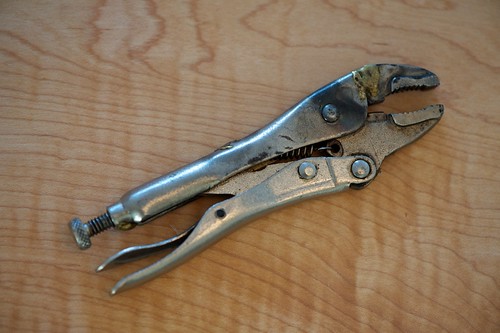
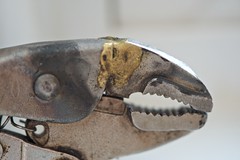
When Dad died, I was engaged in symbolic work. I was never very good at the manual trades; my brother was much better. I’m pretty sure he’d be happy I work more with my hands now, but he’d also be chuckling at my ability to overcomplicate things. I think though, in retrospect, that I came by this tendency naturally. Exhibit A, a tiny (6″) pair of vise grips from my dad’s toolbox:
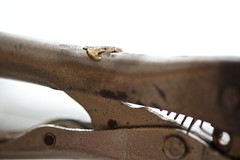
The repair to the upper jaw is fairly obvious, but what doesn’t show at first glance his “repair” of the spring that holds the jaws open. Apparently, it was slipping off so my dad fixed it, quite literally.
The third detail, which I didn’t photograph, is the way my father “improved” the screw threads on the main adjuster. The large screw at the back is threaded through an opening in metal that has just been folded together- a detail common to all vise grips. My father apparently felt this was weak, so he brazed the metal closed around the screw without damaging the threads. That’s the overkill/overcomplication gene at work, I think. To buy a new pair of vise-grips would have just been a couple of dollars, but why do that when this tool could be fixed?
I can’t remember a time that I went this long without writing. I’ve become quite disenchanted with all sorts of symbolic activities, and become pretty much object-oriented. I have no idea what that means philosophically, what I really mean is that I have become far more interested in things instead of words/images/representations of things.
The unnarrated life goes on. I’ve been working with wood, and reading the loose canon of books associated with woodworking. Yesterday, it dawned on me what my problem with most of these works is: the fit between symbolic ideologies and the pragmatic realities of applying tools to objects is rough at best, non-existent at worst. The latest example is the summoning of anarchy to support a skeptical approach to big business (while promoting boutique, petit-bourgeois capitalism) in the name of working wood. Huh?
The Anarchist’s Toolchest contains a lot of interesting information but is ultimately a hypocritical buyer’s guide. If the ideological component (which is pretty much biographical rather than theoretic) were removed, the book would not suffer in the slightest. The cult of personality looms large in woodworking, though, and ideologies as a component of this are always fair game and fodder for the machinery surrounding them. I like Schwarz’s writing style, and will no doubt continue to read most of what he generates although most of what he creates could be classed as heat with little light. It reads like it is written by a tool reviewer, not a woodworker. I suppose, due to the title, I was looking for more philosophy and less consumerism.
There are lots of historical precedents for this sort of capitalism cloaked in radical ideology. The grandaddy of it all in the U.S.A. is of course Gustav Stickley, who I had never even heard of until I moved into his stomping ground. Following William Morris, Stickley seems to mash-up guilded age capitalism with golden age feudalism. The Arts and Crafts philosophy just doesn’t quite gel with the wonderful objects that it produces, and its socialist/utopian underpinnings come off about as useless as anarchist capitalism (or, perhaps more accurately, libertarianism). Just what has any of this to do with furniture or working wood? While it is true that theory generally informs practice, it does not survive it. Theory pretty much comes up short every time. It is without doubt a trace component rather than the main event of material practices.
David Pye suggested that the failure of the Arts and Crafts Movement ™ was due to the lack of a coherent theory of workmanship. It was based more in connoisseurship rather craft (techné). The modern neotraditionalist woodworkers, as far as I can see, victims of exactly the same “theory” of production. For example, the worst possible move for a new woodworker would be to buy inexpensive planes sourced from India. It would be much better to troll flea markets for pre-WWII tools and nurse them back to health, or by expensive boutique tools. Huh? A quick google search will uncover rant after rant against cheap tools, especially Indian ones. Scratch the surface of any collection of woodworkers and you’ll uncover a lot of eagles, American flags, veterans, and survivalists. Of course you’ll also find a lot of vegan nature hippies, punk-rock DIY enthusiasts, etc.— in short, radical ideologies of every stripe The curious thing is that they all build tables, boxes, bookcases, etc. It would be impossible to recover the trace components of their ideologies from their works. Often, I think they delude themselves into thinking so, but it all seems like so much symbolic masturbation to me.
I think what has obsessed me most these past two months is that there is a truth in materials, particularly wood, and I’m anxious to learn it. There is something about a nicely made useful object that brings joy to people. The truth, I think, isn’t in the tools or “listening” to them as Schwartz argues. In his universe, wood is just “stuff” and the tools bring the glory. Other writers like James Krenov or Nakashima go to the opposite extreme, arguing for example that kiln-dried wood is dead compared to green or air dried wood, creating a connoisseurship of wood. Neither wood nor tools speak to me. Nicely made objects, however, do impart feelings that I would not have without them.
I’m pretty sure that the answers are more closely tied to the work itself rather than the mountains of secondary literature. I keep working, and occasionally reading, but I don’t think I have much to contribute to the pile— at least not any ideologies— I’m rather sick of them.
Karl Slover, one of the last surviving munchkins from the 1939 film adaptation of The Wizard of Oz died a couple of days ago.1 One of the weirdnesses of moving to the eastern suburbs of Syracuse was discovering that the munchkins were regular visitors to nearby Chittenango; when I first came to locate a place to live they were having a parade featuring them for Oz-Stravaganza.2 I had always thought that the Wizard of Oz took place in Kansas. It was downright weird. Turns out that Chittenango was the birthplace of L. Frank Baum.
I drove over there yesterday, because I was curious about just what sort of place Baum might call home. There’s no trace of it, really. The address on Falls Blvd. is in the shadow of a hill and it seems logical that someone would build there. The Baum’s only lived there for two years, so it seems unlikely that this is the place that Frank would have called home. But fittingly, in The Wizard of Oz the kingdom of the East is the kingdom of the munchkins.
I’d actually never read the Wizard of Oz before coming here. Like most people I suppose, most of what I know came from the movies. Krista, though, is a huge fan-girl of the movie. In 2007, we drove to the birthplace of Judy Garland— Grand Rapids, Minnesota— where they turned her childhood home into a museum. There’s more to see than just a tract-style home. Reading the book this week, I was somewhat shocked to find that there are no ruby slippers.3 In the book, it is sliver slippers and the magic phrase is “Take me home to Auntie Em!”— dashing my hope for a clever hook into musing that “there’s no place like home.”
Home is—more frequently than not— transformed beyond our recognition or memory in the blink of an eye. I had forgotten that The Wizard of Oz begins with just that sort of transformation. Dorothy’s home in Kansas is ripped from the ground and transported to a new place, landing on top of the wicked witch of the east. Having lived for a significant time in the West, South, North, and East now it makes for a really interesting read. Ray Bradbury, in his introduction to the centennial edition, sets up an opposition between Alice in Wonderland and The Wizard of Oz as touchstones of light and dark world views:
Choosing Alice, are you then a cynic, a skeptic, or just a disillusioned drop-out?
Choosing Dorothy, are you an impossible optimist, the happy warrior, the convivial far-traveler who runs his own lost-and-found to always be found?
Choose.
I don’t claim that we can judge readers by such choices. There must be travelers, like myself, who can go a-journeying through both countries, dark and light, and come forth intrigued, insightful, and happy. Wonderland may be fog and drizzle, but Alice stands as a beacon in its midst, stays sane, comments, and survives 4 (xiv).
I suppose I’ve been living on the dark side for most of my travels, but as I get older I am more open to coming into the light of the Emerald City. Writing snarky comments is a lot easier than trying to write something that is both intelligent and optimistic. Cynicism has always come more naturally to me. That is perhaps why I have not really felt compelled to write that much the last few years— I’ve actually been quite happy living here in New York, although when I read the hyperbole painting Syracuse as the Emerald City it’s hard not to choke-up with laughter and wonder what these people have been smoking.
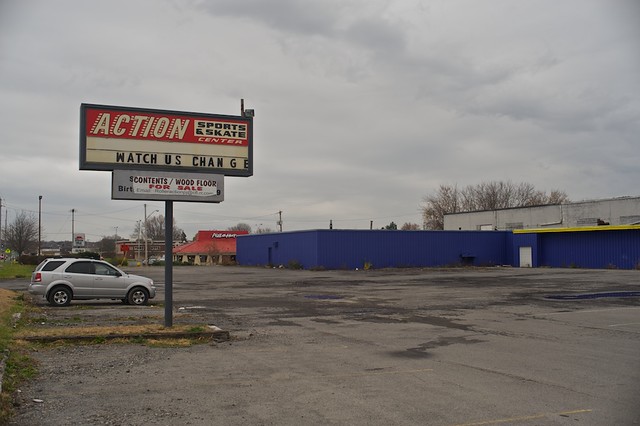
Site of Roselawn, boyhood home of L. Frank Baum— “Watch us change,” indeed.
Roselawn, Baum’s boyhood home was located on Brewerton (a.k.a. “Plank”) Road north of Syracuse. Naturally, the good witch lives in the north. Every other direction was the domain of the wicked.5 Interestingly, the plank road was the first toll road in the U.S. (opened in 1846). Some speculate that the road composed of hickory planks (yellowish wood) might have inspired the “yellow brick road,” but that really seems unlikely to me. I mean, after at least 20-30 years of wagon traffic one doubts that there was any yellow left under the mud. I’ve not been able to find out much about exactly where the 16.5 mile stretch of planks was originally, or when it might have rotted away. I suspect that since it isn’t visible in the 1878 book of views of Syracuse I’ve got, it was gone by Baum’s boyhood. That’s the nature of change, really. While it’s logical to assume that Syracuse had some impact on Baum’s writing, it just doesn’t follow that one might map his fictional work on this all too actual space.
2. I suppose they had to call it Oz-stravaganza because Ozzfest was taken. Though if the rumors of hard-partying munchkins were true then it might be appropriate. In completely unrelated news, it seems that Black Sabbath announced on 11/11/11 that they were getting together for their first studio album in 33 years in 2012. As a big fan of the dark side, I find this to be good news.
3. There are no ruby slippers at the museum either. They were stolen just before we visited the place, and have not been recovered as far as I know. It’s a shame, really. The idea of some shoe fetishist somewhere privately adoring his big score is a bit frightful.
4. Coincidentally, my western home, Bakersfield, was renowned for its fog and drizzle. I once got lost in a parking lot down by the Kern River for three hours because the fog was so dense. I drove around with the car door open watching the curb for breaks that might signal the exit. Besides that though, I wouldn’t say that Bakersfield had much in common with Wonderland.
5. While it seems unlikely that Baum held any animosity towards his birthplace in the east, his mother-in-law lived most of her life in Fayetteville, another eastern suburb. Wikipedia notes that Baum’s relationship to his mother-in-law was wrongly portrayed as antagonistic and any identification with the wicked witch of the west seems wrong on multiple levels.
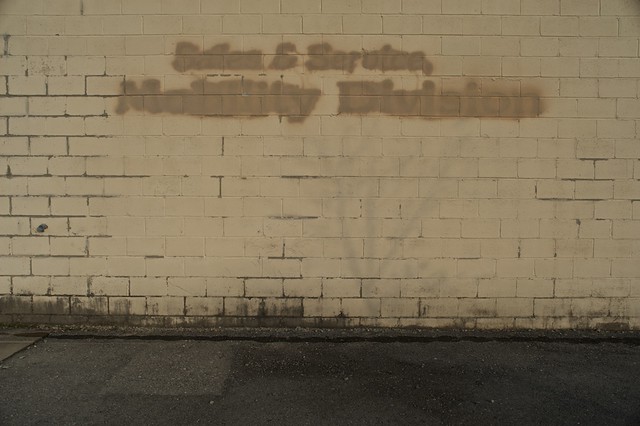
C. W. Lewis Lumber sign, between Bauxite and Benton, Arkansas circa 1996.*
I went to great lengths quite some time ago to find this photograph. It exists only as a negative. As I recall I couldn’t bring myself to print it. After I started to really embrace my new home in upstate NY I shot the negative with a macro lens and worked on it a bit in photoshop because I don’t currently have a negative scanner. I really wanted to write about it, and the circumstances of its production. For better or worse, arriving in upstate New York was the culmination of a horribly twisted journey, and I have been hell-bent (even with my serious reservations about the place) on calling New York home.
California was my home for 37 years. John Hiatt pegged it though: there’s nothing to do but turn around. Just about the time the Internet was coming into everyone’s consciousness, I hitched my dreams to a sculptor in Arkansas. As everyone around me knew, but I wouldn’t admit, these things seldom end well. I found myself unemployed, penniless, divorced, and without a car struggling to make a comeback of sorts. My father spotted me the downpayment and signed for a loan to get me a car, and I secured a job while staying with of my soon-to-be ex-wife. As was/is my usual way of making sense of things, I often got into my car just to drive. Just past the turn-off to a road leading to the man that ultimately won the woman I loved (only fair, he was her husband after all) headed toward the place I thought I was going to call home I saw a sign in the woods.
I pulled over and wept. I took this photograph and wondered if I was ever going to feel at home again. Arkansas was a strange place that never really felt like home. It was close to my family, and I’m grateful for the time I got to spend with them before they passed away. I’m grateful to Arkansas for making it possible for me, at such an advanced age, to go back to school and try to find a new way to be. I never got the chance in California; I was too busy just being. I’m glad I turned around, though for better or worse I never would have imagined that I could end up in New York. Love found me in Arkansas eventually, and that part of my life is better than ever. In the end, Krista is my home, regardless of what place we live in.
*Apparently C.W. Lewis lumber is still there, though C.W. Lewis only ran the place from 1920-1928. The lumber yard around the corner from me here in New York is even older, over 100 years old. I suppose that home always does start somewhere in the trees. I noticed, also, that I actually started trying to resurrect this photo around a year ago. It took me that long to bring myself to write about it I guess.