What’s Good

That other writers describe as art things outside the subject [of a speech] and that they have rather too much inclined toward judicial oratory is clear; but rhetoric is useful [first] because the true and just are by nature stronger than their opposites, so that if judgments are not made in the right way [the true and the just] are defeated [by their opposites]. And this is worthy of censure. Further, if we were to have the most exact knowledge, it would not be very easy for us in speaking to use it to persuade some audiences. Speech based on knowledge is teaching, but teaching is impossible [with some audiences]

Aristotle, Rhetoric 1.11-12 George Kennedy trans

I was summoned for jury duty a while ago, and sat in a room viewing a film about modern justice. It was narrated by Ed Bradley and Diane Sawyer, so I assume that it was probably produced sometime in the 80s. The gist of the matter was this: in the old days, people were tortured or drowned to get at the truth, but now we give them a jury of their peers.

Everyone in the room was from the Syracuse suburbs, and I’d say about 90% were affluent and white. We all had to march three flights to the courtroom. The accused was a thirty year old inner city black man, who seemed to be deeply involved in the process hanging over his attorney’s shoulder reading our questionnaires during the selection process. I couldn’t help but notice that on the “In God we Trust” placed on the wall above the judge’s bench in stick on lettering, the “T” in trust had come lose and was hanging askew. I was among the first summoned into the jury box. The juror questioning process seemed like a review of several sections of Aristotle’s Rhetoric. I answered a question posed to me about examining all the evidence before rendering a decision, and listened quietly while other jurors firmly insisted that they could tell if someone was lying just by looking at them.

I wasn’t selected. I looked up the results later, and those who were found the man guilty.

None of the other arts reasons in opposite directions; dialectic and rhetoric alone do this, for both are equally concerned with opposites. Of course, the underlying facts are not equally good in each case; but true and better ones are by nature always more productive of good syllogisms and, in a word, more persuasive. In addition, it would be strange if an inability to defend oneself by means of the body is shameful, while there is no shame in an inability to use speech; the latter is more characteristic of humans than is use of the body. And if it is argued that great harm can be done by unjustly using such power of words, this objection applies to all good things except for virtue, and most of all to the most useful things like strength, health, wealth, and military strategy; for by using these justly one would do the greatest good and unjustly, the greatest harm.

Aristotle, Rhetoric 1.12-13 George Kennedy trans

I find it hard to trust that the good and just are always stronger. I did not weigh the evidence or participate in the decision, but Ed Bradley and Diane Sawyer assure me that my presence there was of great importance to the polis. At least they sent me a check for $40 today to compensate me for my service.

Heraclitus Shrugged

Writing always seems to be a reconstructive enterprise. My old friend Slim had a song about it: The Story of How It Got That Way. The fun thing about the song is that each time the chorus repeats, key descriptions become their opposites. I think it’s common to construct most messages as stories. Lists make for a boring read. The core problem is the shifting nature of description and emphasis that makes storytelling a constant stream of reinvention. The postmodern mode of thinking casts this as a feature, not a flaw: it’s simply the play of language.

The difficulty comes when you try to imagine a message transcending context. I remember one of the great problems I had when I first started writing in public was my strong tendency to get lost in writing an introduction to whatever message I was composing. At some point, I figured out that I’d been introducing myself – or, more accurately, aspects of myself- for several years. It’s hard to get much done at that rate. Hello- out of time and energy now-I must be going. Approaching writing as a craft, it becomes a core skill to simply throw those introductory “throat-clearing” pages away. Everyone writes them, and it seems cruel to expect others to read them. The real test of the writer as a craftsman is developing the stamina/patience to plow through that part to get to the good stuff.

Ahem. I didn’t start out as a writer. I started as a sorter; much like the early Internet fad “hot or not”, more often than not I found myself sorting things into piles: this is more interesting than that. The curious thing about this practice is that it insists on things to sort. Stories don’t sort easily; they are slippery. Images, at first glance, are much easier. I think that becoming a photographer seemed like the right move for me around the age of thirteen because it made sense to sort out the world. Photography is a curious vocation. The words art and craft tend to come up a lot. I was always a little uncomfortable with the label “artist” because it made the whole affair seem a lot more mystical and impractical than it really was. It was always more pragmatic than that. But craft makes it seem technical and less human somehow. There’s a tension here between unabashed subjectivity (“hot or not”) and genuine investigation. When I began, I was a child of Walter Cronkite. I really wanted to believe that if a photographer did their job well, you could say with some certainty “that’s the way it is” (or at least was).

One of the key things that I took for granted, as I pursued photography as a vocation for the first 25 years or so, was the idea that I was making objects. Photographs were, at least for the first 150 years or so, physical things. As things, they could be invested with a tangible sense of wonder and mystery- I wonder how that was made? Surface character is what always differentiated photographs from printed reproductions, though in a key sense photography is simply a different reproductive process than printing. Melding the two, bringing them together as ink-jet was for me perhaps the beginning of the end of thinking what I did was somehow “special.” The craft of photography, though it became many times more expensive (my current digital camera cost about 15 times as much as my favorite film camera), felt cheaper. The metaphoric shift really cements it though: instead of making photographs I just update my photo stream. Often, it feels as if I might as well pee in it for the difference it makes.

In a decidedly non-digital moment around 1996 in Arkansas, I reached pretty much the same conclusion. When I lived in California, I felt like what I did photographically had worth. People bought prints occasionally, and often asked me to photograph things they felt needed documenting. I had tried to pursue the same sort of documentary work after some major life changes that brought me to Little Rock. I felt privileged to see and photograph a local tribute concert raising funds for a Louis Jordan memorial. Jordan’s widow was there, and I had made a lovely photo of her holding Louis’ high school marching band coronet. It seemed like a beautiful thing on many levels. I printed it 16×20, and mounted it with several other pieces. The owner of the venue had expressed an interest in showing them, and I returned to show him and the promoter. He didn’t show up to see them. Neither did the promoter. In fact, no one there in the microbrewery had the slightest interest. I found myself standing on a street corner in downtown Little Rock holding images in a high wind buffeting around like sails. Even people walking by on the street didn’t glance at them. They were not worthy of even a moment’s interest. I think that’s when I started to identify myself as a retired photographer.

Inevitably, it might have been productive to recognize that I wasn’t special sooner. It took a long time to get that through my skull. One of my final experiences in California was closely documenting Slim, who eventually attempted suicide. My pictures had made no difference in his feelings of self-worth. I documented the scars of the attempt, just as I had so many other moments before, but I just couldn’t admit to myself that what I did was worthless. It took the episode in Little Rock to really drive the point home.

Worthless is of course too strong a word. Ineffectual, perhaps. I picked up my first digital camera a year or so later- a super cheap pen camera with the resolution of a web cam. I had broken my ankle and entertained myself by shooting pictures out the windows of my apartment. Then there was a little Fuji 2mp job. These things were never serious to me. The only things I saved were from a trip to San Antonio with Krista. An internet friend gave me a membership to Flickr a while after that, and I started “streaming” my travel glances. The innocence I once had is long gone, though.

I figured out a few of the problems along the way. My interest in art and craft has less to do with self-importance and more to do with durability. Art, as Walker Evans famously quipped, is useless. Some claim that art endures. On the other hand, craft has utility but is ultimately ephemeral— at least inThomas DeQuincy’s opinion. To me, though, durability seems to be a separate matter entirely. That’s where much of my research has focused these last two or three years. The death of my mother was a more recent catalyst. Death always leads you to question what matters.

I am resistant to identification as either a writer or a photographer these days because I think that both of these pursuits seldom lead to durable goods. I still want to understand the world better, to sort it out— but I harbor no illusions about writing or photographing my way there.

Response/ability

I’ve been trying to figure out why writing has become so difficult for me. I used to really enjoy it. Writing provided an outlet for observations that would otherwise fade too quickly from my consciousness, and although those observations were not necessarily of much importance to anyone else, I found them amusing most of the time. I liked writing in public because it suggested some measure of responsibility to the act- it’s best to strive for a degree of accuracy or at least fairness when others might be reading. But it has some drawbacks: leaving yourself naked and vulnerable, subject to judgement by friends and strangers for what are often momentary thoughts and impulses.

When I was an active researcher, I liked writing online because there are just so many interesting cul-de-sacs that aren’t developed enough for a full treatment, but simply beg to be blogged rather than lost. These often have a personal resonance that would be out of place in a professional or academic context. For “scholarly” purposes, I really think that this sort of context is best stripped away. I hate it when academics waste time telling you about their personal baggage- if I wanted that sort of information, I’d read their blogs. Research is fun and most people like fun stories, which is why I think they sometimes include them, but when reading/listening to papers it uses up time and brain space that would be better used for more relevant information.

My paralysis in the area of academic writing is fairly easy for me to comprehend. Insecurity, in a word, about any possible relevance of my research to a subject field focused on symbolic inducements. I found myself spending more time reading about the niches carved by such labels as “Composition,” “Writing Studies,” “Communication Studies”, “Journalism,” etc.. Each one has some degree of interest to me, particularly in the way they all deploy “rhetoric” as a descriptor of what they study. There has been a lot of progress in deforming the boundaries between symbolic/non-symbolic inducements- “material rhetorics,” “post-humanism” and whatnot. Visual rhetoric, to me, still seems mostly caught in the ditch of the symbolic. To stay interested in it, I broadened the net of my reading so wide that I slipped through the disciplinary weave. I no longer have any idea of who I would write for if I actually managed to write something relevant. This isn’t to say that I plan to stop writing or researching, it’s just admitting that I have had a crisis of confidence that has lasted years now. Paralysis, I think, is the best way to describe it.

Paralysis is also a good word to describe my inability to blog. But the lack of blogging has nothing to do with insecurity or a lack of confidence, and nothing to do with an ill-defined conception of audience. Quite the contrary, it is primarily a hypersensitivity to audience and a fear of appearing too confident or smug to people I care about. The last straw, I think, was when a famous writer misread something I posted (months before) and launched a vile ad hominem attack from his professional site. He repeated this performance of nauseating bile, directed at other people who participate in this wonderful agora shortly afterward. When otherwise smart people just fail to “get” the internet it gives me pause. Is there any chance of just sharing your thoughts publicly without being made the butt of jokes, threatened with legal action, or worse still- sympathized with to an inch of your life? Yes, nothing quite equals the experience of emails from well-wishers that want to stop you from killing yourself when the thought has never crossed your mind.

I’ve always had reservations about the “read-write web.” In the beginning, comments were thought to be an interesting and valuable addition to instances of public writing. Then came comment spam, and of course the ubiquitous troll. Anonymity, I thought, was part of the problem. I could circumvent the problems of undesired feedback by writing anonymously or turning off comments, as many have done. But as I mentioned, part of what I find special and irreplaceable about writing online is its accountability. You speak or write differently when there is a chance that someone will read it- I think you write better, unless you somehow get a thrill from being an ass. Read any newspaper’s comments, or an unmoderated forum and you’ll soon find a stream of bilious non sequitur nonsense. It does seem that some people enjoy being asshats. I don’t think unmoderated comments happen much anymore.

Even when benign or banal, though, comments have always been a problem for me. When blogging, I’m frequently holding many concepts and intensions in suspension in my head. When someone comments, it’s like a shock to my system. Everything sinks to the bottom when I find myself formulating a response. Most often, I don’t respond at all because a response really isn’t necessary. But pointless or not, I end up thinking about it. Worse still, when a response would be polite or at least civil, I think it over for so long that it would be downright weird to suddenly respond so belatedly. I’m simply inept in dealing with comments. Especially well-thought out private ones- those have increased in frequency over the past few years. It might surprise some to know that I get private comments on things written years ago, and that though I have seldom responded I have thought about responding at length. Turning off comments doesn’t really solve the response problem. In fact, I’d have to say I prefer public comments because other people can share in what are sometimes gracious and heartfelt responses. Comments can be a value-added component, and as such should be preserved. I recognize my problem coping with them as a personal problem.

Nothing has happened in this regard in the recent past, mind you. It’s just the gradual effects of thinking of the responses that I left hanging years ago and the responses that I wished I hadn’t found out about. It makes me feel downright antisocial and uncivil. I’m not, really. It’s just that when I step up to this stage I feel that way- struck dumb, paralyzed like a deer in the headlights.

Talking to Krista yesterday it sort of came into focus for me. Writing in public is much like stepping onto a theater stage. There’s a reason why they turn down the house lights. If you can see who you’re acting for, it is a hundred times more difficult. If the audience heckles you it’s hard too. Even applause, particularly when a dramatic moment is still in process of unfolding, disrupts progress.

I’ve aways thought of blogging as writing in process. And like it or not, it has a tendency to stop and start in the oddest places.
Limbert Bookcase

Limbert Bookcase

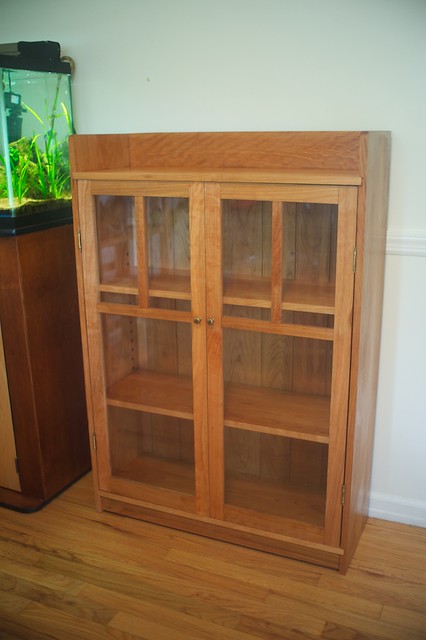
I backdated this entry because I actually finished this bookcase before we left for RSA in Philadelphia and before I had to go in for jury duty and. . . At any rate, it took a long time. The doors took longer than the carcass, and it really made me question the drive to be faithful to original pieces.

It’s a copy of a Limbert bookcase from the same old Popular Woodworking Arts and Crafts project book. The joinery is weak, in my estimation. Stickley’s through tenons instead of the dadoes used by Limbert would have been better. I won’t just follow the plan if I build this one again. I love the beaded shiplap back, and I did add a second knob even though it isn’t original.

Peel

Pizza Peel

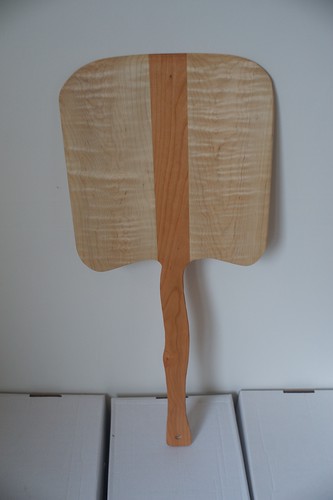
While working on the doors to finish a Limbert bookcase and dimensioning some maple for record cabinets, I discovered that the digital gauge on my planer had gone out of wack and was making everything too small. Thankfully, I had only started machining one piece of curly maple before discovering the miscalibration. Coincidentally, Krista has started messing around with baking bread and wanted a peel. We went to the local restaurant supply and they were out of them. Hmm. I started to think that I could use my excessively “peeled” piece of maple and a cherry scrap to make one. Perfect timing!

Pretty: An Unknown Quantity

In designing furniture — and I daresay anything else — one must first have some acquaintance with mechanical work. Without this it is Impossible to decide how the material — in this case principally wood— can be used to the best advantage, without cumbersomeness on the one hand or fragility on the other. After this, convenience must be studied. Is the design suitable for its intended purpose? To take an extreme case for the sake of illustration, in designing a chair for ordinary use would anyone raise the seat three or four feet from the ground? To do so, of course, would be absurd, for such a height would, except for special purposes, not be pleasant. One could not sit at an ordinary table in such a chair nor put it to the intended use of a chair. Fashion, further, has much to do with design, for it
must not be forgotten that those who cater for the public must do so according to popular demand. If one asks who creates fashion, what can the answer be? It is a species of evolution, but in its origin is so intangible that it cannot be grasped. It is like the fog — very undefined, but with a very unmistakable reality. Is, then, the fashion in furniture not influenced by the designer or the manufacturer? To a great extent it is, but he does little more than apply his skill in such a direction as may, in his opinion, best supply the demand. For the rest the designer must rely on his own resources and his general ideas of what constitutes a beautiful object. At the present time fashion seems to require that everything must be cheap as well as pretty, the latter being an unknown quantity.

D. Adamson, A Chat About Furniture, Work: The Illustrated Weekly Journal for Mechanics Voi. 1 No. 1. March 23, 1889

Stickley #72 Magazine Stand

Stickley 72 Magazine Stand

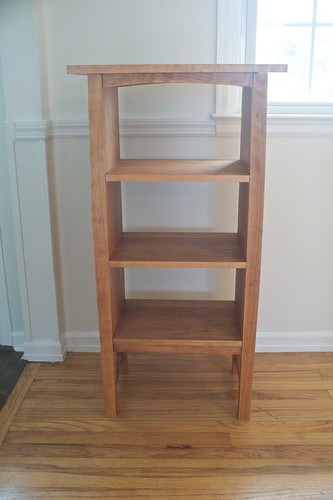
I finally made it through this one. It’s a copy of a Stickley #72 magazine stand, and it only took me 7 weeks and much fussing and cussing. I learned a lot though, including the lesson that I prefer hand tools for most precision work. I screwed up the legs on this piece twice and had to make them over due to router mishaps. I bought a plow plane, and things finally made more sense. The primary problem with power tools is that you can’t really see what you are doing most of the time and when things go wrong, it’s almost always fatal. There are some botched spots on this, but they didn’t mean starting over— they just meant accepting that I’m human.

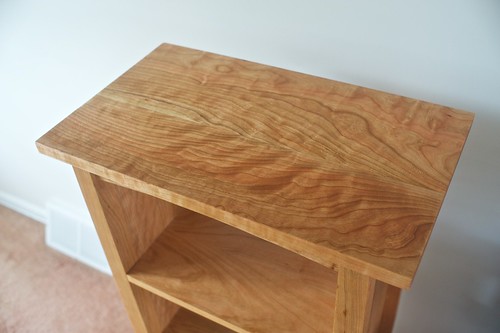
I like the way the top finished up:

Stickley 72 Magazine Stand

I pretty much followed the plan from Popular Woodworking’s Arts and Crafts Furniture Projects except I did curve the sides to match an actual Stickley piece from an auction site. I thought it looked a bit better that way. Next up, I think I’m going to build a Limbert bookcase with glass doors. I have most of the panels glued up and the pieces rough cut already. I’ve been sticking to cherry wood for this crop of projects. I actually worried that it was longer than seven weeks since the last finished project, a faux Arts and Crafts bookcase from the same book:

Latest project

I didn’t write anything about that one, because it was pretty basic. Nonetheless, it did involve 24 mortise and tenon joints and was a good thing to practice on. This magazine stand, however, marks my first attempts to use the router plane, the plow plane, and the spokeshave. Of course it’s got its rough areas, but eventually I think I might actually become passable at this furniture building stuff.

Wooden Boys

I used to think that the running thread in your work was your interest in objects—the tools, for example—whereas now it seems that the real running thread is your interest in translating those objects into pictures.

Yes, that’s the running thread—the alchemical aspect of it—turning shit into gold, hopefully. That’s always been my intention. I’ve never been a reporter. And if I have a romance with the objects that I’m drawing, it’s more important that I have a romance with the mark that I am making.

. . .

I’m also going to have a show at Pace[Wildenstein] in April 2007 of paintings and sculptures of Pinocchio. I’ve been making the sculptures in wood for two or three years, cutting them in wood with a chainsaw.

I can see that you’re fascinated by the story.

This idea of a talking stick becoming a boy, it’s like a metaphor for art, and it’s the ultimate alchemical transformation.

Robert Ayers Interview with Jim Dine

Discussions about tools are a sore spot for me. Don’t get me wrong, I use tools, research them, and generally have a good working relationship with them— but I do my best to resist fetishizing them. I think it’s just my background as a photographer. One of my favorite sayings (I’m not sure of it’s origin) is that what separates painters from photographers is that painters can have long discussions that don’t involve brushes. The obsession with equipment that drives most “hobbyists” is what separates them from those who I think are serious about the craft. Yes, to make things you need tools— but there is absolutely no reason to discuss them all the time.

I remember listening to a National Gallery podcast discussion with Jim Dine a while ago and the moderator asked him “why tools?” Dine replied that his family owned a hardware store, so they were simply around all the time. Dine is obsessed with drawing, and drawing involves looking very intensely at things. Yes, there are metaphorical connotations to tools, but mostly they were there to look at and explore drawing. Looking at things hard is the cornerstone of interesting photography, in my estimation, as well. It is seldom rewarding to read significance into things instead of looking at them. The attachment of inflated symbolic significance to objects is an accurate definition of fetish. The antidote for that, I think, is simply looking — not glancing or casual looking— but looking hard.

Nonetheless, looking can itself become a fetish because privileging it symbolically gives priority to one sense above all others. I’ve always been attracted to sculpture because in a lot of ways it is a relief from the rigors of concentrated sight. This is not to say that sculpture isn’t a visual medium, but rather that it is so much more than that. To appreciate a sculpture, you’ve got to move around it. Some sculptures also invite touch. Touch, I think, is the most natural way to relieve the stress of looking. If it looks smooth, you can touch it to know its texture in a far more profound way than you can by any amount of concentrated looking. Traditionally, the activity of reading also involved touch because one holds the page and feels the presence the book, even if only liminally. Computers/readers are changing that.

I find it interesting that contemporary books on woodworking deploy cliché photographic techniques (black and white, selective focus, close cropping) to emphasize texture and warm sepia tones evoking nostalgia to promote the fetish nature of hand work. It’s part, I think, of the transposition of reality to screen which has brought these tired techniques to the forefront. You can’t touch the book/screen to feel the finish so this probably seems an improvement to most authors and editors over the traditional glossy-color wet page with illusionistic depth. In the end, this arty photography provides less information. A reader is unable to see the full dimensions of an object. From the perspective of technical communication,  it’s a huge fail: useless “pretty” pictures.

To match these new visual strategies, there are also new/old rhetorical techniques: Good old fashioned purple prose. My most recent encounter with it is a very handsome, lushly illustrated volume from 2009 by Tom Fidgen, Made By Hand. I like the book quite a lot, and the emphasis of the book is less detailed regarding tools themselves while maintaining focus on the new/old perspectives facilitated by classic tools. The projects are a cut above the typical do-it-yourself content, though I was really dissappointed in the level of detail regarding the joinery. An Amazon reviewer summed it up nicely, remarking that the pictures were pretty but the explanation left much to be desired. I hope Fidgen does another book avoiding the Pinocchio affect:

Enter the hand tool woodshop. People can easily spend small fortunes on the newfangled handsaws and reissued hand planes. Imported chisels from foreign shores where they’re still being made to serve a practical purpose and not for the enjoyment or entertainment of the amateur woodworker.

There is a place for these tools, working towards a reachable level of fine workmanship in the home or hobby woodshop. A work space may be only a small room in a condo, rising out of a skyline 50 stories above the street. No trees for miles, an asphalt landscape, where finding anything handcrafted would be next to impossible. Even here, in this cold space of steel and cement, the woodworker hides, dreaming of crafting that perfect piece of furniture. Wishing only to use his hands and his hand tools: quietly shaping and sculpting.

A modern day Gepetto, creating thoughtful pieces of woodwork, worthy of true magic.

Tom Fidgen, Made By Hand (11).

DineGeppetoMakes.jpeg

Post junior-high woodshop, around 1982, my most memorable project was a set of record crates from oak to hold my record collection. I set about building them in an upstairs apartment with no patio. I nicknamed the place “The Holiday Inn” because the place looked just like one. Using a workmate and hand power tools, I dusted the walls of the apartment with sawdust— this was long before this new “hand tool revolution.” It wouldn’t have been any more romantic with hand tools, I think. It was frustrating and I never could afford to build enough crates. Wood costs money.

I was a stone-broke Geppeto with only a few tools. The few crates I made were smashed to bits when the U-Haul truck rolled during my move to Arkansas in circa 1994. Most of my remaining tools disappeared in Arkansas; I left a lot behind for the move to Minnesota.