Adhesive

I’ve been spending a lot of time looking at old snapshots lately. It begins to matter very little if I actually recognize the people in them. There’s just something about looking at pictures that sticks with me. Removing a bunch of them from adhesive album pages has been instructive. There are sometimes captions on the back, but usually not. Most of the time, you’re just left with your own thoughts about the picture.

It dawned on me this afternoon that no one really takes a picture because they want to forget something. At one time or another, these children (whoever they are) were important to someone. The someone in this case is my mother; but even she couldn’t remember who most of them were. They date from a time when she first moved to California and was living in a little apartment complex in Ventura. She was twenty, I think, and had a child of her own— my eldest brother David. She remembered that a woman in the complex was always volunteering to take David off her hands; she loved him.

This could be a picture of David, but I’m not sure. Probably not. As I captioned some of these photos, it dawned on me that there isn’t anyone alive to care. Almost everyone is dead, so what does it matter? David had two sons and a daughter; I don’t know what became of his daughter. His sons are alive, but he’s not. I keep scanning and posting these photographs mostly because I like them. I also liked David, but I didn’t know him that well. He was 13 years older.

David always nagged me to go to college. I couldn’t afford it, really. David understood that. It took him six or eight years to get his associates (two year) degree and another four or five to get his BA. He did complete a masters after about fifteen years or so of trying. He stuck to it, and encouraged me to do the same. He was accepted into law school and had just started that when one of his sons was hit by a car, causing severe trauma, brain damage, and a coma. He had to drop out that time and never made it back. He eventually lost a battle with alcohol.

David wasn’t alive when I got my masters. But my mother was.
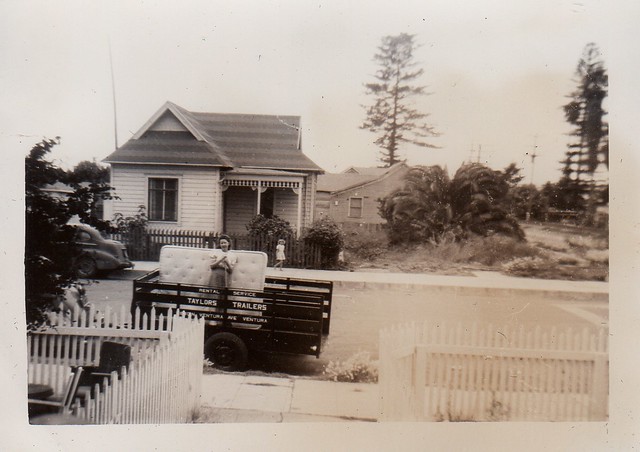
Mom and mattress in Ventura

Music and photographs are often found in albums.

easy-mount.jpg

I’ve been working on sorting through some of my mother’s photo albums. This sort of work often triggers thoughts. And there are always curiosities. Item #1:

Where Jesus is Buried, Canute OK

The caption on the verso makes you wonder just which Jesus (I have no relatives by that name) is buried in Canute, Oklahoma, circa 1929. I did a little digging and found this:

Continue reading “Music and photographs are often found in albums.”

Binocular viewing

Microscope.jpg

Loren’s comment yesterday put some issues in relief for me. He responded to an aspect of what I wrote that I had thought of as a background bit– considerations of the past as narrated vs, experienced. Writing on the internet for many years now, I have come to appreciate that every reading of someone else’s words is truly unique. The person you’re reading isn’t you. In fact, part of the fun of putting all my old crap back online is that my old writings aren’t me either. The me that wrote those things doesn’t exist anymore. There are similarities between him and the person typing today, but we aren’t the same. In some ways, as I go back to keyword them I might not like that person at all.

That post seems very chaotic to me now. I thought I had a point, but it took a long time to find it. It actually began when I was thinking about tubes and writing about why I really want to build more gear that uses them. One reason why is that they are easier than solid state circuits in terms of complexity and fussiness. I have a little IC amp I want to build, and one look at the PC board told me that I had better get a binocular microscope to check my soldering since my eyes are not as good as they once were at picking out tiny details.

Particularly with “comprehensive usage” (sic), technology does increase our knowledge of the world. The correlative point, however, is that  it often stands as a barrier which isolates us from the things we’d like to know. Technology facilitates gaps and distortions, particularly when applied to the problems of memory. Language is a technology. Translation is a complex affair, and it is naive to think of a static “message” (or point) moving from place to place. The places it leaves from, as well as the destinations it arrives at, are always moving. The world (and ourselves) are not the same across time.

The primary lesson of tube technology is that lower distortion isn’t always better. Tubes are frequently far more engaging to listen to than solid state. The distortion with solid state devices are orders of magnitude lower, but music often just sounds better through glowing tubes. Ask any electric guitar player. The sound is quite different, and though you can always chalk it up to “taste” there are reasons why a technology over a hundred years old persists — the sound is involving and fun.

Some distortions are more euphonious than others. Loren’s reading of what I had written so clumsily was a case in point. I have no problem with it. I have been less lucky in the past. The cacophony of the internet often drowns out the slightest kernel of civility with echoed distortions considered by their contributors as “feedback.”

If we accept that all communication is distorted and that all technologies used to further/preserve that communication are flawed, where does that leave us? I think it leaves us searching for the most pleasing forms of distortion, such as tidy stories with easily digested morals.

But, with binocular vision we can see more depth in those things we choose to examine.

Memory technologies

800px-Kennedyb.jpgMy oft recounted earliest memory is of watching the assassination of John F. Kennedy on the TV over and over when I was five years old. Perhaps that was the beginning of my fascination with memory technologies.  Television in its earliest form was not a particularly good one. The video tape technology used to record/repeat the same few seconds of video over and over was better, but still less than perfect. Most early television programs are lost to history because video tape technology was always regarded as disposable. Tape was particularly important in the United States because of the differentiation in time zones; in order to facilitate shared experiences of prime time programing, live broadcasts needed to be delayed. Once the “live” content had been rebroadcast, the tapes were considered expendable and erased. The previous short-lived silver technology, kinescope, was actually far more practical as a memory technology.

There is a gap in our cultural memory there. Some programs from the fifties were committed to film, but in the early sixties when tape took over few made the cut. A huge gap exists between the early years of television, and the later years of secondary markets and syndicated resale. “Broadcast live” was largely a death sentence. There is an analogous situation in the fade of color snapshots. Early silver nitrate black and white technologies were far more permanent than later chromogenic dye technologies. Digital technologies, because of their replicating and broadcast proclivities, will most likely survive fairly well (aside from DRM and encryption concerns) into the future leaving a huge gap in the middle— just like TV.

I find it useful to distinguish two modes of memory here— transmission and fixation. There are early versions of both, in the form of oral traditions and stone or clay tablets. I’ve been joking lately that having lost interest in the internet, I’m looking forward to working with stone tablets. That is only partially a joke. Fixation (as a memory device) lends itself to a sort of intensive study that is absent when the primary means of memory is transmission/replication. Transmission is by definition extensive.

I think it is possible to argue that cultural memory is primarily extensive. Attempts to fix something as indicative of a culture is always doomed to degenerate into fetishism and its evil twin, nostalgia. Nonetheless, it seems that elements of the intensive come in to play in instances such as memorial sites. Such sites might be labeled as fetishes, but they have a cultural value that is peformative and not fixed (though they are by definition, fixed). Architecture and monuments have a curious relationship with memory which does not fit neatly in the intensive/extensive distinction. That complexity centers on the level of consciousness involved in the performance of memory. Do we mindlessly repeat the narratives we are given, or do we consciously live them?

No matter which method is used, memory is always distorted. In order to fix memory, we must kill it first. To survive by repetition, memory has to be dumbed-down and stripped of most of its complexity. If we reflect on an actuality, it is never the same from one moment to the next– what we think we know is always subject to revision by the new.

If my mother were still alive, she might tell me that I didn’t actually watch TV that day. 

Scarcity/Abundance

cover_2328111722009.jpg

Sometime yesterday afternoon, I embarked on a bit of a Hawkwind festival.1 I’ve always enjoyed it when I can take the time to just listen to an artist’s catalog straight through, and in this case it will take several days to traverse the items in my collection (about 530 tracks, I think). They are not on the top of my list of favorite artists at all, it’s just that they have released a lot of records and I get someone compulsive in my collecting. It’s weird remembering where this whole Hawkwind fascination started.

I can blame the long defunct Midnight Records in Oildale, California I suppose. They had an interesting import section, which I always trolled looking for one of my true favorites, Roy Harper.2 I had never heard of Hawkwind, and they certainly weren’t on the radar of any of my punk/heavy metal friends. I first noticed a record called Levitation which featured Ginger Baker (of Cream) on drums. I liked that one a lot, so I started snatching them up when I got the chance. Their albums were pretty scarce, because they didn’t really have a US label at the time. Record collecting was one of my first obsessions (from the age of about 10 or so), and the hard to find things always seemed to bring the most satisfaction. It wasn’t simply trying to be different, but rather that the artists around the fringes always seemed to reward sustained interest/attention. I had no idea that they were actually huge in Britain.

Midnight Record’s selection was small, but strong. They also sold used, so I could stretch my paltry budget further. Just the same, I would save up and around once a month or so I would try to make a pilgrimage to a record store in LA like Rhino to snatch up $100-$200 worth of LPs at a whack. LPs are an interesting sort of self-limiting format. Twenty minutes per side, and with a cost per unit high enough (on my 1970s-1990s budgets) to make it impossible to own too much music. I’d pick out a stack of ten or twenty LPs, and study them. The best way to think about it is intensive vs. extensive listening.

When I moved to Arkansas around 1995, things changed. It wasn’t the shift to CDs3, but rather my discovery of tape trading. I began to listen to a lor of bootleg cassettes, because the internet fostered global communities of traders. Suddenly, it became possible to locate rarities with staggering speed and volume. They were still “rare” in the sense that most people didn’t have them, but not so rare in that they began piling up around the house for the price of a blank cassette and a little postage. Obsessive that I am, I became so overwhelmed by music that it seemed like if I listened 24/7 it would still take years to hear it all. My listening habits became, well, extensive. Especially when I started trading with a gentleman in England for Harper recordings. His taste was so different than mine that I had to trade with others to get things that he wanted so that I could then trade for Harper…

The shift to digital music can contribute to both intensive and extensive impulses. I’ve been trying to break the habits of an eternal search for novelty in favor of a more considered approach. I don’t use shuffle anymore, except in the car. I listen to albums. I think the progress here amounts to a confrontation with too much. I’m trying to learn to relax about this constant searching for stuff.

The catch phrase around the house is “too many toaster waffles.” In the 2007 movie, Alvin and the Chipmunks, flush with musical success, buy massive quantities of toaster waffles and gorge themselves with predictable effects. It is easy to be a victim of abundance.

1 Though the badge has disappeared, most of my listening can be tracked on lastfm.

2I suspect a Roy Harper festival is in my future; I’d like to listen while perusing his lyric book.

3The transition to CDs was actually long and slow, leading to much introspection as old favorites were rediscovered in new formats, furthering intensive listening.

Burned

Fingertip

Soldering can be hazardous. A wayward finger found the barrel of the soldering iron yesterday. It hurt for hours, and then as quickly as it happened it stopped hurting. The damaged skin pulled away from my body, and has already started to crack. It will soon fall away, replaced by new skin without a trace of damage. Of course, most people wouldn’t make a big deal about it. But I started thinking about something in the shower this morning.

Drug addiction is inextricably entwined with nostalgia. It’s funny that it captures so many more young people than it does middle aged/old people. The theories I recall hearing most recently have to do with certain pleasure centers in the brain that are stimulated by some drugs, that become scarred by over stimulation so that the user desires more and more of the chemical to replicate the original experience. That’s nostalgia, I think.

In high school, I had a bout with barbiturate addiction. It became fiercely clear that I had a problem during summer school of my junior year when I gave a friend a couple of my pills at nine a.m., and by the break at eleven he had passed out face down on his desk and some friends and I had to tactfully lift him up and carry him outside. I had taken over twenty of the same pills by ten. Not good. It hurt a lot to give them up, and I think it probably helped me avoid similar mistakes in the future. In fact, for all of my messing around, there really aren’t any scars that show from those days. I seldom get nostalgic.

My longest bout with addiction was with cigarettes. I smoked a lot. The biggest revelations upon giving those up around five years ago were that cigarettes were really making me sick. Who knew? I mean, you light up a cigarette when you feel anxious and want to calm down, when all the while it is the lack of the cigarette that makes you anxious to begin with. I’m much calmer now. Smoking is not a weakness, nor a crutch (as many smokers rationalize) it is simply a lifestyle choice— you live in the nostalgia of the last cigarette you smoked. Can we do it again, please?

I decided I wanted to clean up my oft-posted photograph of myself tinkering at the kitchen table so that the edges would be pure white today. It dawned on me, looking at the scan, that a kerosene lamp that you can see behind me in this early sixties photo now resides in my basement:

lamp.jpg

I broke the shade about a month ago. I can tell by the vague shapes that it was the original shade, which depicts dancers dancing around the flame. I can buy a new shade, but it won’t be the same. Realizing just how long I’ve been hanging around this lamp makes me much sadder than when it happened. It was just a piece of glass to me then. Now, it’s something more.

Home Again

auto007.jpg

We’ve been back home for just over a week, and I just can’t seem to get my fingers to engage with the keyboard. Part of the complication is that Krista will be departing for London in a little while, and we’re trying to get as much accomplished around here as we can before then. It was a productive trip in a lot of ways, but perhaps the most significant discovery was that we do indeed live in Central New York. It felt like home, when we arrived.

This is indeed a good thing. It would be a shame to be “just visiting” for five or ten years. Just before we left, I managed to mount the turntable to the living room wall and hook it up again. The records are still in boxes, but I don’t think I’ll be needing that dashboard record player just yet.

Purdue University

The summer travel season is hear again. It’s day 2 and we’re in West Lafayette, IN at Purdue. As with most trips, there have been a lot of technical issues right out of the gate, such as the new computer unlicensing my copy of Aperture. This has made it interesting trying to deal with photographs. But, luckily I have a copy of Adobe Lightroom to switch to. Now, I just have to figure out how to work it.

Krista figured out that we’ve been doing this every summer for about seven years now. The more we do it, the less we plan it. I’m not sure where we’ll go from here. I know I have to present a paper at RSA in Minneapolis next weekend, and Krista just finished hers at Computers and Writing today. So we’re free, for a while now. I just need to finish the damn paper between now and then. It dawned on me this morning when we were talking that writing is always about saying, tentatively, I plan on talking about something but I’m not quite sure what it is. Then, a few pages later you figure out what that thing really is. Then, the hard part– making what you’ve already written sound like you knew what you meant to say all along.

I turned on the old version 1 of this blog from 2001-2002, so it looks weird to see the old entries at the bottom of the page. They’ll scroll away soon enough.  But it reminds me that, ultimately, I still haven’t figured out what I meant to say when I started writing this blog almost ten years ago.

Autobiography

4-months.jpg

Watched Hubert Selby Jr: It/ll Be Better Tomorrow last night. His last words were a list:

A list of indignities

  • Birth
  • Death

Most writing begins with autobiography. The craft involves placing one word after another, and one’s self as a topic is always close at hand. Free-association aside, writing involves communicating something to someone and it’s easier to communicate something you have knowledge of. Before taking Chuck Anderson’s class, I hadn’t given a lot of thought to how we lie to ourselves and each other when reconstructing events. Birth and death are great examples: without the buffer of fictionalizing these experiences, they might be too much to bear. Trauma is never far away from our memories. Trauma is how we learn.

Of course, one could make the argument that we are guided by pleasure as much as pain. We learn that lying in the sun is pleasant, that certain foods or behaviors make us feel good, etc. but these things lack the persistence of memory found in the unpleasant. We dwell (with good reason) on what we don’t want to happen again more than what we wish to repeat. Pleasures, when repeated, are often diminished and loose their luster. Pain shines through in the quiet moments when we don’t have much else to occupy our consciousness.1 Most sane people would not chose pain; it chooses us. So we narrate painful memories from a position outside them.

Autobiographical writing, then, is largely a subset of fiction writing. It’s frequently pathetic and not particularly interesting to read unless the writer has a talent for embellishment that isn’t eclipsed by the inclination to whine. When I was teaching writing, it seemed like the hardest task was to get people to get past the fiction— to quit whinging (and wanking) and write something of real world consequence. While it is certainly true that autobiographical writing is of great consequence to the writer, it’s circle of influence seldom stretches beyond personal rationalizations of the indignities of life. We write about what we know for an audience that we know cares: ourselves. Rationalization is essential, because otherwise what we label as experience is meaningless.

Selby’s Last Exit to Brooklyn was one of the few books that I couldn’t read without putting down, over and over again. The scenes that unfolded were too much to bear. But I suspect that was part of the game he was playing with himself: testing just how far he could push language into the indescribable, into the sublime. Over and over people in the film remarked what a “regular” a guy he was in person. His books are literature, not autobiography, though I have no doubt that parts of them began in experience. He pushed them the other way down the axis closer to irationalization. His friends spoke of his books as redemptive; I never found redemption. The universe is dark in there.

(1) I had a dentist once who explained it this way: During the day there are a lot of distractions that keep you from thinking about your pain. In the middle of the night is when the toothache really hits you, and becomes unbearably severe. You can’t sleep because the quieter you become, the more intense the pain is.