Prepositions

A week or so ago I was driving in the North Country, taking photographs, and listening to an NGA podcast interview/lecture with Mel Bochner on the occasion of his exhibit of Theory of Boundaries. Listening to him, I found myself much more interested in installation art than I have been in a long time. I really was taken by his candor regarding the commodification of art, and the role of installation in bucking that trend. However, looking back from the present day of course, he rightly observes that anything including a momentary installation can be commodified. It was really naive to think otherwise. “Theory of Boundaries” is a set of language fractions (prepositions), presented on raw pigment (chalk, originally carpenter’s chalk used for chalk lines). I confess that I hadn’t heard of him, though I have known and loved the work of his contemporaries like Ed Ruscha. Bochner’s language works seem really seminal in retrospect, and his recent collaboration with a landscape architect, Kraus Campo, fascinates me.1

With that in mind, it seemed reasonable to take a walk (a long one, though) from the Andy Warhol Museum in Pittsburgh to The Mattress Factory. Krista was a bit in pain when we got there, and we walked (thanks to google) into some fairly questionable alleys complete with beat cops keeping an eye on lost tourists, so perhaps we were a bit less receptive than we should have been. Mostly, the installations there seemed pointless and silly. Jerstin Crosby’s piece, in particular, elicited one viewer who happened to be there with us to exclaim: “I could do this!” My question would be: why would anyone want to? Free association has never really been all that interesting to me. I picked up the magic 8 ball, sitting on the piece of plywood that set the “table” for the tableau, and it said “I cannot answer at this time” (or something to that effect). Compared to installations I’ve seen at the Walker or at MOCA this place just seemed lame and pointless.

I’ve been wandering around a lot more lately, trying to figure out just what I want to do. Mostly, I’m enjoying making things but I’ve been contemplating a return to photography as well. I can’t really figure out exactly what is up. All I know is that I feel downright energized by the visit to the Warhol museum, and by the Low concert, in a way that I haven’t in a long time. The Mattress Factory was a relatively minor hiccup in an overwhelmingly interesting visit to a new place. I look forward to going back sometime in the near future, but the next trip on the books is to Tennessee. There’s so much more to say about Pittsburgh and what I’m thinking about in general but I’m feeling a bit tongue tied. This often happens when I’m thinking about visual things. The visual and verbal always seem to clash in me. I can do either, just not at the same time.

This isn’t the case with music, thank god. It seems to blend with just about anything. I listened this to a Michael Nesmith (yeah, hey hey he was a Monkey) album called “The Prison” this morning. I like it enough that I just located a vinyl copy to explore further; apparently it’s written as the auditory “background piece” to a piece of writing included in the album’s booklet. I can’t wait to try the full experience. But the primary trigger for me was on the second cut, “Dance Between the Raindrops”:

“Dance between the raindrops,”
Were the last words that he said
As I tumbled head long into the storm.
So rising to the challenge
I wrestled with the door
Using what I thought was my good arm.

But there is no way in
To where you already are.
There is no way out
Of everywhere.
No satisfaction can come
To that which is fulfilled,
And all the lies will fall away
With the cares.

Leave the door closed loosely
So the messenger will know
That it’s all right to just walk in.
This fear that you’ve been feeling
Has no substance of its own
And though the battle rages fiercely, you will win.

For there is no way in
To where you already are.
There is no way out
Of everywhere.
No satisfaction can come
To that which is fulfilled,
And all the lies fall away
With the cares.

Michael Nesmith, “Dance Between The Raindrops,” The Prison (1994)

It’s all about the prepositions, the boundaries I guess. There is no way in to where you are; there is no way out of everywhere.

Watching Low practice a craft that, at least for me, gives feelings substance and weight moved me deeply. I had forgotten what that was like. I had hoped to find moving spaces to occupy in Pittsburgh, but in the end I think the most valuable one was the “skull room” in the Warhol museum where mortality surrounds you, though the Warhol/Basquiat Last Supper was pretty awesome too. A great trip, really.

1Though it must be noted that public reaction appears to be mixed. I was unaware of this artwork when I was in Pittsburgh, but I’ll definitely seek it out next time I’m there. I must say that the Strip alone begs another visit.

Center of the World

Center of the World
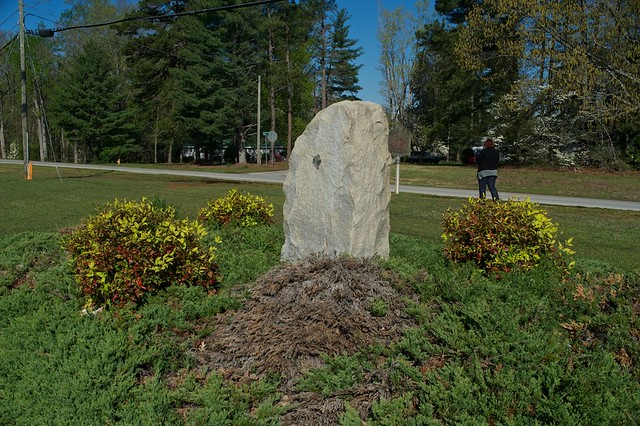
The Center of the World (according to the Cherokee tribe, at least). My center is stage left.

For the first time in a long time, I find myself with a bit of an urge to write. It’s been a strange few years, and looking at it now from a distance I think part of the problem is that I’ve just been too happy. My imaginary audience for the most part would be bored stiff by a person signing on each day to say how great life is. Don’t you just hate those people? It seems more pertinent to relate times filled with complexity and mixed feelings, because those are closer to the center of reality. In actuality though, I suspect that most who know me would be glad to hear that I’m doing well. But I just can’t think of that revelation as interesting.

It is much easier to write about traumatic experiences or to scribe angry polemics that you just have to get off your chest. I’ve spend a lot of time avoiding the latter, at least until yesterday. And as for trauma, well, historically it seems as if there is an eternal spring of those that bubble up. What stopped me from going there, in the beginning at least, is the thought that I might hurt someone who was there during the endless procession of tragic people moving in and out of my life— or worse still, get it wrong and need to be corrected. Now, it seems that almost everyone I have ever known is dead. No, I’m not that old. It’s just that most of my true friends lived that hard. You have to be a real overachiever to die when you are in your 20s or 30s.

The hurt of losing them (and the hurt of knowing them) was a key engine for creativity for me for many years. It didn’t manifest directly as being about them, but more a desire and drive to do something of some significance. The death of my mother a few years ago changed that profoundly. She was the first person I’ve ever known who actually died at almost the right time. By that I mean, she left no unfinished business and her life had been full and rewarding until that point. But I have to add the “almost” because she did suffer from dementia for 18 months or so before the end. It was cruel because it was not self-inflicted, but no nearly so bad as living through various chronic diseases that afflicted both my older brother and other friends. They spent a lot of time in pain; she didn’t.

But as my mother lost her mind, I began to realize that ultimately nothing matters as much as I thought it did. Success doesn’t matter. Legacies really don’t matter. Money doesn’t matter. Being kind to people is the only thing that matters— for me, at least. It’s the little kindnesses that make the world bearable. It’s those kindnesses that I remember most, when I think of all the people who are gone. It’s easy to subscribe to kindess as an abstract thing, I mean just who isn’t in favor of being kind? But kindness is also things like cleaning fecal matter out of a rug. It’s also continuing to talk to and visit someone long after they are recognizable as the person you knew. That sort of kindness is hard— hard and concrete.

I’ve lost most of my patience with the abstract these days. Talking about concepts like “coherence” and “identity” seems downright frivolous and trivial. What matters more to me is what we can touch, and what we can see. More and more I realize just how small and narrow that subset of things is. What we can imagine is vast; what we can actually experience is narrow and tiny. Recalling those years studying Blake, it’s just Songs of Innocence and Experience, I suppose. For decades, I was enraptured by innocence. Now, finally, I find myself wanting to more directly confront experience.

I guess I always pictured myself as spending most of my time reading poetry/prose or making photographs when I found the freedom to do it. Instead, I find myself wanting to build tables and cabinets and feel their presence in a room. It’s an odd adjustment, to be sure. A key adjustment is locating some sort of imaginary audience in my head that actually cares about such things.

A month, another year.

New 26g Bowfront

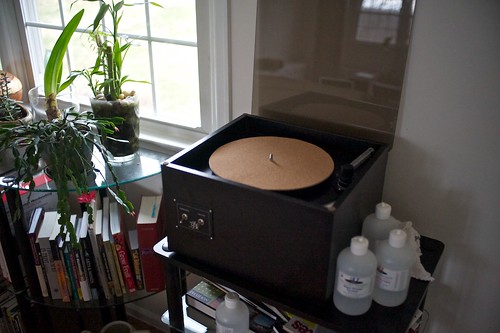
I really don’t have much to say these days. It’s been a month since my last confession… I finished the aquarium stand I was working on a couple of weeks ago, and I’m about halfway done with a pair of skinny end tables to go with the couch. But the real news is my new used machine:

VPI 16.5 Record Cleaning Machine

I’ve wanted one of these things since they were invented. I have thousands of LPs, so it seems only sensible. I have been spending a lot of time listening to records for the first time in years. I found this bit of industrial decor used for a good price, and now I have to  engineer either a new enclosure, or a cabinet to hide it so that mi esposa learns to like it as much as I do.

9 Years of New

Something has spoken to me in the night, burning the tapers of the waning year; something has spoken in the night, and told me I shall die, I know not where. Saying:

“To lose the earth you know, for greater knowing; to lose the life you have, for greater life; to leave the friends you loved, for greater loving; to find a land more kind than home, more large than earth—

—Wheron the pillars of this earth are founded, toward which the conscience of the world is tending— a wind is rising, and the rivers flow.”

Thomas Wolfe, You Can’t Go Home Again qtd. 2002

The last couple of years has taken its toll. I lost the closest thing to a best friend I ever had just after I moved to New York. But I didn’t know it. I didn’t find out until I searched for his address to send him a Christmas card. Though the loss is old, it feels new. He was much younger than me, and apparently he died in his sleep just after I spoke to him last. He didn’t seem like he wanted to talk at the time, so I figured I’d just wait for him to call me. We had that sort of thing going on, I suppose that’s why we always stayed friends. When we got enough of each other we’d just drift apart for six months or a year until we were happy to hear from each other again. But this time around, he won’t be calling back.

In 2003, I had no complaints. I suppose that hasn’t changed. In 2004, I was working on a Master’s thesis (which was later called an “ambitious failure” by my Ph.D. advisor— an appraisal that I don’t disagree with). Everything is uncovered in a twinkle with electricity, and then it disappears. In 2006, I thought rubbing might be involved; in 2007, I was a hop across the river from Sodom. By 2008, I was keeping my chin up and my head out of the oven. Perhaps one of the happiest moments from the Twin Cities though, was voting for Al Franken.

Nonetheless, you’re either with it all the way or you blow the scene. All 72 or 3 inches of snow have melted by now, and I’m starting to feel better about living in Central New York. In another month, it will be ten years of writing stuff down in public. I suspect I’ll continue that; writing in private nearly cost me my life, while writing in public has brought me a new one. Thanks for reading, my love.

Archie and Jughead

Riverdale, CA

I’ve been obsessing a bit about Lewis Mumford lately, partly because I always encounter his writing in oft-anthologized inflammatory “theory bites.” I couldn’t help but think that there was more to it than a simple case of iconophobia. A used copy of Art and Technics, the source for Vickie Goldberg’s anthologized snippet I blogged about a few days ago, showed up yesterday. I don’t often just rip through things like I ripped through this book (a series of lectures)— but I read a hundred pages in about two hours. When it’s had time to digest a bit (and I finish the remaining 50 pages), I’d like to say more. But for now I have to comment about this bit:

Each art has its technical side, and technics involves calculation, repetition, laborious effort, in short, what would often be, were it not for the ultimate end of the process, sheer monotony and drudgery. But in the period when handicraft dominated, the artist and the technician arrived, as it were, as a happy compromise, because, for one thing, their roles were assumed by the same person. By this modus vivendi, the artist submitted to the technical conditions of fabrication and operation, schooling himself to do a succession of unrewarding acts in return for two conditions: first, the comradeship of other workers on the job, with the chance for chaffer and song. companionship and mutual aid in performing the work; and second, the privilege of lingering with loving care over the final stages of the technical process and transforming the efficient utilitarian form into a meaningful symbolic form. That extra effort, that extra display of love and esthetic skill, tends to act as a preservative of any structure; for, until the symbols themselves become meaningless, men tend to value, and if possible save from decay and destruction, works of art that bear the human imprint. (49)

The distinctions that Mumford strives to make in his binary art/techic framework make for an interesting grid: arts are subjective, technics are objective; arts are human, technics are inhuman; arts are orphic, technics are promethean; arts are symbolic, techics are utilitarian; etc. He doesn’t argue for the abolition of either, but rather suggests that they are codependent and in danger of losing balance in the contemporary (1952) world. The case that he makes in this section is that symbolic value has greater durability than utilitarian value. Which reminded me of a photographic series I was working on in the mid 1990s.

Songs from the Valley Towns was my name for a group of mostly square format images taken with my Rollei as I drove back and forth between Bakersfield and Fresno visiting my friend Slim, who had recently completed a collection of songs with the same title. What became clear to me was that there was a symbolic San Joaquin Valley, and there was an actual one. The two things were often at odds with each other. I remember passing through Riverdale, which was primarily a two or three block stretch of nondescript stucco strip malls and open farm fields, and laughing inside.

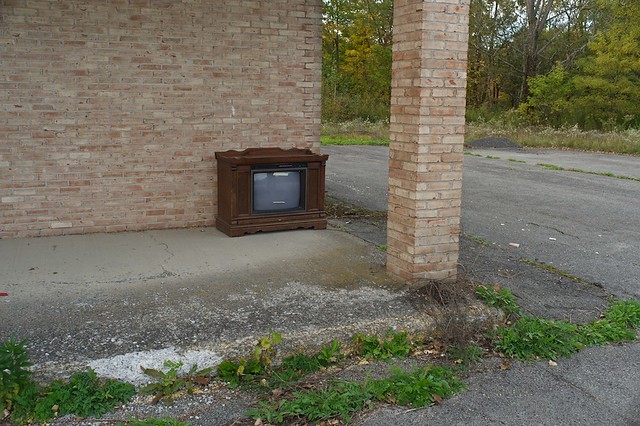
Riverdale was famous! This was the ancestral home of Archie and Jughead in the comics. I didn’t see any sign of Riverdale high, where Betty and Veronica would have hung out though. Just a TV dealership, and I think a gas station on the corner. The symbolic content of the place (false documents, after all, because comic books don’t exist) overwhelmed its actuality for me. Riverdale wasn’t the only revelation, there was also Pixley, which I blogged as far back as 2002. Pixley was the home of Petticoat Junction on TV.

Pixley, CA

There was no sign of a railroad track for miles, just a note on the door of the unattended used car lot that payments could be made at the Pixley Cafe next door. There was a playful dissonance to all this. I remember reading somewhere that Paul Henning, creator of Petticoat Junction, Green Acres (coincidentally a suburb of Bakersfield) and The Beverly Hillbillies, had simply looked at a road map and pulled his place names from that. Many of the places in the popular imagination could be found, in their less than symbolic form, scatted across the San Joaquin. The symbol, as Saussure has so assuredly demonstrated, is strictly arbitrary.

This amused me greatly then. It still does now; one of these days I need to do some decent scans/ fresh prints of these images. But, back to Mumford:

Now, the dynamic equilibrium on which all life depends is a difficult one to maintain, and nowhere has this been more true than in the balance between art and technics. Esthetic symbolism for a long time seemed to man either a short-cut to knowledge and power or an adequate substitute. So he applied it, not merely to things that could properly be created or formed by these methods—works of poetry and art, systems of conceptual knowledge like mathematics, or patterns of law and custom—but also to the physical environment and to natural forces: he foolishly invoked art and ritual to bring on rain or to increase human fertility. Without the counterbalancing interests and methods of technics, man might have easily gone mad, in that his symbols might have progressively displaced realities and in the end have produced a blind confusion that might have robbed him of his capacity for physical survival. At some point in his existence man must leave his inner world and return to the outer, must wake up, so to say, and go back to work. [emphasis mine] The tool tended to produce objectivity or matter-of-factness, as my old teacher, Thorstein Veblen, used to call it, and objectivity is a condition for sanity. (50-51)

Thinking about Slim’s semi-fictional songs, and the semi-fictional nature of the San Joaquin Valley tended to suggest that the world was filled with facades, and behind these facades there are a lot of ghosts. Mumford’s insights are not wholly negative and technophobic, they are strikingly insightful and progressive for their age. I am drawn to Mumford’s thinking, which tends to steer across the poles of print culture, photography, and sound reproduction technologies as lightning rods for productive discussion. There are no hard and fast lines between art and techics, between subjectivity and objectivity, and it seems a shame that he is colored as a curmudgeon.

Human history, unfortunately, discloses many symbolic aberrations and hallucinations. Perhaps the fatal course all civilizations have followed so far has been due, not to natural miscarriages, the disastrous effects of famines and floods and diseases, but to accumulating perversions of the symbolic functions. Obsession with money and neglect of productivity. Obsession with the symbols of centralized political power and sovereignty, and neglect of the processes of mutual aid in the small face-to-face community. Obsession with the symbols of religion the neglect of the ideal ends or the daily practices of love and friendship through which these symbols would be given an effective life. (51)

I think this anticipates Habermas’s concern with systematically distorted communication and the disjunction between system and lifeworld. The real treat for me is that Mumford faults not the systems, but the deployment of symbols inside them.

In a lot of ways, California was a sustained hallucination that lasted 37 years for me. My means of coping with it was primarily photography.

Bakersfield

I started thinking about Bakersfield again; I’m not sure why. Some things are best viewed from a distance. I’m trying to find perspective, and consequently I keep thinking about how strange it felt to return there in 2008. There’s a weird sort of oscillation, between near and far, between looking at something and yet through something. It’s a part of who I am, but at the same time I could be from anywhere. It’s just a place, among many places I’ve been. But it is where I’m from.

Or more accurately, I suppose, where I really grew up was here:

Breckenridge Mountain views

It’s more accurate to say that I found perspective by leaving town and looking back from a higher prospect. It’s the barrier here that interests me— white lines painted on the pavement. This cattle guard is a red herring at the base of of the climb up Breckenridge Mountain; further up the road, as I recall, there was a real one. One had to be careful navigating a bicycle across that one. The mixture of faux and real grates is the norm. I suppose it’s so the cattle won’t get wise and realize that they really can leave town if they want to. Or, I suppose you could think of the success of these “virtual” guards as a an intelligence test. Many of my friends growing up suggested that it wasn’t really possible for people from Bakersfield to leave. I suppose it depends on how easily fooled you are.

Symbolic Imperfections

imperfection.jpg Jeff Ward, 1976

I thought of this picture today while reading an excerpt from Lewis Mumford’s Art and Technics (1952):

The fact is that in every department of art and thought we are being overwhelmed by our symbol-creating capacity; and our very facility with the mechanical means of multifolding and reproduction has been responsible for a progressive failure in selectivity and therefore in the power of assimilation. We are overwhelmed by the rank fecundity of the machine, operating without any Malthusian checks except periodic financial depressions; and even they, it would now seem, cannot be wholly relied on. Between ourselves and the actual experience and the actual environment there now swells an ever-rising flood of images which come to us in every sort of medium—the camera and the printing press, by motion picture and by television. A picture was once a rare sort of symbol, rare enough to call for attentive concentration. Now it is the actual experience that is rare, and the picture that has become ubiquitous.

. . . We are rapidly dividing the world into two classes: a minority who act, increasingly, for the benefit of the reproductive process, and a majority whose entire life is spent serving as the passive appreciators or willing victims of this reproductive process.1

Around 75 or 76, I was engaged in trying to make sense of William Blake’s collected works (in a pilfered Modern Library Edition without illustrations). Like many I suspect, when I found S. Foster Damon’s Blake Dictionary at the local Pickwick bookseller down at the Valley Plaza Mall I thought I had found the keys to the kingdom. All a person had to do is figure out what his symbols meant, and you could extract the meaning, right?

I didn’t really think of it in those terms, I suspect— it was more a matter of figuring out what the words meant and why he chose those specific ones. I didn’t really know what a semiotic or symbolic approach was at the time; I was in that cusp between high school and college. My photo teacher, Chris Burnett had recently stepped down as chair of the English department at Foothill high and was willing to help me with both Blake, and photography. He didn’t really know that much about Blake, so he didn’t really discourage me from relying on Damon, nor did he say anything about trying to read the words apart from Blake’s images. For all I knew, Damon’s magic decoder ring actually worked. I think I spent most of the fall of 1975 trying to make sense of Blake, culminating in reading Milton’s Paradise Lost in the spring of 76 in a last ditch attempt to figure Blake out. I wanted more context.

The oblique connection between the Mumford passage and the Blake story is simply this:

The Giants who formed this world into its sensual existence and now seem to live in it in chains; are in truth. the causes of its life & the sources of all activity, but the chains are, the cunning of weak and tame minds. which have power to resist energy. according to the proverb, the weak in courage is strong in cunning.

Thus one portion of being, is the Prolific. the other, the Devouring: to the devourer it seems as if the producer was in his chains, but it is not so, he only takes portions of existence and fancies that the whole. But the Prolific would cease to be Prolific unless the
Devourer as a sea recieved the excess of his delights.

William Blake, MHH16; E40

Blake saw the same division into creative/consuming classes from the opposite side. The “cunning” labor under the illusion that they are exploiting artistic products when the process is ultimately more symbiotic in nature. Artistic production, in Blake’s estimation, is connected with courage: the courage to be taken, and as is often the case, to be taken wrongly. Note that Blake also references sensual existence as the antecedent to  these difficulties. 

Which brings me to the photograph at the top of the entry, a bit of juvenilia really. My brother David thought that this picture could be read symbolically. “You should call it ‘follow the leader’,” he claimed. With typical irony, David’s point was that the guy in front always gets beaten-up the worst. I never thought of that. I was simply attracted to the funky silver spray paint that was dressing up the old poles, creating odd textures in conjunction with the asphalt (and oddly congenial to the “N” surface matte paper that I printed the original on). 

Context explicates attempts to explain the image, not the image itself. David was a technician for IBM and well-versed in corporate culture. I had departed high school, and was working on prints for review at Bakersfield College for my first class with Harry Wilson. It’s pretty understandable that we’d look at the same image different ways. To his credit, I never once heard Harry Wilson offer a symbolic critique of a photograph. He looked at this one  for a moment, solicited reactions from the other students (they liked it) and then as I recall we simply moved on. Years afterward, I think the image popped into my head when I started noticing triadic compostions, but not for long. I can think of far better examples (with regression even). Retroactively, I suppose I can always generate some reason to find this image interesting

Harry was right. It’s best to just move on. The problem with the search for symbolic meanings in a symbolically saturated world is that they tell us more about the person doing the interpreting than they do about the true sensual condition of the world. Though one could make a case for iconology or iconography, it seems a better move to be prolific.

Mumford’s paranoia seems largely unfounded to me. It is a sort of knee-jerk, reflexively imbuing images with symbolic rather than actual significance that is the problem, not the attendant multiplication and reproduction. The divide between producer and consumer may or may not be exacerbated by technology– but it seems pollyannaish to suggest that this gap will ever be closed.

Symbolic contexts never explain the pragmatic deployment of communication strategies. Twenty-years on, taking many classes with R. Paul Yoder at the University of Arkansas, I remember invoking Damon’s symbolic approach to Blake. Yoder’s response was always to say, “that may be true, but what actually happens in the text?

Why do we care about certain things and have aesthetic sensual reactions to them? I don’t think that semiotics can ever get you closer to understanding that. One of the biggest ways of defusing the energy of aesthetic responses is by classing them as symbolic action rather than action.

Now I look at the picture, and the implied action: “why would anyone paint those beat-up poles bright silver?” and move on, quickly. There are more profound actions/questions to address.

Harry was right. I’ve had lots of teachers who were right over the years. The further I get away from the days that made me, the more I understand the context. But the real kicker is feeling like I still don’t understand the text at all.

1 Reprinted in Vicki Goldberg’s edited collection Photography in Print (381-382).

The most perfect place is where you are right now.

April 1983
A motel next to an RV dealer on Union Avenue, Bakersfield, CA

I’ve been thinking a lot lately about places (and perspectives on them). I don’t think that I approach place in the same way as a lot of people, perhaps because of where I grew up. Coming of age in the 1970s, the tradition in photography (especially in California) was dominated by Ansel Adams and his descendants. Not that there’s anything wrong with that.

But those photographs did not describe my world, my home. When I looked out the window I saw something completely different. But it would be myopic to suggest that place is simply a matter of geography/time. People are mobile creatures, and perhaps always have been. It shocked me how far many photographers of the nineteenth century were able to travel, aided by technology or not. But perhaps it’s communication media that have had the greatest effect on leveling things, creating uniformity when there wasn’t any uniformity before.

I remember taking linguistics classes that explored the subtleties of inflection/pronunciation and meaning vs. places of origin (i.e. home). California is fairly nondescript linguistically, but I didn’t even test positive for California idioms. My speech patterns contained artifacts of most of the regions in the US. Talking to my mom, she told me that I learned most of my language and pronunciation from the TV. I watched a lot of TV growing up. The dissonance between the images I saw on television (those people didn’t look like anyone I knew, though the places seemed oddly familiar) and the images I saw in real life was pretty jarring. Just the same, I learned a lot from the box.

No one I knew ever confused TV with real life; “reality TV” is the ultimate absurdity. I think that what TV homogenized is not our lives, but rather our dreams. It sets a horizon that most of my generation never strayed far from. What has this to do with the places we live? Not much, I suppose, other than to promote a disconnect between ideal places and actual places: since we don’t live in pristine nature we make pilgrimages to it and some even fantasize about living there. Sometime around age 18, I turned the box off; I didn’t own one for a while, until they decided to put music on it (but that’s a different story).

I’ve mentioned before that I started collecting and sorting images when I was a teen. Again, these were idealized images and I was always trying to figure out just what made them ideal. Then, for lack of anything else to do I suppose, I went to Bakersfield College (the high school on the hill) and met Harry Wilson. Harry was a firm believer in the “garbage in, garbage out” school of picture viewing. Looking at crap images all the time drove you to imitate and produce more crap advertising images. This sort of penchant for imitation over innovation seems like a given now. The cornerstone of a liberal arts education is to view/read only the best and brightest so that you can converse with the best and the brightest. I dropped out of college then, but I developed more refined viewing habits when I was there (1976-77).

It was during those years that I was first introduced to conceptual art, and really became fond of the practice of landscape photography. When I first saw Friedlander and Winogrand it was like an icepick in the forehead, but what made me fall right over was interaction with my high school photography teacher who had taken a sabbatical in those years to complete his MFA at Cal State Bakersfield. It was Chris Burnett that introduced me to the idea of conceptual landscapes. I started following formulas of a sort, plotting coordinates on a road map of Bakersfield and Kern County to drive to random locations and take photographs. This odd procedural move helped take the idealization out of the process. While it was hard to stop idealizing the locations, being confronted with decidedly non-ideal subject matter constantly forces you to come up with more interesting ways to represent the world. 

The problem with this maneuver, is that it forces your thinking into a sort of grid. Not that there’s anything wrong with that (it works fine for Chuck Close). This just didn’t satisfy me totally, so I would head out to the Kern River. I was always torn between a gridded, systemic approach to things and an more organic and loose approach. But there has always been one constant:

I think that the best place to be is where you are. 

Going back trying to tag my ramblings, I encountered an entry from 2001 where I mentioned taking a findyourspot survey (remember surveys? How 2000!) that suggested that the best places for me to live were all in the South. I took the survey again (it still exists!) to find that the best places for me to live are all in Minnesota and Wisconsin. Give it another year, and I’ll bet it’s saying that my preference is for Central New York. Our ideal expectations are always inflected by what we are viewing/hearing at any given moment.

North Country Strip Mall
I was here a few days ago

Chuck Close and Far

near and far.jpg

I was standing by the side of a backroad near Clockville when a cow came up to me (true story). I’ve been struggling with trying to get some sort of perspective on what I want to do next. The majority of my adult life I would have tagged myself as a photographer. It’s sort of a strange thing to do, considering that I have little in common with most photographers and find it hard to talk to most of them. If it’s a club, I always avoided joining because I just didn’t like the members. I do like cows though; My dad raised them pretty much as pets. As barbaric as it may sound, we did indeed eat our pets though. But I digress.

There was this sort of tableau in this field that I found interesting, but it kept changing when I tried to photograph it. I was never quite happy with any of the arrangements that presented themselves. Eventually, I just MMS’d a picture from my phone to my wife and drove on.

Cows

It seems like I can only photograph what is close to me. I’m weird that way. I remember that was a major difference between myself and Harry Wilson, one of the few “photographers” I ever really knew and liked. Harry would always travel (usually overseas) to photograph. He never liked what was next to him as subjects for photographs; he required the sort of distance and strangeness that travel brings before he felt creative.

I have become fond of traveling, particularly cross-country, in the last few years. It really helps to clear your head and allows you to think complex issues through. But when it comes to photographing things, I am always drawn to those things that I already know. I feel that if I can just look closer at those mundane things, if I can see them from new perspectives I can learn useful things. So when I travel, rather than looking for the unusual, I tend to be drawn to the usual. Like cows. And blue or yellow flowers. Krista and I came up with that theory travelling across the upper midwest: this country is really composed of cows and blue and yellow flowers.

Then again, I know that I fall prey to one of the central myths of photography. Most everyone of a certain age knows it. In the movie Blow-Up, a photographer just keeps zooming in to find more and more detail in one of his negatives. Eventually, he finds evidence of a murder. Robert Capa famously claimed that if your photographs aren’t good enough, you aren’t close enough. The basic tenet of photorealism is that photographs are seamless, containing endless meaning if we just keep zooming in.

I was shocked to find, searching my blogs, that I never have really written anything about Chuck Close. In the last few years, he has been increasingly thought-provoking to me. He went through a phase of photorealism in his painting, but soon moved to breaking things down into blots and motifs mapped on a grid. I think he has one of the best theories of near and far of any artist I know. Up close, things are personal and idiosyncratic.

You have to step back to really get the sense of Chuck Close’s paintings as “images.” Looking closer doesn’t really tell you something new. It tells you something different.

Cow Cube

My mom kept a little photo cube with pictures of our cows. It dawned on me, reflecting on my time in Clockville, that the problem of near and far (and locating a meaningful perspective) is not simply a matter of space, but also of time. We are never the same from one moment to the next, and even though there seem to be some constants (like cows), meaning is always contingent and fleeting. But the universe isn’t quite as random as it seems, if you can locate the right place to stand.

On that same drive down Oxbow Road, I passed a farm that claimed to be the birthplace of the first registered holstein cow. This place feels more like home all the time.

Needs

When I was a kid, I was really interested in eastern religions (particularly Zen). The framework of Buddhism just didn’t work for me though— absence of striving? WTF? Fine for rocks and trees, not so useful for people. People need things. That’s the only way we learn anything— we must need to learn. Learning, in fact, seems to me to be the goal of consciousness.

Learning should not be confused with literacy. Learning seems to be more deeply connected with a core part of being human, our predisposition toward planning. Squirrels, regardless of the clichés, don’t have retirement plans. Sociality (and thus communication skills) is nonetheless a central need for those with an eye on the future. We hairless apes are not particularly self-sufficient. We band together to survive, honing specific skills to be accepted within our tenuous circles of sociality. We figure out how to fulfill someone else’s needs, so that we may in turn be satisfied.

When I was a kid, I craved images. I would sort pictures into little piles, trying to figure out why I liked them and wanted to return to them. I usually couldn’t vocalize, let alone write down why I liked certain images over others. The more images I saw and collected, the more inexplicable the whole process became. I read a lot, at first to figure out how to make/do things and later to understand why people did the things they did (my father suggested Shakespeare and the Russian writers). I discovered Blake, Milton, and the rest of the usual suspects (Vonnegut, Kerouac and the Beats, etc) that a young man reads. But I didn’t need to be a writer. I was satisfied with reading; but I felt like I could make images. I spent decades learning most everything I could about it.

Somewhere around 36, I finally felt a need to learn how to write. I had to come up with an exhibition statement. A friend named Jeff, who was completing a masters in English Lit at UC Irvine, went through my rough draft with a pen reducing it by about two thirds. Reading between all the blacked out words, it was better. It seemed like writing was a lot like composing images— getting rid of the junk so you can see more clearly the subject that interests you. Writing didn’t seem that hard.

At 37, I found a need to write. I was smitten by a woman half a continent away and the primary form I had to relate myself and my feelings was through  (electronic) love letters. Words worked out well between us, but the when I moved to Arkansas to be with her the reality did not. I didn’t understand why I failed so miserably. At 38, I went back to school both to try and meet new people and learn how to make a better living.

At first, I wanted to study everything— Art, History, Literature, etc. but eventually two paths emerged. I loved literature, so hanging out with other people who liked reading it too was cool. But it wasn’t much of a career plan. Images weren’t being kind to me by this time either; everything seemed so painful. I felt like a walking nerve. People seemed to think I was a good writer. I was never quite sure why. An English professor suggested that I look into technical writing. So I got a dual BA in Rhetoric (seemed much more interesting than “technical writing”) and Literature.

Moving forward into a Master’s degree in Rhetoric (I never could stay interested in technical writing) I was allowed to teach, I loved that. The fundamental need of most students who want to survive college is the need to write. Granted, writing papers is not nearly so interesting as writing love letters or novels, but it is a specific survival skill. Later, I grew to love teaching technical writing as well because it is clearly writing that fills a need in the world. The world doesn’t need a lot more hackneyed love letters or lame novels. We need to understand what we are saying to each other more completely.

I didn’t finish my Ph.D., though I did all the course work because I just simply couldn’t find the need to. I loved teaching, but I never loved the politics of evaluation. How can you really know if you are meeting other people’s needs? I’m not so god-like as to profess to know.

It’s hard to find any real need to write these days. I’m happy, and I really want to rediscover my relationship with images. Some things, you just can’t describe in words. Maybe it’s time to get back to sorting it out. I suppose it’s best to blot out the bits that don’t fit.1

1When I first entered the composition classroom, this was the first assignment that greeted me: compose a literacy biography describing your relationship with writing. Often, there were hidden traumas in there. For example, during my first attempt at community college a million years ago, I dropped out because I wasn’t getting a good enough grade in “English composition.” I was a victim of the grammar cops. So what? I also didn’t have a reason to write— a detail that seems far more important to me.