I was a bit surprised to find the confluence between Bialetti and Aldo Rossi. It seems that the whole world wants to dwell in moka pots. As far as I know though, Bialetti wasn’t a powerhouse of architectural theory like Rossi.
Aldo Rossi
Perhaps it’s just in the rules that if you’re an Italian designer, at some point in your career you’ve got to tackle a moka pot.
In Italy, it began as Stile Liberty, before it fused with the modernist/futurist machine obsession to become art deco.
The distinction with Stile Liberty (art nouveau) is that it’s a total art—an art that includes household utilitarian objects.
Moka express, 1933
The first Bialetti moka pot from 1933 was clearly an art deco design, designed by Alphonso Bialetti—the moka express.
It’s pretty close to that famous version that Renato Bialetti put his moustache on in 1958.
What I wasn’t aware of until tonight, though, is that the Bialetti company also had ties to Borlotto Bugatti, who made brass and stainless steel cutlery.
I’m not sure of the relationship with Carlo Bugatti, the furniture designer who fathered Ettore Bugatti of expensive car fame.
Of course, there had to be a Bugatti Moka pot as well.
“A customer complained that his car did not start properly in winter.
Bugatti replied that if he could afford a Bugatti, he could surely also afford a heated garage.”
Too racy for me. I didn’t locate a price on that one.
Aldo Rossi has two moka pot designs that I located. The first, La Conica, in mirror polished stainless steel doesn’t come cheap at $275.
It’s a looker though, I must say. I love the lines.
The second, done in aluminum like the original Bialetti, called La Cupola looks a bit too much like a thermos for my liking. I wouldn’t like to live there.
It’s easy to get pissed at Adolf Loos, especially when he passionately argues that tattooed people are either savages or criminals. The difficulty in researching him, for me, is trying to figure out some context for his polemic declarations. In the introduction to the 1982 collection Spoken into the Void: Collected Essays 1897-1900, Aldo Rossi suggests that Loos’s writings are best taken in the spirit that they were offered. Sadly, virtually every book I found, and every PDF littered about the web, has the context stripped away along with all the dates and attributions. Even recently published collections offer no documentation about where the articles first appeared.
The power to irritate is closely related to the ability to amuse oneself, and the reader who is not overly confused by the academic pedantry will amuse himself a great deal with the writings collected here. Certain pieces, written in the “journalistic” manner, have provoked me to laughter and remind me of another artist who love to confront problems with a sense of humor, namely James Joyce. There is no doubt that these contemporaries of Freud were well aware that “every joke is a murder,” and may be placed among those artists whom Manfredo Tafuri defines as “villainous.” But Loos, apart from being “villainous” in a higher sense, is often “impudent” in the usual sense of the word. While preaching the uselessness of furnishing provided by architects at the same time of the do-it-yourself method—and from this we should logically deduce that one style is as good as another—he considers Secession [art nouveau] furniture actually to be criminal: “The day will come,” he writes, “when the furnishings of a prison cell by the court decorator Schulz or by Professor Van de Velde will be considered an aggravation of the penalty.” This is a statement which, deprived of its sarcasm, could be said to contain a moralism much like that of Gropius. (viii-ix)
Henri Van de Velde Tea table, Padouk 1896
It appears to me that the designer whose ornaments are so heinous that the ought to be jailed, has produced a tea table that is far less ornamental than the designer who railed so sharply against ornament. In fact, the designs of Professor Van de Velde, a leading Belgian art nouveau designer, are far more restrained than the norm. Loos’s critique is obviously not only sarcastic, but also tongue-in-cheek. That’s the problem of reading things divorced from their context.
I find it downright irritating that there isn’t much out there that isn’t in German on Adolf Loos. Apparently, he was a big fan of America and visited the Columbian Exhibition in 1893, so like Muthesius’s obsession with the English, he provides an interesting view from the outside. The passage from Rossi continues:
In speaking of his mythic America, the significance of which we shall see more clearly below, Loos seems to be delighted with a meal whose main dish is oatmeal; elsewhere he notes the fine eating habits of his much maligned countrymen, “for the Austrians know a lot about good cooking.” This unexplained assertion is equivalent to another on German cuisine: “The German people eat what they are served; they are always satisfied, pay the bill and leave.” (ix)
I am always struck by the way that gastronomy interweaves with architecture; both, one must assume, are matters of taste. In Loos, it seems, sarcasm is a way of life.
Throughout Loos’s writings one can find many quotations of this sort, some even more amusing and sarcastic than the above, and above all supported by a rigorous sense of logic, a persistent sense of involvement, and an anger akin to disillusionment. This feeling of disillusionment is much broader than any sort of disappointment with society or personal matters; it is centered on an abstract idea, a battle in which the enemy is a priori elusive, ungraspable, and not unlike the enemy of the mystic—sin. (ix)
Rossi’s assertion here brings out an aspect I’ve really not considered before. That the punk spirit (e.g. John Lydon’s “anger is an energy”) has some shared consciousness with the puritan aesthetic. It attempts to rid the world of the sins of bad taste.
In this case the enemy is stupidity and the lack of understanding and a sense of the end of things. Speaking of Karl Kraus, Loos summed up his friend’s thought and anxiety, saying, “He fears the end of the world.” The end of the world here is also the end of a world without meaning, where the search for authentic quality involves a man without specific qualities, where the great architecture of immutable meanings carries with it a sort of paralysis of creativity and the non-recognition of any progress of reason. Truth, architecture, art, the ancients—all this is behind Adolf Loos who, like all men of this kind, was well aware that he was traveling down a road without hope. (ix)
No future? John Lydon would be proud. The name Karl Kraus rang a bell, and I eventually remembered that I read an essay by Walter Benjamin on Karl Kraus years ago, and revisiting it today I remembered that Benjamin was also deeply moved by Adolf Loos, who features prominently in critical parts of that essay. The Benjamin essay on Kraus is worth revisiting another day. Returning to Rossi on Loos, what does it mean when one is “traveling down a road without hope”?
This attitude also calls into question the meaning of trade, of day-to-day labor, and consequently, of how one earns a living. On the one hand are the static architecture of monuments, the great architecture of the ancients, and the rather complicated possibility of “becoming” an architect; on the other hand are the minor activities whose efficacy he denies, such as the ordering of a house, it’s furnishing, its interior design. Loos does not hide this contradiction—on the contrary, he posits it as a part of his working terminology, and in one of his responses to a reader of Das Andere he actually affirms that he will continue to furnish stores, cafes, and private homes, even though such an activity is not by any means architectural—especially in an era when “every carpet designer defines himself as an architect.” (ix)
This places the matter of domestic design and fine art front and center; Benjamin’s Karl Kraus essay connects this line of questioning to art and technology instead, although there’s a telling fragment from around the same time period (1931-2) which includes a citation from a book given to Walter Benjamin by Franz Gluck:
On ships, mine shafts, and crucifixes in bottles, as well as panopticons.
“While reading Goethe’s rebuke to philistines and many other art lovers who like to touch copper engravings and reliefs, the idea came to him that anything that can be touched cannot be a work of art, and anything that is a work of art should be place out of reach.” Franz Gluck on Adolf Loos in Adolf Loos: Das Werk des Architekten [Adolf Loos: The Architect’s Works] by Heinrich Kulka (Vienna, 1931) p. 9.
Does this mean that these object in bottles are works of art because they have been placed out of reach?
(Collected Works of Walter Benjamin v. 2, p. 554)
Leaving aside the mind-blowing conceptualization of surveillance as art, this unpublished fragment really highlights the complexity of these questions, and shows strong connections with Benjamin’s concept of “aura,” The separation between day-to-day labor and artistic labor—the importance of and inaccessibility of the artist’s touch—is featured in Benjamin and Loos’s writing on the topic.
What separates the carpet designer from the designer of architecture, of monuments, from the carpet designer? Rossi offers this thesis for Loos’s acceptance of the paradox:
And why does he do all this? Because his trade gives him something to live on, and because he can do it well: “Just like in America where I earned my living for a while by washing dishes. But one could support oneself just as easily by doing something else too.” The contradiction between art and trade is so played down that the argument touches on an aspect that the idealist point of view has always neglected, that of the artist’s means of subsistence. As always, Loos condemns the moralism of action that is directly opposed to the economic romanticism of the Modern Movement. Each person will live in his own house, according to his own personality, but in all probability someone will ask for advice about this or that problem, or more simply will have better things to do than furnish his own house; then the architect, trying to do his job well, will advise him. That is all. In this light, Loos’s sarcasm directed against the Secession is easier to understand; what Loos is really attacking in his contemporaries is not so much their style or their taste (even though he finds it abominable)—what he cannot tolerate is the “redemptive” value that they assign to their own actions. One trade is as good as another; and even a trade like washing dishes can be done well provided one breaks as few as possible.
This certainly is the one aspect which “modern architecture,” so committed to mythifying its relations with industry and reformist politics, has been unable to admit and unwilling to discuss. (ibid., ix, x)
It seems clearer now why arts and crafts, art nouveau, and even the modernists with their imperatives would bear the brunt of such savage critique. Read in this way, all the high minded moralizing about the value of labor seems strained coming as it does, filtered down from bourgeois artists and designers sitting on their high moral thrones. For Loos’s most scathing thoughts on the topic, read “The Poor Little Rich Man.”
Opening pages of Swedish Arts and Crafts- click to enlarge for full effect.
I was looking for furniture designed by Carl Malmsten, or any sort of book about him, when I stumbled on Swedish Arts and Crafts: Swedish Modern —A Movement Towards Sanity In Design, a public relations effort published by the Royal Swedish Commision on the occasion of the New York World’s Fair, 1939.
The Swedish manor culture, which subsequently was to have a tremendous influence on the rebirth of Swedish applied art, reached its height in the eighteenth century. French influences in furniture and interior design marked its entire development, but in the hands of excellent Swedish artists and craftsmen they were gracefully blended into a native Swedish style—simple and unpretentious, with clean lines, and a sound conception of ornamentation. This 18th century received, fittingly enough, during the last part of the century the name Gustavian, because it is a faithful reflection of the spirit which pervaded the age of the great charmer king, Gustavus III—a refined, sophisticated, if rather formal way of living. (8)
This choice of language is strangely parallel to the autobiography of Carl Larsson, first published in 1931. Gustavus III was a “charmer,” while Larsson claims that he himself was not; both also place ornament, and the control of it, at the center of their concerns. One twist here is vital though—the Royal Swedish Commission immediately cites its ties to manor culture.
Larsson appears not long after this “charming” passage:
While during the major part of the nineteenth century Swedish artists and artisans busied themselves with copying the styles of bygone days, at the beginning of the present century a new style was born. It was a romantic, Nordic nationalistic style which found its expression in a great number of monumental buildings, all needing artistic embellishment. The romantic influence was felt also in the home, and Carl Larsson, the famous painter, exercised a tremendous influence on the Swedish taste through his home, a romanticized “peasant” interior of great charm and hominess. (9)
In fact, the development of Swedish Modern design is traced through three different types of home: the manor home, the burgher home, and the farm home. I was taken by many of the farm home interiors displayed in the 1939 World’s Fair propaganda, and did a little googling to find an interesting blog post from BuildLLC, which reproduces a contemporary pamphlet on Swedish Farmhouse design with this commentary:
While the guide is regulating and pragmatic, this method of design probably didn’t feel restrictive to homeowners when these farmhouses were originally constructed — in fact it probably still doesn’t feel restrictive in Scandinavia. There are a variety of options to fulfill a homeowner’s desire to make personal choices, and ample opportunity for each farmhouse to be unique. The important element is that this design freedom all occurs within set boundaries defined by sensibility; by what works and what doesn’t, by what is available and what’s not, by the practicality of time and budget. There are six varieties of roofing, seven types of siding, and nine distinct door designs. These three variables alone allow for 378 unique farmhouse designs and while one completed design could vary from another, each individual design decision is manageable. The nine door options are locally made from community resources, not a thousand from every corner of the earth. The same philosophy of decision-making applies to all aspects of this guide: Design decisions are informed by the collected knowledge of the people who built a house before you did.
While on the surface this seems quite laudable, what’s missing from this is celebration is any admission of the narrow nature of the Swedish conception of Arts and Crafts. As the Royal Commision explains directly in the 1939 book:
Under the aegis of The Swedish Society of Arts and Crafts, (Svenska Slöjdföreningen) a state-aided organization founded back in 1845, one industry after another began to employ artists as designers and production leaders. The result of this close cooperation between the Society, artists, and did not long delay its appearance. Along the entire line the output of Swedish home furnishings industries improved in form as well as in technical quality. However, the Society did not confine its efforts to raising the quality of the industrial products, it also launched a lively campaign to improve the taste of the general public and the standard of the homes of small income groups. By a never-ceasing propaganda, by exhibitions, lectures, courses, publications it hammered the gospel of home culture into the consciousness of the Swedish people, to make them realize the necessity for home furnishings in better accord with their actual needs and in harmony with modern life. By thus directing its program to the entire people rather than to limited groups of society, it was inevitable that the arts and crafts movement was to take on a social character. (8-9)
The social character was not simply the embrace of modern industry, but also traditional homecraft. It makes sense that the Arts and Crafts movement, in its most nationalistic zeal, would thrive in a country with a comparatively small amount of ethnic diversity. Traditional ethnic crafts (homecraft) has been lovingly preserved; it’s admirable, although it seems much easier for a country without large immigrant populations to achieve. In 1899, Lilli Zickerman (1858-1949) formed the Swedish Home Craft Association (Föreningen för svensk hemslöjd).
Lilli Zickerman, lower left.
What Zickerman proposed was a grand program to relieve the idleness and poverty that she saw as a result of industrialism. In her view, it was a matter of national concern and a moral duty that she and her associates help poor people to help themselves to work and to enhance the moral and aesthetic quality of their lives. To accomplish this, she and her associates had to educate people of all social classes to turn away from cheap mass produced goods (gottkopskram) and teach them to appreciate the quality and beauty of home-made crafts. In particular, people were to learn from those who still mastered the traditional arts. The idea, then, was not only to preserve and copy traditional artifacts but also to improve them. All peasant furniture and textiles were neither well made nor tasteful enough to please demanding buyers, and stern control was needed to maintain high quality and proper styling. Ultimately, Zickerman and her associates hoped that their program would have even grander effects: they expected that people’s love of their homes and their home region and its place within the Swedish nation would be awakened and strengthened. That love would have a moral and educational value and would prevent both the exodus to the United States and the growth of a rootless, “unswedish proletariate” of the kind that was joining socialist parties. It is no wonder that it was primarily conservative politicians who supported the homecraft movement, not their political adversaries on the left.
(Barbro Klein, “The moral content of tradition: Homecraft, ethnology, and Swedish life in the twentieth century” Western Folklore (Spring 2000)
Only since the 1970s has there been much backlash. Klein remarks that the social character of homecraft studies has been by described by those who enter it as “pompom research” or “pixie research.” Looking at the propaganda from 1939, it seems that little had changed. The “We Know” that creates the parallel structure of the introduction downright reeks of condescension. The ambivalence since the 70s is manifest in the language used to describe what used to be an optimistic, utopian project:
Few contemporary Swedish ethnologists study in earnest such phenomena as homecraft. The exceptions are a handful of highly accomplished, now retired, women, such as Ingrid Bergman, Sofia Danielson, and Gertrud Grenander-Nyberg who have all been employed at the cultural historical museums. Within the homecraft movement they are sometimes lovingly called “the homecraft mafia.” But their books and papers, which include important Ph.D. and M.A. theses, have not been at the center of the ethnological discussions. Indeed, neither pre-industrial craft nor the homecraft revival have been dominant topics within the discipline during the past thirty years, just as little as peasant art, legendary, or traditional medicine have been. The many ambivalent feelings toward homecraft, from irony to love, come forth in such widely used puns and word plays as hemsk slöjd (“horrible craft”) and slemhöjden (“the slimy hill”).
The pattern here repeats with alarming frequency, in different countries although at completely different time. The task of preserving craft is a difficult one, particularly when its organizing principles (like preservation of national identity) are either adopted uncritically, or hypocritically. There has to be a better organizing principle than nationalism.
I think that the concept of home as a situated but reasonably generalizable locus for the study of craft is worth pursuing.
I dreamed this past night that a strange young man urged me to enter a house where he would show me that he could charm snakes. He went ahead. Naturally, I followed him.
In there, I actually saw him standing in the center of the room, and in front of him, raised almost as tall as he, a thick gigantic cobra moved its head, following the beats of unheard music.
In the dimness of lights and smoke behind them I could faintly discern a group of spectators. Apparently they were convinced that the snake charmer had the dangerous snake completely under control.
I did not. Arriving late and totally alone, I suddenly found myself standing quite close to the actors. I felt unpleasantly insecure and would have liked to be outside again.
For a moment, I closed my eyes and thought: “The snake has noticed you particularly.” I feared it might be coming close…and then…and then I felt it close to me. It had slithered to my feet….It rose along my body…it chilled me and filled me with terror. I knew that one sting meant immediate death, namely if I showed the slightest fear.
“Introduction” Carl Larsson: The Autobiography of Sweden’s Most Beloved Artist, 1
This seems a strange way to commence the story of your life. After all, this isn’t Jim Morrison we’re talking about here, but a man known primarily for painting placid domestic scenes. No wonder many have described this book as “dour.”
Rather than a snake, it seems to me that the story of domestic design at the turn of the twentieth century is more like a hydra with many heads. The northern outpost of Arts and Crafts differs sharply from the English or Mediterranean variants. But snakes? What gives?
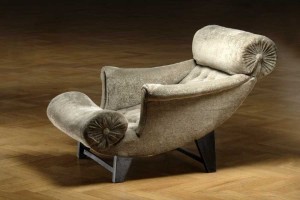
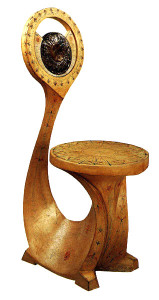
In the center of the “snail room” exhibited by Italian furniture designer Carlo Bugatti (father of the carmaker) there reside three “cobra” chairs. There is an example of one in Chicago; I’ll have to look for it the next time I pass through.
This piece is completely covered in parchment, a technique which hid all joints. Decorations are made of hammered copper, pencil and paint, and it is covered with parchment and leather.
The snail room was meant for games and conversation. The chair was shaped like a cobra, inscribed with floral and geometric motifs reminiscent of Islamic art. The chair’s open design served a practical purpose, allowing men’s coattails and women’s trains to hang down behind the seat.
It’s not really Arts and Crafts, but rather Art Nouveau, emphasizing ornament over the more self-consciously “honest” styles of the north.
Though they are sometimes lumped together, there seem to be some very important distinctions between the complex emergent styles of the late nineteenth and early twentieth century.
I opened my eyes, and now the head of the snake was close to me, facing me. How magnificent it was! The colors, glittering in the most wondrous shades, were blinding me. The most elegant ornaments were forming in front of my eyes. They curled downward to more rigidly geometrical planes, and on the lower parts of its body, where the colors turned more vulgar, the patterns became coarser and more abhorrent.
But the evil little head with the shield around the neck, which is so peculiar to the cobra, offered overwhelming richness of lines and color.
I had to look at it with an admiration close to rapture. The small eyes of the snake were glittering maliciously. They peered almost laughingly into mine. The head was rocking from time to time, sometimes shooting forward and then pulling back, and then I felt its repugnant spongy body pressing itself closer and closer to mine!
I knew that my life was not worth much by now. However, I seemed to myself triumphantly proud, felt that now I would be able to show those present what kind of man I really was.
Or was I?
Oh no, it was so thoroughly terrible, the tension was horrifying! If only the loathsome garishness would disappear! But if all turned out well, what a hero I would turn out to be! (ibid. 1-2)
It is extremely unlikely, I think, that Carl Larsson and Carlo Bugatti were familiar with each other. Nonetheless, it seems almost as if Larsson’s downright weird introduction to his autobiography might be productively be read as a critique of Art Nouveau. There’s a curious love/hate relationship with ornament across all these different threads of design.
Mackay Hugh Baillie Scott, writing in Houses and Gardens (1906) discusses two popular modes of decoration: heraldry and organic motifs. Heraldry, with its deep ties to the English manor house traditions, was old; natural motifs (decorating around some sort of common organic shape, like lotus flowers) were emerging (thanks to the pre-Raphaelites) as a plausible choice to those setting up a home.
Carl Larsson embraced Gustavian design (a situated Swedish variant of rococo), which is perhaps close to an embrace of the sort of traditional heraldic motifs gestured at by Baillie Scott. At the same time, there was a rustic naturalism to his designs. What the English and Swedish outlooks both share is a desire to ornament in such a way that connects with their national identities.
But the cobra did not release me. Now it approached my face, I felt its tongue as if it were fluttering against my lips, but I smiled and remained courageous.
Ah, but I was petrified, and so was my wide smile. Now, now, it stole its narrow, thin, thin, tongue between my lips. I felt it against my tongue. Now I could take it no longer.
I…woke up.
Fortunately it was only a dream, a nightmare.
I immediately realized it was an allegory of my life, as good as any.
You must try to decipher it yourself after reading the memories I have determined to write down.
My steadily smiling face. My hidden horror of life. I certainly was not a snake charmer. It was the snake—life—that charmed me. (ibid. 2)
Not many artists open their autobiography by spinning a tale about french-kissing a snake. I would be curious why Carl Larsson chose this dream, or why Carlo Bugatti chose the cobra as his totem, or the snail. But some things are certain.
The snail room was exhibited at Prima Esposizione Internazionale d’Arte Decorativa Moderna in Turin in 1902. It’s primary dictate: “Only original products that show a decisive tendency toward aesthetic renewal of form will be admitted. Neither mere imitations of past styles nor industrial products not inspired by an artistic sense will be accepted.”
Both Art Nouveau and Arts and Crafts stress connections, through ornament, to the lands that birthed them. Larsson had his folk styles and Gustavian ornament, Baillie Scott had heraldry and pagan naturalism, while Bugatti was more connected with Moorish traditions. All are situated in ways both intellectual and geographic.
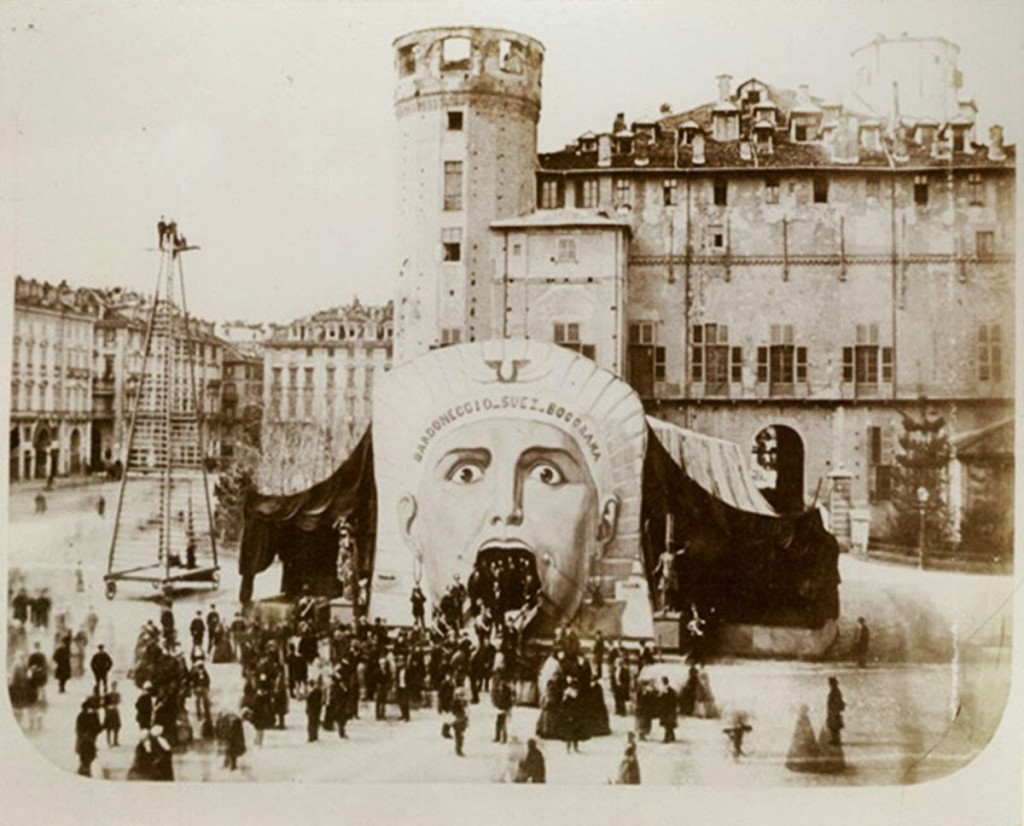
I was researching the Turin Exhibition of 1902 this morning, and ran across this image. I don’t think it’s from the Prima Esposizione Internazionale d’Arte Decorativa Moderna. I can’t figure out where it’s from, but a blog post (in French) has some plausible theories. It’s apparently the central square in Turin, where some years later about two hundred yards from the spot was an Egyptology museum.
The analysis I found suggests that it’s not from 1902, and I tend to agree simply because it looks like a wet plate or collodion photograph (from the degree of blur in the pedestrians). By 1902, dry plates were much faster, so this is either really bad technique or slow film. Further, though, the scholar locates a particular exhibition from 1870 that might explain things. The google translation is:
The pavilion “Bogorama” was erected in Piazza Castello in Turin, behind the Palazzo Madama, during the 1870 Carnival facade, high 10 meters is a sphinx head and bears the inscription ” Bardoneccio-Suez-Bogorama “. Inside is a vast panorama of landscape, 120 meters long and 3 meters high. represented It showed points views varied and delicious, from the Alps to Cairo, then the left bank of the Nile to the temple ruins of Thebes. it’s Casimiro Teja (Piedmontese cartoonist 1830-1897), which is the origin of this panorama project after the return to Egypt of painters and Francesco Enrico Gamba, Cerutti, Perotti, Barucco, pastoris and members of the “Circle of Artists” and “Knight of Bogo” Tommas Juglaris. This view seems to have been then taken to Paris to be exposed, but died in a fire during the Commune riots. for the moment, no clear indication as to the period when the pavilion was installed, or duration.
Bogorama is a catchy name, and it seems wild to think of people flocking to see a panorama inside this temporary building. All this has nothing to do with what I’m researching, but I really wanted to leave a note.
One of the best books I’ve read in recent memory was William Coperthwaite’s A Handmade Life. In trying to figure out what made sense for me, his particular brand of “enlightened selfishness” resonated. A key component in Coperthwaite is accessibility.
In a sidebar I keep revisiting, Coperthwaite laments the accessibility of the small broad axe. I must confess that my least favorite tools are striking tools—things like hammers and axes— because they always seem to go horribly wrong for me. Wood splits (and not where you want it to) or worse still you hit yourself with them. They make loud noises and crush things, etc. However, axes are a frequent matter of discussion among green woodworkers for spoon carving and other activities which I am deeply interested in.
The hard part is that they are really designed to operate on green wood, which I don’t have easy access to. There are only small scrub bushes on my property and trashy pine trees. The only two decent trees, a maple and a pear, aren’t large enough to contribute branches of any size. Also, good axes are expensive. I bought a small swiss hatchet for splitting kindling, but I’m terrible at using it and it’s not really designed for delicately shaping wood. A good axe would cost far too much for me, given my timidity on the topic. Peter Follansbee has excellent recommendations on axes, I suspect, but I’m really not ready to go there. I was surprised that he didn’t mention Coperthwaite’s democratic axe.
Coperthwaite tells the story of searching for a decent broad axe. He carved a model from pine, and found that a blacksmith friend in Japan agreed to forge him one. After two years, the axe never materialized and he was traveling in Italy and found an old blacksmith there that would make one for him. This one was delivered, but Coperthwaite lamented:
Now, these are far from democratic tools. To get one you first have to design it and then know a smith in Japan or Italy or wherever who can—and is willing to—make an axe from your design.
It was doubtful that the axe from Japan would materialize, and the Italian smith was very old and sick and would probably not make another. A good broad hatchet for students and friends who wanted one was as elusive as ever. And though this axe adventure was exciting, and I had acquired some fine ones, we badly needed to have some inexpensive ones available. (17)
The primary difficulty in engineering and axe is the “eye” which attaches it to the handle; this can be avoided by making the blade from a flat plate of steel bolted to a handle. Then, the only technical challenge is hardening and annealing the steel once it is cut out, but a small propane torch and normal household oven can manage that. I note that John Wilson has a similar type of design for an adze, another difficult to find and expensive classic tool.
The importance of the sidebar isn’t really the design of an axe and presentation of easy to follow instructions so that anyone might accomplish it, but the philosophy behind the creation of this tool:
This experience with the broad hatchet is important for me on several levels. First it has been an exciting adventure all along the way, from learning to appreciate the variations in different forms of such a basic tool, to designing my own which others ultimately made, to ultimately making my own. Another level of the adventure is to be able to help others make their own hand axes and in the process gain the confidence that comes from making a tool. This process demonstrates how we can have adventure in a variety of ways: designing, working with the hands, and working with the mind as we carry the concept of democratic things further.
Another value this experience had for me is the breaking of mental and social barriers, which we need to be able to do if we are to solve our problems and create a society that works for all people. (18)
While I was trying to put all this together, I was a bit distracted by a podcast that Chris Schwarz linked— Looking Sideways. What fascinates me about Coperthwaite’s axe isn’t the tool itself. It’s the attitude toward toolmaking and tool sharing. Andrew Sleigh’s interview with Deb Chachra actually dovetailed nicely (stealing one of her hook phrases). She argues that we need to reassess making things in the emphasis we place on the things themselves to rebalance ourselves. Thirty minutes in, she offers the observation that “nice stuff that lasts forever is valuable, but so are the sort of day-to-day experiences that people have.” That’s similar to what Coperthwaite is arguing here. He’s championing not only the physical labor, but also the social and mental labor involved in his search for a serviceable axe.
In her Atlantic article “Why I am not a maker” (not her title, according to the podcast), she makes some really important assertions in the section that the title is misleadingly extracted from:
I am not a maker. In a framing and value system is about creating artifacts, specifically ones you can sell, I am a less valuable human. As an educator, the work I do is superficially the same, year on year. That’s because all of the actual change, the actual effects, are at the interface between me as an educator, my students, and the learning experiences I design for them. People have happily informed me that I am a maker because I use phrases like “design learning experiences,” which is mistaking what I do (teaching) for what I’m actually trying to help elicit (learning). To characterize what I do as “making” is to mistake the methods—courses, workshops, editorials—for the effects. Or, worse, if you say that I “make” other people, you are diminishing their agency and role in sense-making, as if their learning is something I do to them.
There is a quote that Coperthwaite offers up in his book that places the problem in a deeper context:
My teaching is a raft whereon men may reach the far shore.
The sad fact is that so many mistake the raft for the shore. —Buddha (53)
What is important about Coperthwaite’s democratic axe isn’t his methods—securing the the assistance of other artisans, learning how to harden and temper steel, etc.— but rather the effect of solving a difficult problem with easily sourced material, and better still, teaching anyone to solve similar problems themselves. It’s not limited to those who can afford to take a workshop, or travel miles to sit at his feet. A Handmade Life includes how to make an axe, how to bake a loaf of bread (with a recipe) and much more.
I feel incredibly blessed to live in a time where so many share so much on the Internet providing not only access to things, but methods of doing things that I really wouldn’t have invented on my own. It’s not just about having the tools, it’s knowing what you want to do and why. And it’s also important to value all forms of labor, not just the ability to make, except in the sense of making your own life.
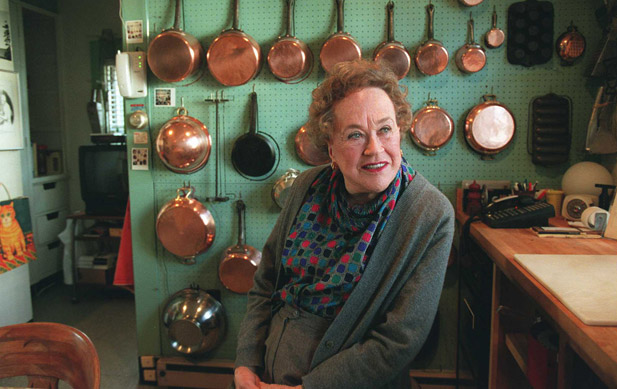
Julia Child’s kitchen at the Smithsonian Institution
Julia Child’s kitchen presents an interesting case in domestic design. There is a clearly delineated philosophy behind it. In itself, that’s not rare; however, to have it reflect so directly the philosophy of a practitioner and influential teacher is not as easy to come by. It’s a workspace, and a democratic one at that.
It’s quite fitting that it was bequeathed to a national museum. As far as I can tell, virtually all of the Smithsonian’s facilities are free from admission charges (except the Cooper Hewitt Museum in NYC) and are open virtually every day of the year except Christmas. Access has no barriers. That, of course, was the centerpiece of the efforts of Julia Child. In the foreword to Mastering The Art of French Cooking from 1961, she began:
This is a book for the servantless American cook who can be unconcerned on occasion with budgets, waistlines, time schedules, children’s meals, the parent-chauffeur-den-mother syndrome, or anything else which might interfere with producing something wonderful to eat. Written for those who love to cook, the recipes are as detailed as we have felt they should be so the reader will know exactly what is involved and how to go about it….No out-of-the-ordinary ingredients are called for. In fact the book could well be titled “French Cooking from the American Supermarket,” for the excellence of French cooking, and of good cooking in general, is due more to cooking technique than anything else. And these techniques can be applied wherever good basic materials are available.
The 1983 introduction of the revised edition remarks that the new advances in technology, such as the food processor, have further lowered the barrier to cooking excellence by simplifying the drudgery; the recipes, in many cases, were revised to reflect that. But from the beginning, it seems as if Julia’s first rhetorical task was to remove the aura of preciousness from fine cooking:
We have purposely omitted cobwebbed bottles, the patron in his white cap bustling among his sauces, anecdotes about charming little restaurants with gleaming napery, and so forth. Such romantic interludes, it seems to us, put French cooking into a never-never land instead of Here, where happily it is available to everybody. Anyone can cook in the French manner anywhere, with the right instruction. Our hope is that this book will be helpful in giving that instruction.
The emphasis, as in most craft literature, is on education about materials (ingredients), tools (batterie de cuisine), and technique. What is also striking though, is that as her career moved on, she also gave a lot of attention to discussing her rationale for her work environment and mise en place. In other words, it wasn’t just about raw materials, tools, fixtures, and skills—attention was also given to workflow and the assortment of jigs that shape it.
In the “Design Anatomy” issue on Julia’s kitchen from 1977 in Design Quarterly composed by Bill Stumpf and Nicholas Polites, the delineate some of the difficulties in finding good analysis of workspaces:
Industry has a tendency to pander to immediate market interests, seeing research narrowly through product eyes; government has a fixation on consumerism and regulation; and, designers rarely have the time, motivation or money required to carefully analyze a philosophical question. (12)
They go on to assert that Julia’s kitchen is “artless,” because it reflects not only successes but failures; it is also “easily perceived,” “small scale,” and “productive”(13). The analysis they offer is useful to anyone interested in domestic design. Throughout, I was reminded of a lot of contemporary writing about woodworking tools and materials.
Julia Child’s batterie de cuisine, translated by some on the Internet as referring to “pots and pans” is impressive to say the least. But she wasn’t what you would call a tool collector, nor was she snobbish about perfection. The labeling of her tools as a batterie is telling; one does battle with the food, and the tools are the artillery. In Mastering The Art of French Cooking, she suggests that a cook seek out a restaurant supply to acquire good serviceable tools. Obviously she had a big assortment of things (enough to equip a couple of restaurants by some estimations) but they were acquired over the course of a lifetime. Stumpf and Polites summarize her attitude on tools:
Julia’s kitchen is remarkably affordable. This has been achieved by applying four principles. The first deals with the feeling for what is elegant and common and the fact that these qualities are not mutually exclusive in an environment or object. Julia hangs her array of fine French skillets and pots on common pegboard. The cupboards are of pine, yet the drawer slides are of commercial quality, the wine collection is racked on common pine wood shelves and labeled with masking tape. Good quality chinaware is set upon an oilcloth table covering, and so on.
One of my favorite tricks pictured in the analysis is the labeling of all spice jars with the first letter of the name of the spice written large on masking tape, to assist finding and replacing the jars on the spice rack. This seems an essential innovation for less than perfect eyes like mine. I noticed that many people who visit the display at the Smithsonian comment on the oilcloth table covering. It’s a far cry from the carefully woven Arts and Crafts table drapes of not so many years before.
The second principle deals with the long term value of tools. She will buy the least expensive if it works well and endures under heavy and prolonged use.
The third principle focuses upon sources of supply that deliver good value. Julia’s stove was purchased used, and she shops for utensils in professional shops and hardware stores,not design conscious boutiques. In short, Julia loves her tools but is not dominated by them. First, she loves good food and is a good cook. That perspective is never lost on the best of everything kind of environment.
The arguments among hand tool woodworkers regarding boutique tools is something that grates on me like fingernails on a chalkboard; this is where the real bourgeois privilege rears its ugly head in tool geek land. I have nothing against those who can buy a $250 panel gauge (ultimately just two sticks attached together with a bit of brass), but it just doesn’t seem to be a solution for the vast majority of workers. There are obviously tools that are worth more than the sort of mass market “tool resembling objects” that the primary gurus of woodworking rail against, but it troubles me that there is seldom a middle ground in these discussions. A person can buy used (as Julia Child did on some items) if and only if one has the expertise to do so.
That’s hard to acquire when a craftsman first starts out. There have been attempts to address this, but Julia Child’s second principle, of “buying the least expensive if it works well and endures under heavy and prolonged use” is generally lost on woodworkers. Also conspicuously downplayed (though sometimes addressed) is the fourth principle:
The last principle deals with the gradual acquisition of good quality objects. One doesn’t buy a collection of cooking tools and then hope to cook with them. One learns slowly, adding tools to suit new recipes and processes. Only by knowing how to cook can a cook truly evaluate the worth of a tool. . . particularly a new tool. (18)
The Design Quarterly articles go on at great length about her stove, with extensive photographs as if it were a sculptural object, but in the end the detailed discussion of workflow in Julia’s kitchen is the real pay off. I will have much more to write about that later.
Julia’s kitchen is indeed a philosophical space. It’s not at all anarchistic, it’s structured in such a way to generate as much of a dialog as possible all the while keeping a sort of easy expertise in flux, ready to be modified and experimented with. It’s a democratic kitchen, which like Julia’s recipes, is within reach of everyone.
Looking out the window this morning, I was struck by how the animal tracks had grown. The rows of circles melted in the snow are not features of the terrain, or the work of humans. They are marks of habit—the deer and squirrels that live in my backyard usually take the same route as they go about their business leaving small tracks.
Over time, it becomes less and less clear what sort of tracks they are, and they sprawl and dissipate in ways that lose all resemblance to their original motives and forms. Forensically determining their anatomy and traversals becomes more difficult as time passes.
Until the last year or so, I was completely unfamiliar with Julia Child. My only real exposure to cooking shows was Martin Yan —”If Yan can cook, so can you!” I managed to make a fairly decent lo mein twenty or thirty years ago from that. Modern cooking programs do very little for me. The whole “cooking challenge” nonsense that seems to dominate these days really leaves me cold, and haven’t found much in the genre that really excited me.
I had thought, until I started watching (perhaps due to her screechy patrician voice), that Julia Child was too precious for me. Besides, I had never (as far as I knew) eaten French cooking, so my interest in the subject was low. But I couldn’t have been more wrong about Julia.
One of the best tangents that Witold Rybczynski triggered for me lately was the Walker Museums “design anatomy” issue on her kitchen from 1977. Julia’s kitchen was a habitation that just screams “I am alive!”
I’ve been watching Julia Child videos for the last year or so, and Jacques Pepin too. What’s different about them from most of the cooking shows out there is that they present an environment that is not hostile or competitive, an environment where everything is simple and possible.
Cooking is about being alive, and celebrating life—not winning prizes or celebrating rare ingredients or techniques. It’s all very average and normal—the opposite of precious. Part of what makes this possible is the environment in which it is enacted, the kitchen.
Building on the essay by David Kirsh I linked previously, Matthew Crawford describes the kitchen as a jig deployed by an expert in an interesting way:
A physical jig reduces the degrees of physical freedom a person must contend with. By seeding the environment with attention-getting objects (such as a knife left in a certain spot) or arranging the environment to keep attention away from something (as, for example, when a dieter keeps certain foods out of easy view), a person can informationally jig it to constrain his mental degrees of freedom. The upshot is to keep action on track, according to some guiding purpose, one has to keep attention properly directed. To do this, it helps a great deal to arrange the environment accordingly, and in fact this is what is generally done by someone engaged in a skilled activity. Once we have achieved competence in the skill, we don’t routinely rely on our powers of concentration and self regulation—those higher level “executive” functions that are easily exhausted. Rather, we find ways to recruit our surroundings for the sake of achieving our purposes with a minimum expenditure of the scarce mental resources.
High level performance is then to some degree a matter of becoming well situated, let us say. When we watch a cook who is hitting his flow, we someone inhabiting the kitchen—a space for action that has in some sense become an extension of himself. (The World Outside Our Heads, 33)
This cuts to the heart of what I’m trying to figure out through my reading and research. My home, as Krista describes it, is a “co-habitat.” I would like it to be a place for skilled work in living. Wendy Hitchmough’s The Arts and Crafts Lifestyle and Designtriggered a new round of research into specific rooms beyond the kitchen, but for starters, the kitchen works. In Julia’s case, it’s a workshop but it’s also a social and collaborative space.
On what would have been Julia Child’s 100th birthday, Jacques Pepin wrote a touching memoir about their relationship for the New York Times;
Julia and I started teaching together at the university. We argued on stage, stealing each other’s mise en place. We felt comfortable together, had a good rapport, a good time, and we respected each other. Our affectionate disagreements resulted in heated, opinionated discussions; we had conviction, enthusiasm and passion for our métier. This resulted in our doing a couple of three-hour PBS Specials called “Cooking in Concert,” both of which were filmed at B.U.
Eventually, these specials led to our doing a series together for PBS at Julia’s house in Cambridge. Both the series and companion cookbook were called “Julia and Jacques Cooking at Home.”
I find it interesting that the sort of special spatial arrangement that Crawford was writing about, a cook’s “mise en place” is featured in Jacques memories. And in deep sympathy with the sort of situated and contingent world view that the articles about expert intelligence that the AI articles I recently mentioned, Julia and Jacques worked with no plan:
We did not follow recipes, creating them as the shows were filmed. We cooked like friends, spouses or couples do: cooking and drinking together, arguing, then sitting down and sharing the food.
Using Crawford’s framework, it seems safe to say that inhabiting a kitchen means being comfortable enough with the arrangement to admit contingency and disagreement, but also embracing the sort of synergy that comes from not being in total control of events as they unfold. It’s about having a loose sort of arrangement within a carefully specialized regimented environment that allows a maximum of creative potential. Knowing where things are enough to be comfortable, but not being so attached to a planned layout that you can’t release control and allow chance and character to enter the world.
In short, as Van Gogh would say, the kitchen and the people and tools in it should have character. The latest round of readings I’ve been doing have brought out a lot of interesting aspects to the character of various kitchens. Julia’s now resides in the Smithsonian, with good reason. Jacques is out there on Facebook, and the world will really be diminished when he’s no longer in it.
The Papuan tattoos his skin, his boat, his paddles, in short everything he lays his hands on. He is not a criminal.The modern man who tattoos himself is either a criminal or a degenerate. There are prisons in which eighty per cent of the inmates show tattoos. The tattooed who are not in prison are latent criminals or degenerate aristocrats. If someone who is tattooed dies at liberty, it means he has died a few years before committing a murder.
The urge to ornament one’s face and everything else within reach is the start of plastic art. It is the baby talk of painting. All art is erotic.
The first work of art, the cross, was erotic. The first work of art, the first artistic act which the first artist, in the urge to rid himself of excess energy, smeared on the wall. A horizontal dash: the prone woman. A vertical dash: the man penetrating her. The man who created it felt the same urge as Beethoven, we was in the same heaven in which Beethoven created the Ninth Symphony.
But the man of our day who, in response to an inner urge, smears the walls with erotic symbols is a criminal or a degenerate. It goes without saying that this impulse most frequently assails people with such symptoms of degeneracy in the lavatory. A country’s culture can be assessed by the extent to which its lavatory walls are smeared. In the child this is a natural phenomenon: his first artistic expression is to scribble erotic symbols on the walls. But what is natural to a Papuan and the child is a symptom of degeneracy in the modern adult. I have made the following discovery and I pass it on to the world: The evolution of culture is synonymous with the removal of ornament from utilitarian objects. I believed that with this discovery I was bringing joy to the world; it has not thanked me. People were sad and hung their heads.
Adolf Loos, “Ornament and Crime”
The French and the Germans obviously couldn’t be further apart on these issues. Van Gogh and Gauguin had a completely different perception of “primitives” than Hermann Muthesius and Adolf Loos; the same could be said of other European artists like Picasso and Braque.Joan Miro’s embraced of children’s drawings, and it’s also worthwhile to note that Paul Klee, a Swiss-German, didn’t have any difficulty as seeing children’s art as worthwhile and even “progressive.” Further, even Loos himself deployed ornament on utilitarian objects, despite this shrill protest.
Knieschwimmer chair
Aesthetic puritanism never seems to work out, but nonetheless, Loos was its most impassioned advocate:
If I want to eat a piece of gingerbread I choose one that is quite smooth and not a piece representing a heart or a baby or a rider, which is covered over with ornaments. The man of the fifteenth century won’t understand me. But all modern people will. The advocate of ornament believes that my urge for simplicity is in the nature of a mortification. No, respected professor at the school of applied art I am not mortifying myself! The show dishes of past centuries which display all kinds of ornaments to make the peacocks pheasants and lobsters look more tasty, have the opposite effect on me. I am horrified when I go through a cookery exhibition and think I am meant to eat these stuffed carcasses. I eat roast beef.
A fan of roast meat and boiled vegetables, Loos had a big impact on kitchen design, although somewhat indirectly. Loos outlook was utopian in the extreme. He sought to conserve the labor expended in ornamenting things to use it more productively furthering humanity. He did concede that some did get pleasure in the creative labor invested in ornament, and claimed that he would wear ornamented products to please others, though he took no pleasure in it himself. But he stood by his claim that the urge to ornament was counterproductive and wasteful, a primitive affectation for the masses.
The Taylorist “Frankfurt Kitchen” designed by Margarete Schütte-Lihotzky was thought to be a liberatory design— freeing women to work in factories instead of the house. The simplified version of a kitchen, which dispensed with most food storage, sought to streamline the social habits and inheritance of the kitchen in the same way that Loos sought to strip away ornament.
Historical culinary practices were thought by the German modernists to be a “primitive” affectation with no place in modern life.
The most telling comment, as translated by Wikipedia, was this:
On her 100th birthday Schütte-Lihotzky commented “You’ll be surprised that, before I conceived the Frankfurt Kitchen in 1926, I never cooked myself. At home in Vienna my mother cooked, in Frankfurt I went to the Wirthaus [restaurant/pub]. I designed the kitchen as an architect, not as a housewife.
Schütte-Lihotzky worked closely with Loos in the 1920s, and the changes to the kitchen wrought by her designs and the emerging new philosophy of the kitchen have had a deep influence on domestic design. Schütte-Lihotzky conceived the kitchen as an integral part of the living area, though it could be partitioned off if need be. This is in stark contrast to the English manor house tradition of a completely separate wing for domestic activities. This change presents interesting problems, both socially and architecturally.
Loos offered his solution in a 1926 lecture entitled “The Modern Settlement” suggesting that unpleasant cooking smells were best avoided, not by separating the kitchen from the living areas, but rather by only cooking foods which had pleasant aromas—ham, eggs, and beef steak. His argument for a rationalized system of food production and management has echoed across the twentieth century, with many unwanted side effects. I’m trying to track down much more material on this.*
Curiously, there seems to be an obsession among German architects of the early twentieth century with fire. Hermann Muthesius goes into great detail on the subject:
But an open fire is still indispensable for several activities at the English stove. First among these is the toasting of bread that forms so important an element of the English breakfast; toast entirely replaces our continental breakfast bread and rolls. The English are also still very fond of roasting meat on an open fire, a method of preparation that undoubtedly has great advantages; for the juices remain in the meat and meat prepared in this way is tastier and more easily digested. It would not occur to the English to add any kind of sauce to roast meat; and indeed, it needs none. At most they use one of the piquant sauces that can be bought ready-made such as the famous Worcester sauce. Consequently an important aspect of the higher culinary art, the preparation of sauces, is practically non-existent in the English kitchen. If one adds to this fact that vegetables are also simply boiled in water with nothing added and that all the dishes consisting of several ingredients combined and cooked together which our German cooking is so rich, are entirely unknown, it becomes obvious that English cooking is extremely simple, almost primitive. (The English House, 97)
So, the conclusion is—open fires, no sauces, no fancy breads, plus boiled vegetables equates with “primitive.” For culture, the English are (according to Muthesius) dependent almost entirely on the French. However, this doesn’t mean that their aren’t good things to say about this “primitive” English life:
But all English dishes are made from the best raw materials. Nowhere will you find a leg of mutton to equal that in England and their beef and vegetables are also excellent. Good materials make up for the lack of style; indeed, once one has become used to the artless English cooking, one has the feeling that embellishments would not find favor there; and once has made its acquaintance, the sophisticated French cuisine seems spineless, almost insipid. (ibid.)
It’s easy to see from this that the lack of embellishment in English cooking is the most positive thing about it, an aesthetic trend grasped by the Germans with a revolutionary zeal. Stripped down kitchen facilities, and stripped down food, become the hallmark of the twentieth century. Rationalized kitchens go hand in hand with rationalized food.
*After writing this, I discovered this passage in Adolf Loos’ 1910 essay titled “Architecture”:
If we were to come across a mound in the woods, six feet long by three feet wide, with soil piled up in a pyramid, a somber mood would come over us and a voice inside would say, “There is someone buried here.” That is Architecture.



 Of course, there had to be a Bugatti Moka pot as well.
 Aldo Rossi has two moka pot designs that I located. The first, La Conica, in mirror polished stainless steel doesn’t come cheap at $275.







 I’ve been watching Julia Child videos for the last year or so, and Jacques Pepin too. What’s different about them from most of the cooking shows out there is that they present an environment that is not hostile or competitive, an environment where everything is simple and possible.