Furniture for Sitting

Otto Wagner, Armchair, Thonet model #6516

The Otto Wagner room is beautiful not because, but in spite of the fact that it was designed by an architect. For this architect served as his own decorator. This room will not suit any other person because it will not correspond to his personality. It lacks perfection for any second party: thus we may no longer speak of beauty. To do so really seems a contradiction.

By beauty we understand the highest degree of perfection. For this reason it is completely out of the question for anything impractical to be beautiful. The fundamental requirement for any object that would lay claim to the designation of beautiful is that it not violate the borders of functionality. Of course the functional object by itself is not beautiful. There is more to it than that. A Cinquecento theoretician of art probably expressed it most precisely: “An object that is so perfect that one can neither add to it nor take away from it without harming it is beautiful. Only then does it possess the most perfect, the most complete harmony.”

The most beautiful man? He is the most perfect man, the man whose bodily structure and intellectual capacities offer the best assurance for healthy offspring and for the maintenance and sustenance of a family. The most beautiful woman? She is the perfect woman. It is her responsibility to kindle a man’s love for her, to nurse her children, and to give them a good upbringing. Thus she has the most beautiful eyes—practical, sharp (not short-sighted or timid), the most beautiful face, the most beautiful hair, the most beautiful nose—a nose that allows her to breathe well. She has the most beautiful mouth, the most beautiful teeth—teeth which can chew her food best. Nothing in nature is extraneous. The highest degree of functionality in harmony with all the other parts is what we call pure beauty.

Adolf Loos, Neu Freie Presse, June 19, 1898

I think this essay enters the realm of the cringeworthy sentences that Loos was concerned about. But it seriously lays the groundwork for the future of functionalism, and its embrace of machine perfection. Before disregarding this line of reasoning, note what Loos actually does with it.

Roman Osteria (1820) from Pori Art Museum, Finland by Aleksander Lauréus (1793-1823)

We thus see that the beauty of a useful object only exists in relation to its purpose. There is no absolute beauty for the useful object. “See there, what a beautiful desk!” “The desk? Why, it’s ugly!” “It’s not a desk at all! It’s a billiard table!” Oh, a billiard table. Of course! It’s a beautiful billiard table.” “Look! What a lovely pair of sugar tongs!” “What, you think they are beautiful? I find them abominable!” “But it’s a coal scoop!” Well then, It’s a lovely coal scoop!” “What an exquisite bedroom Mr. X has! (Substitute here the name of the stupidest man you know.) “What? Mr X’s bedroom? And you find that exquisite?” Oh, I’ve made a mistake. It belongs to OberBaurat Otto Wagner, the greatest architect of his time.” “But then of course it is exquisite, in fact.” The most beautiful and picturesque osteria with the most authentic dirt is ugly to anyone except the Italian peasant. And these others are correct as far as they themselves are concerned.

So it goes for every single functional object. Are, for example, the chairs in the Wagner room beautiful? I do not think so because I cannot sit comfortably on them. Probably many others will discover the same thing. But it is perfectly possible that Otto Wagner can sit comfortably in these chairs. Thus in his bedroom, that is, in a room where he does not receive guests, the chairs are beautiful (provided of course that he finds them comfortable). They are shaped like Greek chairs. But over the course of centuries the technique of sitting, the technique of being at rest, has undergone significant changes. It has never stood still. Every nation and every era have done it differently. Positions that for us would be exceedingly taxing for repose (just think of the Orientals) may for others be very practicable. (ibid. 29)

An axiom that beauty is equivocal to perfection is turned into an argument for cultural, temporal, and functional relativism. Now that’s progressive. Even more striking is the argument that the tastes of the public need not enter the private sphere. This amplifies the task that he began in his first discussion of Otto Wagner domestic interiors: they are beautiful because they are perfect for him.

Greek style chair, influenced by discoverys at Pompeii, Winterthur Museum.
Greek style chair, influenced by discoveries at Pompeii, Winterthur Museum.

At present we demand from a chair not only that we may rest while sitting on it, but moreover that we may become rested quickly while sitting on it. “Time is money.” Resting thus had to become a specialized field. Resting after an intellectual endeavour demands a totally different position than resting after outdoor exercise. Resting after doing gymnastics is different than resting after riding a horse; resting after riding a bike differs from resting after rowing a boat. Yes, and what is more, the degree to which one has exerted oneself demands its own particular technique of relaxation.

One can expedite his relaxation by taking advantage of various opportunities to sit down, utilizing one after another, and by finding a number of different attitudes and positions for the body. Have you never felt the need, especially if you are very tired, to hang one leg over the arm of a chair? In and of itself the position is a very uncomfortable one, but sometimes it is a real boon.

In America they are able to take advantage of it anytime at all since no one there would ever consider a comfortable sitting position impolite. There one is permitted to put his feet up on a table if the table is not used for meals. But in this country we seem to find it an affront when our fellow men make themselves comfortable. There are still people who become quite nervous in the presence of someone who puts his feet up on the opposite seat in a train compartment or lies down at all.

The English and the Americans, who are free from such a petty way of thinking, have really perfected the art of relaxation. They have invented more kinds of chairs in the course of this century than the whole rest of the world, including all its various peoples, throughout its entire existence. . . . (ibid, 32)

What surprises me the most though, I must admit, in Adolf Loos is his steadfast championing of the craftsman as a unique contributor to the development of design:

Our carpenters would have thus arrived at the same results if they had simply been left alone and the architects had not mixed in. If the converging of the forms had continued at the same pace as was maintained from the Renaissance up to the time of the Congress of Vienna, then there would be almost no difference between the mentality of a London carpenter and that of his Viennese counterpart. But there is a world of difference between the mentality of the London carpenter and that of the Viennese architect. (ibid, 33)

Recall that Loos’s previous article celebrates Otto Wagner because he can enter into the mindset of the craftsman when designing; in the next few articles, Loos then turns to hypothesize that what has held back Austrian craftsmanship is in fact the existence of schools for craftsmanship.

Fortified

Château Gaillard's inner bailey
Château Gaillard’s inner bailey

Studying domestic architecture has lead me some strange places. Adolf Loos’s essays reminded me that I didn’t know squat about Austria, and the process of figuring that out I keep ending up back in England. The architectural zone that Loos was writing about is marked by the historicism promoted by Jacob von Falke. The location— Ringstraße, the ring road— gave birth to Ringstraßenstil or ring road style.

The Ringstraße follows the path of an old fortification, a wall erected in the 13th century to protect Vienna financed by the ransoming of Richard the Lionhearted, who coincidentally was a lover of walls himself. He claimed that he could protect his own Château Gaillard (the saucy castle), perched over the Seine, if its walls were made of butter.

Historically, on many levels, houses have been centers of power. Wielding a lot of power, the Norman kings like Richard, did a lot of business in the keep, most often a square structure behind walls like Château Gaillard. Apparently, due to architectural constraints (primarily the difficulty in constructing strong roofs) these places were often quite small.

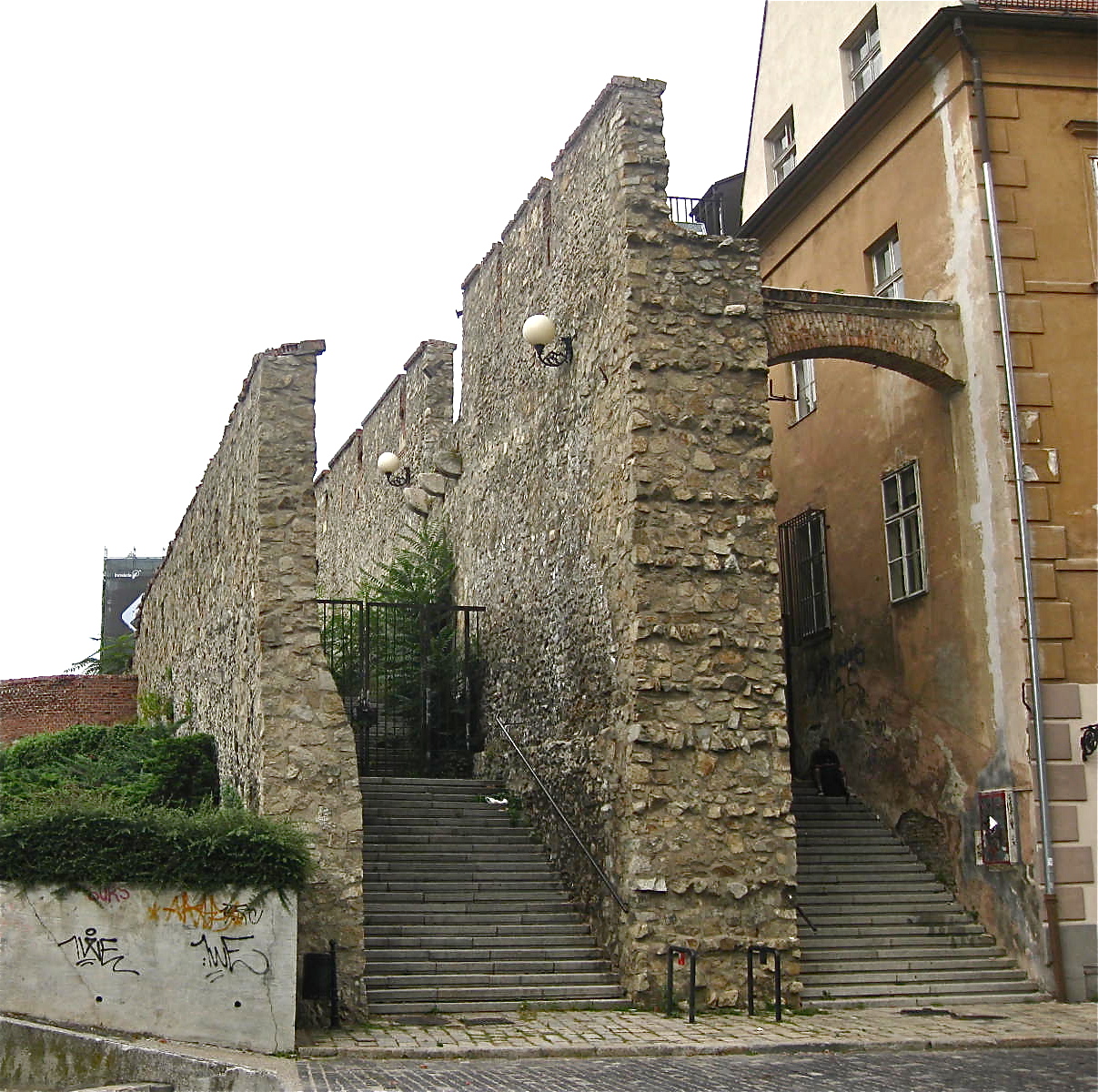
Austrian towns like Vienna liked surrounding themselves with walls. Many are still apparent other cities nearby, like this nice double wall in neighboring Bratislava, Slovakia:

Bratislava_Town_Walls_2

Austrian walled towns began appearing in the 11th century, and the one in Vienna was a feature of the town until the 19th century, when it was torn down the surrounding buildings were kept on the newly constructed  Ringstraße, a historical district. It was a showpiece for the city; Sigmund Freud used to go for strolls there.

Architecture, as Loos reminded me, is often rhetorical. The renovations of many of the European capitals in the mid 19th century was fortification of a different sort. Baron Haussmann’s renovations of Paris for Napoleon III were part modernization, and part crowd control. Long straight streets make it easier to move troops, and harder for revolutionaries to erect barricades: the Ringstraße discourages revolution, a clear and present danger when you have a ruling minority, as you had in Vienna, the main capital of the Austro-Hungarian empire.

What was really refreshing to me, examining Swedish architecture, was the lack of emphasis on fortification. Though the farm buildings were distributed around a central latrine area, it didn’t seem to be for protection; it was a practical, rather than persuasive, arrangement.

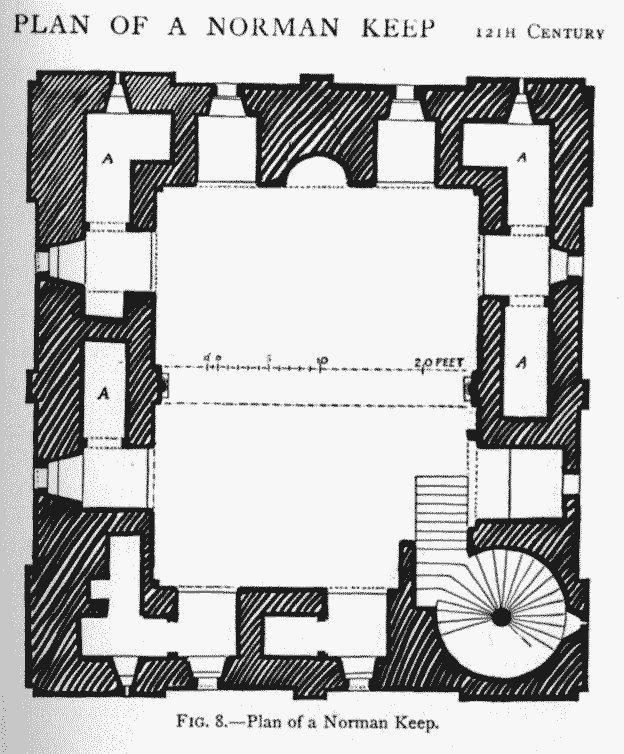
How were dwelling interiors initially divided? What was inside the big Norman keep? I found some information in The History of Everyday Things in England (1922) by Marjorie and C.W.B. Quennell that I haven’t found in more modern resources:

Keep

The plan of the keep is very much the same on all floors. The lower, or ground, floor below the entrance served as a storehouse for the large quantities of food which must have been required during a siege.

At the first floor, or entrance level, was the guard room; above this, on the second floor, was the great hall, with its galleries all around; and above that, one more floor, probably used as a dormitory. The well of the castle was in the keep so that the garrison might be sure of water in case of siege.

The staircase was in one of the angles, and lead up to a square tower opening on to the battlements, with similar towers on the other three angles of the castle. Here the guard did sentry-go 75 feet above the level of the top of the mount, so that they could see a long way over the trees and prevent surprise by the enemy.(15-16)

The small rooms (A) are generally conjectured to be the bedchambers of the principal members of the family. Googling around a bit more, I’ve identified this particular Norman keep as Hedingham Castle in Essex; what makes it of interest is the centrality of the Great Hall:

castle_hedingham_keep_greathallThe illustration, nicked from the web because I couldn’t create a better scan myself, shows a non-arched roof and a large social space without furnishings. It’s generally acknowledged that medieval furniture was all portable, tables and stools and such. This is the origin of the sort of “King’s room” that Adolf Loos was discussing in his essay on “Interiors in the Rotunda,” which became increasingly crafted to impress across the ages. The small ancillary rooms, visible in the floor plan, weren’t really useful for all that much I suspect—a bed with a tiny window/porthole to the outside.

But this does not mean that the complexes of structures weren’t differentiated. Take for example, this breakdown (including furniture) of a medieval manor, Chingford,  granted by the Chapter of St. Paul’s Cathedral, London, in 1265, to their Treasurer Robert Le Moyne:

He received also a sufficient and handsome hall well ceiled with oak. On the western side is a worthy bed, on the ground, a stone chimney, a wardrobe and a certain other small chamber; at the eastern end is a pantry and a buttery. Between the hall and the chapel is a sideroom. There is a decent chapel covered with tiles, a portable altar, and a small cross. In the hall are four tables on trestles. There are likewise a good kitchen covered with tiles, with a furnace and ovens, one large, the other small, for cakes, two tables, and alongside the kitchen a small house for baking. Also a new granary covered with oak shingles, and a building in which the dairy is contained, though it is divided. Likewise a chamber suited for clergymen and a necessary chamber. Also a hen-house. These are within the inner gate.

Likewise outside of that gate are an old house for the servants, a good table, long and divided, and to the east of the principal building, beyond the smaller stable, a solar for the use of the servants. Also a building in which is contained a bed, also two barns, one for wheat and one for oats. These buildings are enclosed with a moat, a wall, and a hedge. Also beyond the middle gate is a good barn, and a stable of cows, and another for oxen, these old and ruinous. Also beyond the outer gate is a pigstye.

It isn’t incredibly clear exactly how many buildings there were. Places are broken down by function, not by building. For example, the kitchen and bakery were generally separate buildings, no doubt due to the smells and complexities of cooking on open fires, but also because large spaces simply couldn’t be effectively covered by roofing.

A reconstruction of Edward I's chamber at the Tower of London
A reconstruction of Edward I’s chamber at the Tower of London

By the time we get to Edward I (1272 to 1307) interiors begin to change significantly. Here, we finally begin to see the sort of “private space” for a king that Adolf Loos alludes to. What is striking to me in his essay “Interiors in the Rotunda” is the distinction between public/ceremonial spaces, which are by design “rhetorical” in the sense that they must persuade the inhabitants of the social and political power of their owners. The private chamber, for Loos, is a different space entirely. While it can be poetic, it must above all be personal.

bathroom1
The Queen’s bath, Leeds Castle

Edward I’s wife, Eleanor of Castile, brought many innovations into the dwelling spaces of Kings. I really must read Sara Cockerill’s recent book, from the sounds of this excerpt:

So why does Eleanor of Castile deserve to be rescued from the scrapheap of history? One very good reason is because she was far from unobtrusive; she was a remarkable woman for any era. Eleanor was a highly dynamic, forceful personality whose interest in the arts, politics and religion were highly influential in her day – and whose temper had even bishops quaking in their shoes. Highly intelligent and studious, she was incomparably better educated, and almost certainly brighter, than her husband. She was a scholar and an avid bookworm, running her own scriptorium (almost unique in European royal courts) and promoting the production of illustrated manuscripts, as well as works of romance and history. Equally unusually she could herself write and she considered it a sufficiently important accomplishment that her own children were made to acquire the skill.

She also introduced numerous domestic refinements to English court life: forks, for example, first make their appearance in England in her household and carpets became sought after in noble circles in imitation of her interior design style. She was a pioneer of domestic luxury: she introduced the first purpose-built tiled bathroom and England’s first ‘fairy tale’ castle – both at her own castle of Leeds, in Kent. She revolutionised garden design in England, introducing innovations – including fountains and water features – familiar to her from Castile.

The fork was an important innovation, as was the interior bathroom. Jabon de Castilla, or castile soap, was an important export from Castile in the Middle Ages, so it makes sense that Eleanor would be attached to bathing. Roofs got better and the interiors of buildings were differentiated into different spaces, as Muthesius recounts, and the specialization apparent in manor complexes transferred into the interior in ways a bit unique to England, although with obvious international components.

What strikes me in all this is the transformative power of rhetorics of display. I think that Loos is right to insist that personal spaces must be individual, and the rules are simply different for public, rhetorical spaces. They can’t be directly compared at all, though we’ve been conflating them for years. As walls come down, though the physical barriers are transformed, psychic barriers between public and private are permeable.

If you look at the public display of interiors, say on Pinterest, what you see are tidy stylish public spaces meant to create desire, to persuade—not spaces meant to be lived in. Living is messy, and usually not in need of fortifications.

Interiors in the Rotunda

The Rotunde, center of the exhibition, 1873
The Rotunda, center of the exhibition, 1873

The engineer for the Vienna Rotunda was J. Scott Russell, who utilized 4,000 tons of iron. Including its topmost crown which was 60 feet tall, its height reached to 284 feet. The diameter of the dome itself was 440 feet, with a circumference of 1,080 feet and peak of 284 feet. Its structure consisted of 32 pairs of columns of iron each 80 feet tall. It is estimated that these columns, which had been reinforced with iron plating, each individually bore the weight of 109 tons. These iron columns provided the only physical support for the dome. The supporting columns were connected by an iron circular girder riveted together on the site. In a display of modern technology, this ring was then raised by hydraulic lift, with the columns placed under it as it was elevated. Radial girders 200 feet long were bolted to the girder at its top and bottom. These measurements place the Vienna Rotunda as the largest of its kind. By comparison, it was 3.17 times larger than the dome of St. Paul’s cathedral in London, 2.26 than that of St. Peter’s in Rome, and 2.22 larger than the Crystal Palace in London.

“The Rotunda of the 1873 Vienna International Exhibition”


The demands I put forth in the preceding article amount to heresy. Neither the archaeologist nor the interior decorator nor the architect nor the painter nor the sculptor should design our homes. Well, who should do it then? The answer is very simple: everyone should be their own decorator.

Then of course, we would not be able to live in “stylish” homes. But this “style,” style in quotation marks, is not really necessary. What is this style anyway? It is hard to define. In my opinion the best answer to the question of what is stylish was given by that stout housewife who said, “When there is a lion’s head on the night table, and when the same lion’s head is present on the sofa, the chest, the beds, the chairs, the washstand, in short, on all objects in the room,  then one calls this room stylish.” Cross your heart, my dear craftsmen, can you honestly say that you did not contribute to the teaching of the people to have such a nonsensical opinion? It was not always a lion’s head. But a column, a knob, or a balustrade was always forced upon all the furniture; at times it was a longer one, at times a shorter one, at times a thicker, at times a thinner one.

6c0256387fb5eaf769923b0ed2b6d1e0

This kind of room tyrannized its poor inhabitants. Alas, pity the unfortunate owner who ventured to purchase something additional for it! For this furniture can tolerate absolutely nothing else in its vicinity. If one received something as a gift, there is no place to put it. And if one moved to a new place that did not have exactly the same dimensions as the old one, then one had to give up forever the idea of having a “stylish” home. Then the Old German ornamental divan would have to be put in the blue Rococo salon and the Baroque chest in the Empire sitting room. What a horror!

Compared with this, the ignorant peasant, the poor worker, and the old maid were well off. They did not have problems like these. Their homes were not stylishly decorated. One piece came from here, another from there. Everything was mixed together.  But how can this be explained? The painters, whom one credited with some amount of taste, neglected our magnificent homes and painted instead the interiors of ignorant peasants, the poor workers, and the old maids. But how could anyone find these interiors beautiful? For we have been taught that “stylish” homes are beautiful.

. . .Naturally rooms that are not used for living are not relevant to this discussion. I will let the plumber take care of the powder room and the bathroom; the appropriate specialist will see to the kitchen. And finally, for those rooms used for the reception of guests, for celebrations, and for extraordinary occasions, I will call in the architect, the painter, the sculptor, the interior decorator. Every individual will find someone who fulfills his specific needs. For there is always a special bond between the producer and the consumer of goods, but it surely cannot be extended to rooms that are for living.

It has always been this way. Even the king lived in a room that developed with and through him. But he received guests in rooms that were created by the court architects. And when good subjects were led through the golden rooms, this sigh escaped from many a breast: “Oh he has it good! If only I could live as well as he does!” For the worthy subjects are unable to imagine their king other than with a crimson ermine coat, with a scepter in his hand and crown on his head, strolling in his park. No wonder that the good subject, as soon as he came into money, immediately went about securing for himself too these presumably royal living quarters. I am actually astonished that I haven’t seen anyone running around dressed in crimson!

Slowly but surely, however, it was discovered with dismay that in fact even the king lives quite simply. The retreat was abrupt. Simplicity was the last word, even in ballrooms. In other countries, the march of fashion once again beginning to advance, while we were preparing to retreat. There is no escape from it no matter how much—alas, very, very much! —our craftsmen would like. Taste and the desire for variety go hand in hand. Today we wear narrow style pants, tomorrow wide ones, the day after tomorrow it’s back to the narrow style again. Every tailor knows this. Yes, you will say, we could spare ourselves the next wave of wide pants. Oh no! We need them so that we will be glad to get back to narrow ones again. We need a period of simple ballrooms to prepare ourselves for the return of the elaborate ballroom. If our craftsmen want to get over the period of simplicity more quickly, there is only one way: to accept it.

At present, we are entering upon this period. One can tell that this is the case from the fact that the most admired room in the Rotunda is also the simplest one. It is a bedroom with bath, specifically intended for the designer himself. It is my belief that this may be the reason that the public is so strongly attracted to this room: they queue up to see it. The room pulses with the magic of the individual and the personal. No one could ever live in it, no one could occupy it, be totally and completely alive in it, other than the owner himself Otto Wagner.

Apartments by Otto Wagner

…The bath is a jewel. The wall cladding, the floor covering, the ottoman cover, and the pillows are all made out of the same downy material as our bathrobes. It has been kept to a subdued violet pattern; the white, the purple, and the silver of the nickel-plated furniture, toiletry articles, and bathtub provide the dominant color scheme. The bathing unit is actually made of plate-glass mounted with nickel. Even the cut-crystal faceted glasses on the washstand have been made according to Wagner’s designs, as have the attractive fixtures of course.

I am an opponent of the trend that considers it especially desirable that a building has been designed along with everything in it—d0wn to the coal scoop—by the hand of the architect. I am of the opinion that the building can have a rather monotonous appearance as a result. All individuality is lost in the process. But I draw the line at the genius of Otto Wagner. For Otto Wagner has one quality that I have found in only a small number of English and American architects: he is able to slip out of his architect’s skin and into the skin of any craftsman he chooses. When he makes a water glass, he thinks like a glass-blower or a glass-cutter. When he makes a brass bed, he thinks, he feels, like a worker in brass. All of the rest—his very great architectural knowledge and skill—has been left in the old skin. He takes only one thing with him wherever he goes: his artistry.

Adolf Loos, “Interiors in the Rotunda,” Neue Freie Presse, June 12, 1898

Jubilee

Plakat_Jubiläumsausstellung_1898
Postcard from the 1898 Vienna Jubilee Exposition

The series of newspaper articles by Adolf Loos I’ve been excerpting were written on the occasion of the 1898 Vienna Jubilee Exposition. International expositions (which this one isn’t really listed as, it’s more of a national expo) are a central organizing locus to major changes in domestic design. Bill Bryson, for example, uses the Crystal Palace exhibition (usually marked as the first international one) as his initial point of departure in his book Home.

Loos’s first selected piece begins with his reminiscence of the 1893 Columbian Exposition. Thanks to Loos, I find myself looking a bit further back to the Weltausstellung 1873 Wien [1873 World Exposition Vienna] as instrumental in the development of the movement toward arts and crafts education in the nineteenth century.

Världsutställningen_i_Wien_1873._Man_och_kvinna_i_folkdräkter_från_Järrestad,_Skåne_-_Nordiska_Museet_-_NMA.0039768
Swedish folk costumes displayed at the Weltausstellung 1873 Wien

Its motto was Kultur und Erziehung [Culture and Education]. The movement across Europe was to tie the quality of industrial products to the morality and national identity of the individual countries. What I didn’t realize, which I found out via Loos, was that such concerns were institutionalized at that time. The attempt to codify Swedish Modern at the 1939 World’s Fair in New York wasn’t an isolated moment: it was the culmination of a long journey through crafts education—and crafts education proved central in many other countries as well.

The timeline on The Austrian Museum of Applied Arts / Contemporary Arts is informative. In 1867, the Wiener Kunstgewerbeschule [Vienna School of Arts and Crafts] was founded and a building was constructed for the museum. “Uniting the practical and theoretical” is a common theme, and central to this is the mission for education. The Österreichische Kunstgewerbeausstellung [Austrian Exhibition of Arts and Crafts] opens in 1871 with the completion of buildings for both the museum and the school. The international exposition follows closely in 1873.

Preceding the efforts to embrace craft in Sweden (1899), in 1884 the Austrians establish the Wiener Kunstgewerbeverein [Viennese Arts and Crafts Association]. The ties to industry are quite direct:

Numerous well-known companies and workshops (above all J. & L. Lobmeyr), personalities and professors at the School of Arts and Crafts join this organization. Its objective is to further expand all the powers of creativity and execution developed by the city’s arts and crafts industry since the 1860s. To this end, several temporary and publically accessible exhibitions are organized at the Imperial Royal Museum of Art and Industry. Objects on exhibit are available for purchase. With these novel and lavish exhibitions, the association manages to generate the domestic and international resonance necessary for the realization of its aims. (Austrian Museum)

This sets the stage, and establishes the precedents for Adolf Loos’s desire to reject of the efforts of the School of Arts and Crafts. Through successive leaders, various historical periods were nostalgically reenacted and rejected. Similar movements occurred in the US as well, with shoddy period furniture knock-offs changing from moment to moment with the fashions, before the final commercialization of Arts and Crafts as a movement, both social and commercial. As is typical, the US was far behind the rest of the world.

In fact, one of the major foreshadowings of arts and crafts is found in Jacob von Falke’s 1871 book Art in the House , which was translated and distributed in the US by 1879. Jacob von Falke was a deputy director of the Viennese School of Arts and Crafts, becoming full director from 1885-1895, and largely credited with initiating the period of historicism in design which both the Secession and Adolf Loos raged against. The school remained affiliated with the museum until 1909, until it was split off into a separate Ministry of Culture and Education.

I think that marks a more definite move to separate the cultural and the commercial in Austria, a move which did not occur in Sweden. In the US, there was never any cultural sponsorship to begin with; it was simply left to the few academics and private relief efforts, that is until the WPA (Federal Artists and Writers Project) in the 1930s. The most interesting thing about the Swedish model to me is the maintenance of a “homecraft” organization in concert with a separate industrial craft organization. The roles seem to be conflated in Austria.

In Germany, the Deutscher Werkbund [German Association of Craftsmen] wasn’t suggested until 1899 (roughly contemporaneous to Swedish efforts) and it represented another attempt to get art into industry. An early member of the Werkbund has been repeatedly cited here, Hermann Muthesius. It wasn’t formally organized until 1907, and lacked the emphasis on traditional craft found elsewhere. The Werkbund was the progenitor of the Bauhaus.

The story of all this is exceedingly complex, and these little narratives are an effort to scatter a few bread crumbs to contextualize the source materials I’m saving here.

Interiors: A Prelude

Adolf Loos, 1922 Trude Fleischmann
Adolf Loos, 1922, photograph by Trude Fleischmann

The carpenters have displayed their products to the right and to the left of the silver courtyard. Stalls were constructed and model rooms were built for them. This is how it has been done for years at every exhibition. Thus the carpenters say to their clients: This is how you should live!

The poor client! He is not permitted to arrange his own living space by himself. That would be a pretty mess. He would not know where to begin. The “stylish” home, what a great conquest of our century, demands extraordinary knowledge and know-how.

It was not always like this. Up until the beginning of this century people did not have these concerns. One purchased furniture from the carpenter, wallpaper from the paperhanger, lamp fittings from the bronze founder, and so on. And if they did not all fit together? This could happen. But one did not let himself get carried away by such problems. In those days one decorated his home the way one outfits himself today. We buy our shoes from the shoemaker, coat pants and waistcoat from the tailor, collars and cuffs from the shirtmaker, hats from the hatter, and walking sticks from the turner. None of them knows any of the others, and yet everything matches quite nicely. How can this be? It happens because all of them work in the style of 1898. The craftsmen in the home-furnishing industry also used to work this way in earlier times, everyone in one style, the one which currently prevailed— the modern style.

But then, all of a sudden, the modern style developed a bad reputation. It would be too complex to explain why in these pages. Suffice it to say that men became dissatisfied with their times. To be modern, to think and feel in the modern way, was considered superficial. The profound individual sought to immerse himself in another era; he found happiness for himself as an ancient Greek or as medieval metaphysician or as a Renaissance man.

This fraudulence was of course too much for the honest craftsman. He was unable to participate in it. He understood too well how people ought to store their clothes in a wardrobe and how his fellow men wanted to take a rest. But now he was expected to make all kinds of chests and chairs for his customers— Greek, Roman, Gothic, Moorish, Italian, German, Baroque, classical—according to their respective spiritual creeds. Moreover, one room was to be decorated in one style, the next in another. As I said, the craftsman just could not keep up with it.

Then he was placed under tutelage. And he still finds himself in that position today. At first the scholarly archaeologist set himself up as the craftsman’s tutor. But that did not last for long. Then came the upholsterer; no one could have held much against him since he had very little to do the preceding centuries and thus could not very well be restrained from imitating old models. He seized the advantage and flooded the market with innumerable new forms. He made furniture so overstuffed that the cabinetmaker’s woodwork could no longer be seen. These pieces were hailed with great shouts of joy. The public had now had enough of archaeology; people were finally pleased to get furniture that belonged to their own era, that appeared to be modern. The upholsterer, that worthy man, at an earlier time had industriously stitched away with his needle and stuffed his mattresses. Now he let his hair grow long, donned a velvet jacket, tied around his neck a tie that fluttered as he walked, and became an artist. He removed the word “cushion-maker” from the firm’s sign and substituted “decorator” for it. It had a better ring.

Hans Makart (1840-1884) Grosses Blumenst?k [Large Flower Piece] Oil on canvas, c.1884 80 5/8 x 46 3/8 inches (205 x 118 cm) ?tereichische Galerie Belvedere, Wien
Hans Makart (1840-1884)
Grosses Blumenstyk [Large Flower Piece]
Oil on canvas, c.1884

And so the over-domination by the upholsterers began; it was a reign of terror that we can all still feel in our bones. Velvet and silk, silk and velvet. Makart Bouquets, dust, suffocating air and lack of light, portieres, carpets, and “arrangements” —thank god we are all done with that now!

But then the cabinetmakers received a new tutor. This was the architect. He was well versed in the specialized literature and thus was easily able to carry our all commissions involving his expertise in every sort of style. Would you like to have a Baroque bedroom? He will produce a Baroque bedroom for you. A Chinese spitoon? He will make one for you. He can do everything, everything, and in every style. He can design any useful object, from any period or people. The key to the secret of his uncanny productive ability lies in a piece of tracing paper for the library of the School of Applied Arts—if, that is, he has not indebted himself to the local bookseller for the sake of his own larger private library. In the late afternoons he sits glued to the seat of his drawing board and traces a Baroque bedroom or a Chinese spitoon.

. . .

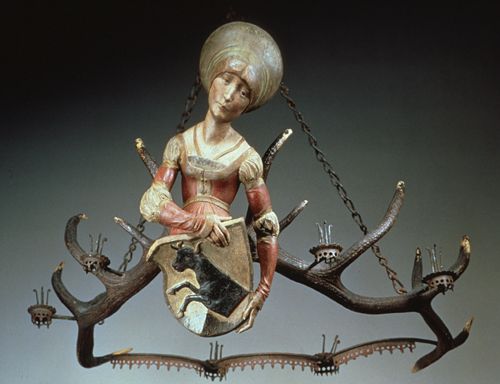
Lüsterweibchen, c. 1510–15 by Tilman Riemenschneider

In the assembly room of the Crafts Association, the Viennese arts and crafts workers were voicing their complaints. It was all Hofrat von Scala’s fault: “You see, Herr Architect,” said one craftsman to me after the meeting, “we are having a pretty bad time of it. The good times that we had are gone. Twenty years ago I could sell a lüsterweibchen for  hundred gulden. And do you know how much I could get for the same lüsterweibchen today?” He named a figure that was really quite low. I felt sorry for the man. He seemed possessed by the notion that he would have to make lüsterweibchen all his life. If only someone could convince him otherwise. For people do not want lüsterweibchen anymore. They want what is new, new, new. And that is truly lucky for our crafts industry. The taste of the public is in constant flux. Modern products will fetch the highest prices, unmodern products the lowest. So, craftsmen of Vienna, you have a choice! But those of you who regard the modern movement with fear simply because your storerooms are full of unmodern furniture do not have the right to oppose this movement. Least of all do you have the right to demand from the Austrian Museum, which must protect the interests of all craftsmen, that a position be taken that would facilitate the sale of your furniture stocks. A servant of the state may not get involved in such affairs.

Adolf Loos, Neue Freie Presse, June 5, 1898

The New Style and the Bronze Industry

Door handle to the bathroom in the Military Museum in Vienna.

But does the crafts industry itself not know what it’s best products are? Oh no. It knows as little about its own production as the poet, the painter, in fact any artist at all can know about his own art. Such an artist will always value most highly those products of his muse which have cost him the most effort and vexation. Those creations, however, which he produced almost naturally, without effort, to which he was predisposed and which bear most strongly the stamp of his own individuality, his own character—these he dismisses as not particularly important. Only the unanimous agreement of the public is able to convey to him the correct opinion of his products.

. . .We in fact have something most people lack: our celebrated Viennese good taste, of which some could even be jealous. It is only those unreasonable schools of ours which are to be blamed. They have inhibited the natural development of our arts and crafts.

But the answer to that persistent question goes like this: everything that an earlier period has already produced, insofar as it is still useful today, can be imitated. But the new phenomena of our culture (railway cars, telephones, typewriters, and so forth) must be resolved without any conscious echoes of a formal style that has already been superseded. Modifications of old objects in order to assimilate them to modern uses are not permitted. And so the rule is this: either imitate or create something that is totally new. Of course, I do not necessarily mean by this that that which is new is always the opposite of what came before.

As far as I know, this challenge has never before been expressed so exactly and so precisely, even though similar statements have been made abroad and in professional circles, and even recently in the Austrian Museum. But people have actually been working according to this principle for years now. And this is perfectly comprehensible. A copy of an old master is also a work of art. Who can forget Lenbach’s magnificent imitations of old Italian Masters in the Schack Gallery in Munich? But what is totally unworthy of being called a true work of art is the conscious effort to express new ideas in the style of an old master. It is destined to fail. This is not to say that a modern artist, through an extensive study of a particular school, through a predilection or a reverence for particular period or master, cannot make that style so much his own that his work strongly bears the spiritual imprint of his master. I only have to think of the old-master feeling in Lenbach, or the Quattrocento pictures by the English. But the true artist cannot paint now a la Botticelli, now a la Titian, now a la Raphael Mengs.

What would one think of a writer who today wrote a play in the style of Aeschylus, tomorrow composed a poem in the style of Gerhart Hauptman, and the day after tomorrow, a farce in the style of Hans Sachs? And worse, what writer would have the pitiful courage to reveal his own impotence by confessing his sources? And now let us consider a state school for poets where young artists would be emasculated by being constrained to follow this doctrine of counterfeit, where this kind of literary servitude would be raised to a principle. The whole world would pity the victims of such a method. Yet such a school exists, not for poets, but for the arts and crafts.

. . .

The School of Applied Arts sets the fashion for useful objects. In Vienna it is no easy task to get a hold of a good coal scuttle or fireplace fender! And how difficult it is to find good hardware for doors and windows! I once wrote somewhere that in the last two decades we have gotten Renaissance, Baroque, and Rococo blisters on our hands because of our door handles. There is, however, one proper door handle in Vienna to which I have access; I make a pilgrimage to it whenever I am in the neighborhood. It is located in the new building on Kohlmarkt and was designed by Professor König. But do not go there, my dear reader! They would suspect that I was teasing them if you did. That is how unobtrusive this handle is. (15-17)

Adolf Loos, Neue Freie Presse, May 28, 1998


Exposition

Adolf Loos and Elsie in Sylt island, 1921

This book contains the essays I wrote up to and during the year 1900. They were written at a time when I had a thousand things to think about. For didactic reasons I had to express my true opinions in sentences that years later still cause me to shudder when I read them. Only at the insistence of my students have I in time come to agree to the publication of these essays.

Adolf Loos, “Foreward” Spoken into the Void: Collected Essays 1897-1900, [Vienna August 1921]


When we stick close to our own turf, we never become aware of the treasures hidden at home. That which is first-rate is gradually taken for granted. But when we have have taken a look around us, outside of us, then a sudden change occurs in our estimation of our homespun products.

I left home some years ago to acquaint myself with architecture and industry on the other side of the Atlantic Ocean. At the time I was still totally convinced of the superiority of German crafts and handiwork. With pride and enthusiasm, I went through the German and Austrian sections in Chicago. I glanced with a sympathetic smile at the budding American “arts and crafts movement.” But how that has all changed! My years of residence over there have had the effect that I still today blush with embarrassment when I think of the disgraceful representation of the German crafts in Chicago. These proud and splendid pieces of workmanship, these stylish display pieces—they were nothing more than a philistine sham.

There were, however, two crafts that saved our prestige. Our Austrian prestige, that is, not the German, for here as well the Germans have nothing good to show for themselves. These crafts were the production of the leather fancy goods and the gold- and silversmith trades. They did not operate in the same way. While the producers of the former items were inclined to perform honestly in every line of work, one encountered some of the latter trade’s products in the camp of the shams.

At the time I harbored a silent rage about these objects. There were wallets, cigar and cigarette cases, picture frames, writing implements, suitcases, bags, riding whips, canes, silver handles, water bottles, everything—all of it—smooth and polished, no ornament, no decoration. The silver was at the very most, fluted or hammered. I was ashamed of these pieces. This was not the work of the arts and crafts! This was fashion! Fashion! What an appalling word! The greatest insult to the true and proper craftsman, which I still was at the time.

Of course, the Viennese bought such things gladly. They were called “tasteful,” the efforts of the School of Applied Arts notwithstanding. In vain were the most beautiful objects of earlier periods displayed and their production encouraged. In the end, the gold- and silversmiths did what they were told. They even had their sketches made by the most famous men. But the objects thus produced just would not sell. The Viennese were incorrigible. (Of course, it was different in Germany. There the wallets were overloaded with the loveliest Rococo ornamentation and found a great market.  “Stylish” was the ticket.) The Viennese individual was persuaded only with great difficulty to submit his home furnishings to the new regime. But in matters of useful objects or of his own body he followed his own taste exclusively, and here he considered all ornament to be vulgar.

At any rate, I was still of a different mind at the time. But I do not hesitate to make it clear now that at the time even the silliest fop could have surpassed me in matters of taste. The strong wind of America and England has since stripped me of all prejudices against the products of my own time. Totally unprincipled men have attempted to spoil this time for us. We were always supposed to look back; we were always supposed to take another age as our model. But all of this has now retreated from me like a bad dream. Yes, our time is beautiful, so beautiful that I could not see living in any other. Our age is beautiful to look at, so beautiful that, had I the choice of picking out the garment of any other time at all, I would reach for my own with joyful hands. It’s a pleasure to be alive.

In the midst of the general characterlessness of the arts and crafts we must recognize the great service of the two branches of the Austrian arts and crafts already mentioned. They had enough backbone not to conform to the general denial of the time. But respect must also be paid to the Viennese people, who, in spite of all the reforms in the arts and crafts, supported these two industries by their desire to buy. Today we must say confidently that it was only through the productions of leather fancy-goods and through the gold and silver industries that the Austrian arts and crafts received recognition in the world market.

Indeed, the manufacturers in these industries did not wait until the state, by introducing the English models, ended the universal commercial stagnation—a step that now has proved necessary in the furniture industry—but rather, having already gathered strength from the English ideas fifty years earlier, they were renewed and solidly established. For the furniture industry is English from A to Z. Yet, despite this fact no decline has become noticeable, as had been prophesied by pessimists in the furniture business. “England means the death of the arts and crafts.” They say the death of arts and crafts, but they mean the acanthus ornament—about which it was probably true. But our time places more importance on correct form, solid materials, precise execution. This is what is meant by arts and crafts!

(“The Leather Goods and Gold- and Silversmith Trades” Neue Freie Presse, May 15, 1898 p.7,10)

The architectural library is demanding that I give this one back, and there are many notes and expositions on craft in this slim little volume that I want to record.

International Fashion

Heine
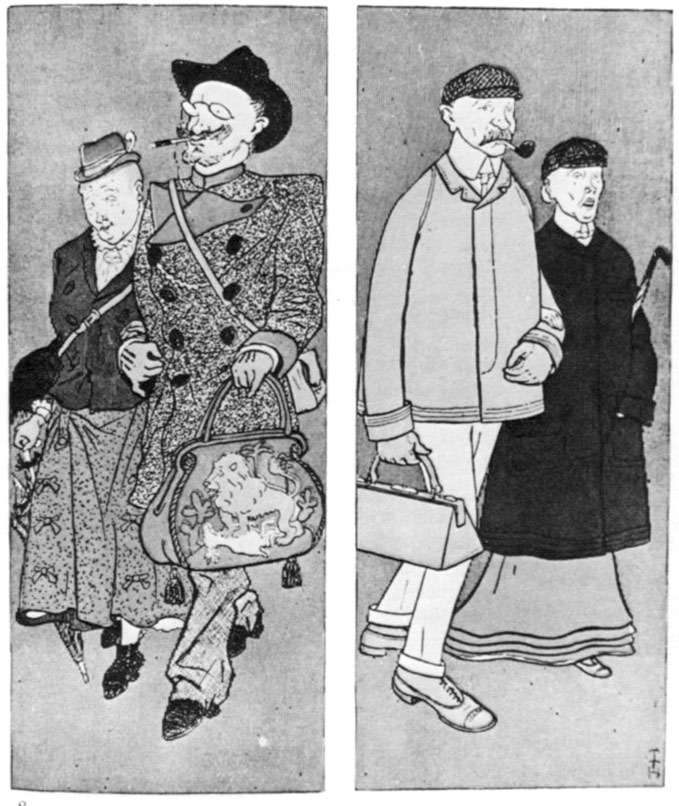
Cartoon by Theodore Thomas Heine contrasting German and English Fashions. Caption for the image at left: “Herr and Frau Schmidt look like this when they travel to London”; for the image at right: “And like this when they return after a week there as Mr. and Mrs. Smith.” From Simplicissimus: Illustrierte Wochenschrift, Munich, 1902.

An American philosopher says somewhere, “A young man is rich if he has a good head on his shoulders and a good suit in his closet.” This is sound philosophy. It demonstrates an understanding of people. What good are brains if they do not express themselves with good clothes? For both the English and the Americans demand of an individual that he be well dressed.

But the Germans do them one better. They also want to be beautifully dressed. When the English wear wide pants, the Germans point out to them immediately (I don’t know whether this is thanks to old Vischer or to the golden section) that these are unaesthetic and that only narrow pants may be considered to have any claim to beauty. They bluster, they grumble, and they curse, but nevertheless they have their trousers widened from year to year.

Adolf Loos, “Men’s Fashion” Neue Freie Presse, May 22, 1898

Swedish Design

Swedish-Dolls
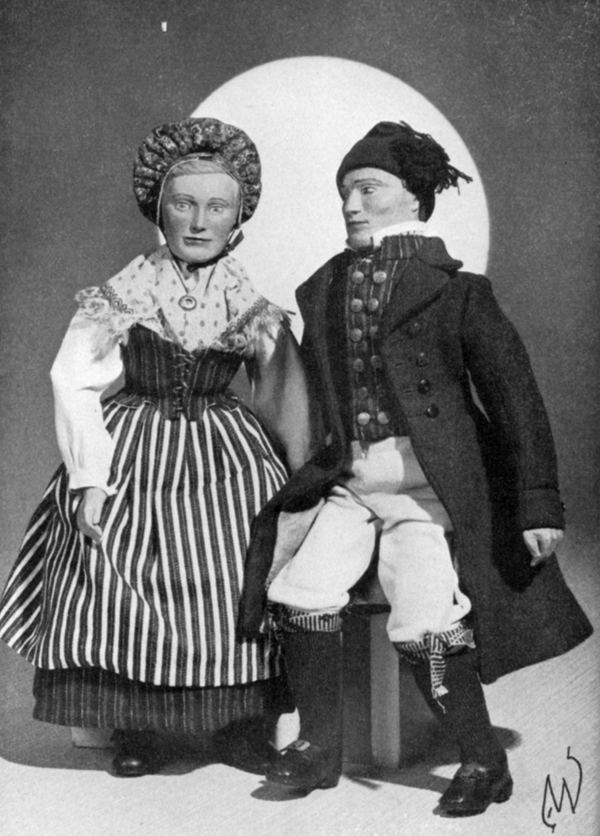
Dolls in national costumes, exact copies of originals in the collection of the Nordic Museum and Skansen, from Swedish Arts and Crafts (1939)

Other than Ikea, I really wasn’t familiar with the unique qualities of Swedish design when I steered a course that way researching domestic design. The biggest discovery of the last few years, (read: “news to me”) is that other countries not only sponsored design, but actively promoted it to improve their countries and national identities.

Not so for the U.S., sadly, where apparently our contribution is cheapening everything by cost-cutting commercial capitalism. While this happened everywhere, it was worse in the US because our government did absolutely nothing to stop it, excepting perhaps the WPA in the 1930s. But the WPA was more of a jobs program, rather than a program of “moral improvement” as the efforts elsewhere promoted themselves.

In England, they had many efforts to improve design in the twentieth century, which I encountered in my readings of David Pye and Herbert Read. In Japan, the mingei movement has elements of this, though its focus was on traditional craft rather than industrial design.

In Sweden, the effort is all the more purist and moralistic due to the socialist government structure adopted there since the 1930s. And the most interesting feature of Sweden is that it embraced both tradition and machine/industrial design. To continue from a source I located last weekSwedish Arts and Crafts: Swedish Modern —A Movement Towards Sanity In Design, I feel compelled to take a few more notes.

Clearly, they were aware of the same degradation that England was concerned with in terms of industrial products and design:

The Swedish home did not escape the debasement in taste which everywhere accompanied the advent of industrialism. The arts vegetated and handicrafts slumped with the disbanding of the guilds. The urban population rapidly grew with the great influx from the rural areas. In the dismal, crowded homes of the early industrial workers there was no opportunity for carrying on the old home craft traditions, which for centuries kept alive the feeling for form and material on the farm. Instead of being producers in a self-sufficient economy, the newly created industrial labor rapidly became the largest consumer class for ready-made factory goods. The new consumer industries were able to produce cheaply, it is true, but the output was of a low standard, due to the lack of manufacturing traditions, the debasement of material, its poor finish and form. But it was not only the recently established working class that fell victim to the first raw phase of industrialism, the taste of all groups of society quickly degenerated. (8)

Note that the crisis is not necessarily the products, but the fact that people will buy them. It’s a matter of taste. The English felt the same way, and in fact the book follows directly from this to cite William Morris. The movement to resurrect traditional craft is seen as an important element in rescuing the public taste from degradation, through the home-craft institutions. It’s a social movement, front and center—but not just of a prelapsarian nationalism, but of the desire to build a new machine society. Now, over a hundred years later, it might be considered to be a worthy “manufacturing tradition.”

Some of the reading I’ve been doing suggest that Swedish design can be productively explored along two axes: Carl Malmsten on one end, and Bruno Mathsson at the other. Carl Malmsten represents the “traditional” axis.

Malmsten-1
Carl Malmsten, Living Room interior (1939)

This interior is devastatingly familiar to me. It’s a lot like the way that my eldest brother’s first wife, Dana decorated their apartment in LA. Dana was Danish, oddly enough. Now, looking at it, all I can see is Shaker style—the clean lines, the austerity. The table really wouldn’t be out of place at Hancock Shaker village. But another interior from Malmsten, also from the New York World’s Fair in 1939, is a bit different:

Malmsten-2

This looks a lot more like modern Ikea, in terms of the wall units, but the settle in front is almost prairie style or arts and crafts. On the edge, indistinct and nearly out of the frame in the front right corner, is a more unusual cupboard type cabinet that is inlaid, which is displayed in a detail from the same catalog, Swedish Arts and Crafts:

Malmsten-3 It’s difficult to tell from the poor halftone, but, these are pastoral scenes with an almost Rocco flair. I suspect this is an homage to Gustavian design.

Malmsten, obviously influenced James Krenov’s aesthetics much more than his more famous counterpart, Bruno Mathsson.


Mathsson

Mathsson, though he was a carpenter’s son, embraced more industrial designs.

I was struck by his chairs with built in swing aside easels, as I’ve been trying to figure out how to manage my lap top in the evenings. There are modern variants of this, of course.

Mathsson was most famous for his chairs, and there’s much to be said on that front at a later time.

For now, what I’m really most interested in are the examples of Swedish kitchens displayed in 1939.

Swedish-Kitchen
In this design from G.A. Berg, the kitchen has been folded into the living room. Yes, that’s a sink back there divided from the sofa by cabinetry. Perhaps the most unusual feature though, is the dining table that slides between the two halves of the room. Yes, you can slide it into the kitchen for more prep area, and then back into the “living” area for serving. The dining table is on wheels. The mechanics of it are a bit clearer by enlarging the image above, though the general plan is apparent in another view, taken from the kitchen side:

Swedish-Kitchen-2What is clear is that they wanted to innovate, not simply in appearance, but in manners of work:

Abroad, the Swedish efforts to create applied art attuned to modern man and his needs have been termed a style, Swedish Modern.  However, by style is most often implied a distinct mode of presentation, something stationary and final. The present Swedish development in the field of industrial arts, on the other hand, is chiefly distinguished by its dynamic character. It is not a style, but rather a movement which we would like to define with the following statements:

Swedish Modern means high quality merchandise for every-day use, available for all by the utilization of modern technical resources.

Swedish Modern means natural form and honest treatment of material.

Swedish Modern means esthetically sound goods, resulting from close cooperation of artist and manufacturer. (13)

Happy Day on Happy Mountain

ext-nu-comp1aI had to steal this image from Urban Rancher’s blog. It’s a drawing of a cabin that became a reality, one of thousands of “tiny houses” that have been all the rage for the last decade or two. I note that this man’s plans include having a separate tool shed nearby (already built in 2010). In the future, he also wanted to add a kitchen/bathroom building with plumbing, etc. I was reminded of one of Chris Schwarz’s famous dictums (about workbenches, I think): “Invent nothing.”

It seems as if most of the the cabin porn floating around on the internet is placed there as if it were a modern invention. Researching Swedish design lately, I was struck by the downright organic progression that is commonplace in many “national” architectures—the transition from farm to manor house.

shed-kit-from-aboveOn tinyhousedesign.com, I note that some enterprising contemporary designer has come up with a “shed cluster concept”:

To make this little group of sheds habitable you’d probably want to build each shed to serve a purpose like a bathroom, kitchen, bedroom, family room, office, studio, etc. Some of your sheds could even serve a combination of functions.

I noted a similar design around a central patio for a mountain vacation cabin, implemented off the drawing board in Microshelters when I had that book out from the library a few weeks ago. Enterprising readers might note that we have a concept just like this already— it’s called the residential home.  The drawback noted by this designer is that the central area would make it difficult to traverse from shed to shed in inclement weather, making this design more suitable for temperate climates. A common roof for the whole structure might be more practical, but you’d have to worry about snow loads and whatnot—returning, of course, to the typical residential home.

Curiously, I had noted that English manor homes were often designed around an open courtyards, or they had courtyards adjacent to the kitchen for easier management of supplies and raw materials. The temperate climate idea made some sense, that is until I started looking into Swedish farm houses. The plans in the brochure I linked a few days ago had some intriguing configurations, buildings around a square (as drawn above) and also U and L shapes. I finally broke down and started typing the Swedish language words surrounding those drawings into a search engine with very productive results.

Gård_i_Brösarp

This is an example of a Sydsvensk gårdstyp; you might note the similarity with the “shed cluster” above. The Swedish Wikipedia page (via google translator) lists a source from 1922 for its content, noting that “The farms are characterized by a fully enclosed courtyard, normally [the] house is half-timber. Unlike the northern Swedish farms have the sydvenska traditional manure pile located inside the courtyard.” There are several listings for regional variants, somewhat corresponding the the types in the BuildLLc brochure.

Moragården,_flygfoto_2014-09-20

The Nordsvensk gårdstyp looks essentially similar, but, as the above entry noted the manure pile is inside the courtyard. There’s more information, though:

In Dalarna, where the real inheritance principle applied, were also farm buildings in the square were missing, or siblings through inheritance broken up parts of the yard and started the construction of adjoining farm plots, which are partly assembled.

In the early 1800s begin to modern secluded rows of barns appear on the pastor farms, but it will take until the end of the 1800s before modern building techniques begin to break up the traditional courtyard pattern. Today there are almost completely preserved farm plots of heritage centers and cultural history museums, where they often reconstructed.

I noted in my reading, that the compound concept is often groups of families or friends bonding together with their tiny homes, like the Llano River Compound, aka, the Llano Exit Strategy or this vacation home outside Ontario. It’s a regular 12th century innovation. Dalarna, by the way, is also where the Larssons scavenged all their farmhouse furniture.

The oldest variant of the farmhouse compound concept in Sweden is the Centralsvensk gårdstyp. The clustered compound, from my readings on English manor houses, began as a defensive fortification strategy. The Centralsvensk gårdstyp lacks conspicuously lacks these features.

Harkeberga The caption for this photo is translated as:

Härkeberga chaplain farm from the 1700s is an example of a central Swedish gårdstyp. In the middle of the picture is stable that divides the courtyard of the manor house and farmyard.

So, rather than circling the wagons for protection there is a linear relation between the “manor” house and the farmyard, often with latrines and manure piles in the middle. Manor house, in the Swedish wikipedia entries, is defined as the house on a farm that is neither barn, stable, nor equipment storage. That’s a bit different from the English tradition; different social customs dictate similar structures, but different pathways from here to there.

To summarize, the Swedish farm house usually features some sort of outdoor “shared space” between buildings of differentiated functions—at the center, often, there was a pile of manure (both human and animal, latrines were usually located there as well). Excepting, of course, in the south where the manure is kept outside. Manure management is important.

NMA.0063326_Gårdsinteriör_från_Triberga,_Hulterstads_sn,_Öland
Farm Inside Triberga , Hulter City parish , Oland in 1906. The farm burned down around 1925.

The impulse to “divide and conquer” by separating out functional elements is constant in human dwellings. Before the factory “assembly line” there was the farmhouse and manor house structures. Hermann Muthesius really explicates it nicely:

The most distinctive feature of any English house, even from the outside, is its domestic quarters. The continental observer may find that the residential quarters are not so very different from what he is used to, but the domestic quarters come as a total surprise. He knows the kitchen only from its insignificant status in the continental house and is now confronted by a full-grown domestic organism that amazes him not merely on account of its size but also its comprehensiveness. Whereas on the continent the kitchen is the room in which every aspect of household management takes place, the room in which not only the cooking is done but in which servants spend their time and take their meals and in which all the cleaning is done, in the domestic quarters of the English house the management of the household is broken down into a dozen different operations, for each of which a room is provided. (The English House (1908), p.95)

Obviously, for Swedish farms, manure management seems to have been the center of evolution; in the English manor house, it’s an army of human servants each fulfilling a different task requiring separate accommodations: the institution of service.

Leaving aside the complexity of the English manor house kitchen for the moment, let’s take a look at the way that Muthesius describes the evolution:

Part of the reason for this phenomenon lies in the historical development of the English house, which has largely developed out of the country farmhouse. In the Middle Ages the kitchen was always a separate building, usually centrally planned and standing on its own, whereas store-rooms were directly adjacent to the end of the hall where the entrance was. It was not until the great social changes of the fifteenth century that the kitchen was moved into the house, where it joined the other domestic quarters to form the domestic wing as it appears from there onwards. When Inigo Jones brought the Palladian house to England and abolished all practical considerations at a stroke, the domestic quarters were moved into the basement, where they had to get along as best they could. Or else they were torn apart and set down arbitrarily in outbuildings attached to the main house by colonnades. This period saw a complete break in the development of the domestic offices. So that with the arrival of Romanticism, when the English house burst the bonds of Palladianism, they extended and spread themselves with greater freedom. They surfaced once more from the cellars and were from now on grouped to form a self-contained set of rooms on ground-level. Indeed, as though by way of compensation or long years of neglect, the generation that was now at the helm treated them with redoubled affection, and the main contribution of the nineteenth century to the development of the English house may  almost be said to lie in its ingenious development of the domestic offices. (ibid., 95)

One can see echoes of Muthesius’s contention that the English were more regimented than continentals, in the way he describes the matter of “domestic offices.” In discussions of domestic architecture, virtually all writing of the twentieth and twenty-first centuries for that matter places the kitchen at the center of household architecture and management.

The Swedes, particularly in the mid-twentieth century, also had strong thoughts about kitchens. That’s where I’ll try to pick this up next time. The countervailing trend against to the urge to expand homes is one which simplifies and collapses things together.