Secondhand World

30 year watch
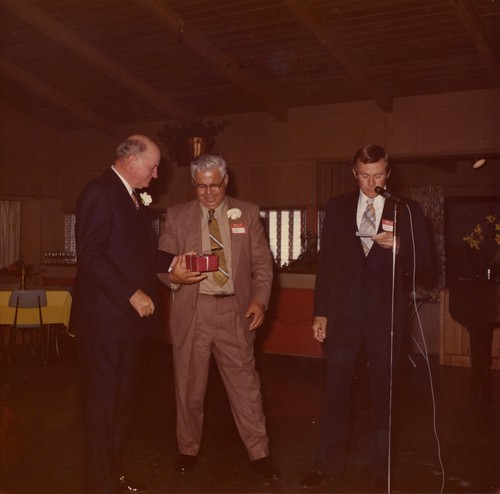
My father receives his thirty-year watch for the benefit of the cameras

Deliberately, on every historic occasion, we piously fake events for the benefit of photographers, while the actual event often occurs in a different fashion; we have the effrontery to call these artful dress rehearsals “authentic historic documents.”

So an endless succession of images passes before the eye, offered by people who wish to exercise power, either by making us buy something for their benefit or making us agree to something that would promote their economic or political interests: images of gadgets manufacturers want us to acquire; images of seductive young ladies who are supposed, by association, to make us seek other equally desirable goods, images of people and events in the news, big people and little people, important and unimportant events; images so constant, so unremitting, so insistent that for all purposes of our own we might as well be paralyzed, so unwelcome are our inner promptings or our own self-directed actions. As a result of this wholly mechanical process, we cease to live in the multidimensional world of reality, the world that brings into play every aspect of the human personality, from its bony structure to its tenderest emotions: we have substituted for this, largely through the mass production of graphic symbols—abetted indeed by a similar multiplication and distribution of sounds—a secondhand world, a ghost-world, in which everyone lives a secondhand and derivative life. The Greeks had a name for this pallid simulacrum of real existence: they called it Hades, and this kingdom of shadows seems to be the ultimate destination of our mechanistic and mammonistic culture.

Lewis Mumford, Art and Technics excerpted in Vicki Goldberg’s edited collection Photography in Print (381-382).

I continue to be fascinated by Mumford’s iconophobia, as he channels Plato’s mistrust of mimesis. To Mumford’s credit, as the passage continues he makes it clear that what he fears is not the iconography of art and artists but rather the symbols created for and by the masses. What I wonder is this: is the smiling obligatory snapshot the symbol, or is it the watch?
30 year watch    

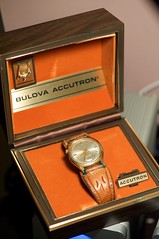
The damn thing never kept time. It never had any utility as a watch; regardless of the claims of the commercials. It was a symbol, and not a happy one for my father. My father always smiled in pictures, even when he was irritated. The whole concept of a secondhand world, filled with technologies (either of accuracy or reproducibility) would have been incredibly foreign. You took the watch that the world offered for your service, and you moved on. He was bitter, because in the end everyone he knew was dying and the company that awarded the watch would not grant him what he really wanted: a transfer back to his home state of Oklahoma. He wore cheap Timex watches until he died, but he never threw the Accutron away. It was symbolic.

The conferring of the watch was also symbolic, but not in any particularly damaging way. I think Mumford really exaggerates that part. Dad had to get dressed up and go to a studio photographer in town to get his likeness taken for the company newsletter. Mom happily hung onto that picture as well. The significance, I think, is not in the symbols but in the way we act. Symbolic inducement, to use the old speech-com term for visual rhetoric, is real. But what we do matters much more than what our social rituals symbolize.

We have never lived in a non-multidimensional space. Such theories of simulation (as manifest in Baudrillard more recently) are to me, worse than useless. They distract us from the reality of our rituals and the physicality of our products—especially our recorded products. The symbolic has never been the center of action, but its periphery.

A symbol-worker never grew a tomato. My father did. He didn’t live in a secondhand world. Symbols remained in their place, reserved for special occasions or filed in a seldom revisited drawer.


June 26, 2000

Symbolic Imperfections

imperfection.jpg Jeff Ward, 1976

I thought of this picture today while reading an excerpt from Lewis Mumford’s Art and Technics (1952):

The fact is that in every department of art and thought we are being overwhelmed by our symbol-creating capacity; and our very facility with the mechanical means of multifolding and reproduction has been responsible for a progressive failure in selectivity and therefore in the power of assimilation. We are overwhelmed by the rank fecundity of the machine, operating without any Malthusian checks except periodic financial depressions; and even they, it would now seem, cannot be wholly relied on. Between ourselves and the actual experience and the actual environment there now swells an ever-rising flood of images which come to us in every sort of medium—the camera and the printing press, by motion picture and by television. A picture was once a rare sort of symbol, rare enough to call for attentive concentration. Now it is the actual experience that is rare, and the picture that has become ubiquitous.

. . . We are rapidly dividing the world into two classes: a minority who act, increasingly, for the benefit of the reproductive process, and a majority whose entire life is spent serving as the passive appreciators or willing victims of this reproductive process.1

Around 75 or 76, I was engaged in trying to make sense of William Blake’s collected works (in a pilfered Modern Library Edition without illustrations). Like many I suspect, when I found S. Foster Damon’s Blake Dictionary at the local Pickwick bookseller down at the Valley Plaza Mall I thought I had found the keys to the kingdom. All a person had to do is figure out what his symbols meant, and you could extract the meaning, right?

I didn’t really think of it in those terms, I suspect— it was more a matter of figuring out what the words meant and why he chose those specific ones. I didn’t really know what a semiotic or symbolic approach was at the time; I was in that cusp between high school and college. My photo teacher, Chris Burnett had recently stepped down as chair of the English department at Foothill high and was willing to help me with both Blake, and photography. He didn’t really know that much about Blake, so he didn’t really discourage me from relying on Damon, nor did he say anything about trying to read the words apart from Blake’s images. For all I knew, Damon’s magic decoder ring actually worked. I think I spent most of the fall of 1975 trying to make sense of Blake, culminating in reading Milton’s Paradise Lost in the spring of 76 in a last ditch attempt to figure Blake out. I wanted more context.

The oblique connection between the Mumford passage and the Blake story is simply this:

The Giants who formed this world into its sensual existence and now seem to live in it in chains; are in truth. the causes of its life & the sources of all activity, but the chains are, the cunning of weak and tame minds. which have power to resist energy. according to the proverb, the weak in courage is strong in cunning.

Thus one portion of being, is the Prolific. the other, the Devouring: to the devourer it seems as if the producer was in his chains, but it is not so, he only takes portions of existence and fancies that the whole. But the Prolific would cease to be Prolific unless the
Devourer as a sea recieved the excess of his delights.

William Blake, MHH16; E40

Blake saw the same division into creative/consuming classes from the opposite side. The “cunning” labor under the illusion that they are exploiting artistic products when the process is ultimately more symbiotic in nature. Artistic production, in Blake’s estimation, is connected with courage: the courage to be taken, and as is often the case, to be taken wrongly. Note that Blake also references sensual existence as the antecedent to  these difficulties. 

Which brings me to the photograph at the top of the entry, a bit of juvenilia really. My brother David thought that this picture could be read symbolically. “You should call it ‘follow the leader’,” he claimed. With typical irony, David’s point was that the guy in front always gets beaten-up the worst. I never thought of that. I was simply attracted to the funky silver spray paint that was dressing up the old poles, creating odd textures in conjunction with the asphalt (and oddly congenial to the “N” surface matte paper that I printed the original on). 

Context explicates attempts to explain the image, not the image itself. David was a technician for IBM and well-versed in corporate culture. I had departed high school, and was working on prints for review at Bakersfield College for my first class with Harry Wilson. It’s pretty understandable that we’d look at the same image different ways. To his credit, I never once heard Harry Wilson offer a symbolic critique of a photograph. He looked at this one  for a moment, solicited reactions from the other students (they liked it) and then as I recall we simply moved on. Years afterward, I think the image popped into my head when I started noticing triadic compostions, but not for long. I can think of far better examples (with regression even). Retroactively, I suppose I can always generate some reason to find this image interesting

Harry was right. It’s best to just move on. The problem with the search for symbolic meanings in a symbolically saturated world is that they tell us more about the person doing the interpreting than they do about the true sensual condition of the world. Though one could make a case for iconology or iconography, it seems a better move to be prolific.

Mumford’s paranoia seems largely unfounded to me. It is a sort of knee-jerk, reflexively imbuing images with symbolic rather than actual significance that is the problem, not the attendant multiplication and reproduction. The divide between producer and consumer may or may not be exacerbated by technology– but it seems pollyannaish to suggest that this gap will ever be closed.

Symbolic contexts never explain the pragmatic deployment of communication strategies. Twenty-years on, taking many classes with R. Paul Yoder at the University of Arkansas, I remember invoking Damon’s symbolic approach to Blake. Yoder’s response was always to say, “that may be true, but what actually happens in the text?

Why do we care about certain things and have aesthetic sensual reactions to them? I don’t think that semiotics can ever get you closer to understanding that. One of the biggest ways of defusing the energy of aesthetic responses is by classing them as symbolic action rather than action.

Now I look at the picture, and the implied action: “why would anyone paint those beat-up poles bright silver?” and move on, quickly. There are more profound actions/questions to address.

Harry was right. I’ve had lots of teachers who were right over the years. The further I get away from the days that made me, the more I understand the context. But the real kicker is feeling like I still don’t understand the text at all.

1 Reprinted in Vicki Goldberg’s edited collection Photography in Print (381-382).

The Late Barbara Billingsley


RIP

“It ain’t a privilege to be on TV
and it ain’t a duty either.
The only good thing about TV
is shows like ‘Leave it to Beaver.'”

“‘Shows with love and affection’,
like mama used to say.
A little Mayberry living
could go a long way.”

from Greendale by Neil Young

I was celebrating having located the limited edition audiophile LP set of Greendale when Barbara Billingsley died. I used this clip from Airplane for years to teach the problems of bridging discourse communities (in Tech Writing classes). Tech writers just never get any respect either. Now that I basically live in Mayberry, the loss (and humor) seems even more poignant.

A product that would fail you


From I Need that Record (bonus material)

One of the most common critiques/observations about photography is that it interferes with experience. It is commonplace to assert that all photography is elegiac in nature; it is only slightly less commonplace to compare photography with collecting. It seems productive to examine the relationship of shithoarding (Mike Watt’s colorful description of collecting), time travel, and experience.

Watt’s observes that young people don’t think about the future (and the certain loss of the past) much, favoring instead to dwell on experience and social interaction is well placed. But when it comes to music, we all are not blessed with having tons of live venues just outside our doors. Most of us, historically, have had to rely on records (or CDs, or MP3s depending on your vintage). In that way, the modern experience of music is also elegiac. As a kid, I was just becoming aware of the majesty of Jimi Hendrix’s music when he died. He was long dead by the time I had collected all of his records. It’s not always that extreme, but I think more people discover bands after they don’t exist anymore than discover them in their prime. Does that make these musical experiences elegiac or otherwise inferior to the sense of discovery of new art? Is music appreciation always tied to nostalgia, to shithoarding, to shadow worlds imitating more primal experiences?

From this perspective, recordings (visual, verbal or textual, and musical) are always products that fail. They aren’t originary experiences; they are commodifications of experiences: products meant to be consumed and thrown away or perhaps hoarded. MP3s certainly seem disposable. They are infinitely replicable, and therefore not precious. The same is true of CDs (as a storage medium rather than objects). Vinyl still has that mystique as collectable objects, but it’s connected to the imperfect (read physical) nature of their production and distribution. Paper fades, but it also holds a sort of physicality of touch that more pure repositories of data don’t have. The physical, like life, is riddled with imperfection.

What is missing in this theoretical cul-de-sac is the idea of recordings as social artifacts. As social artifacts, recordings attain a degree of perfection beyond the data they contain. A record doesn’t just simply have value as a commodity, it has exhibition value. It’s interesting to me that Chuck Close from the beginning sought museum sales far more than collector sales for his laborious works. In fact, the lovely self portrait of his that I admired in Minneapolis originally sold for a paltry $1500 or so, just so more people would see it. No one seems concerned about limiting their art experiences to “live painting” rather than dead ones. 

Regardless of replications, I would argue that sincere confrontations with recordings are atemporal rather than elegiac. It’s a matter of how the recording is performed in a social context. Paintings are grouped and regrouped incessantly; so are record albums. Photographs are the most disposable of all though— without an elegiac function, most photographs have difficulty maintaining sustained interest. That is, unless you are a working photographer trying to hone your craft, or an educator or historian attempting to illustrate or simply understand another place and time. The time machine factor always lurks; but we always experience recordings now rather than then. Yes, they have a documentary (or record) value that can be commodified, but the experience of records is social and atemporal.

An interesting take on these matters was recently published (in a buyer’s guide, imagine that!) by Robert Harley of the Absolute Sound:

My friend Mike was at a hi-fi show with the manufacturer of an expensive turntable when a showgoer asked the manufacturer how much the turntable cost. When he was told that it was $75,000, the showgoer replied in shock, “That’s a lot of money for a turntable.” Mike instantly shot back, “Yes, but it’s cheap for a time machine.”

My friend’s view, in addition to being a brilliant witticism, is dead-on perfect; audio components are not things to be possessed, but facilitators for connecting you with music. A turntable doesn’t spin records, it transports you across time and space to those magical moments when extraordinary music-making occurred. It lets us in on the exuberance, tenderness, joy, and despair that can be felt by human beings.

I disagree that the time machine metaphor is “dead-on,” simply because most modern recordings are synthetic; rather than being any sort of event that can be recaptured, they are imaginative products that cannot be located precisely in time. This nostalgic and wistful review of a Mazzy Star album is a case in point. But Harley also explores music as shithoarding vs. social activity:

I see high-end audio from my friend Mike’s perspective. Quality audio equipment isn’t about consumption and materialism, but about experiencing and enjoying one of life’s fundamental pleasures. Sitting at home listening to music (and sharing it with others) is as much a return to simplicity, basic ideals, and valuing experience over possessions as I can imagine. A high quality audio system isn’t a shrine to technology or wealth, but a vehicle for exploring the world of music.

With that different view of high-end audio, the contemporary trend toward experience over possessions, of nourishing our core needs rather than encouraging mindless consumption, should embrace what high-end audio brings to the table— hearing your favorite music wonderfully reproduced night after night. Whether a turntable (of any price) is a thing on your equipment rack or a time machine isn’t determined by the turntable (the object) or it’s owner (the subject), but rather by the relationship between the two. The message from our community needs to be more about time machines and less about gear.

The peroration is decidedly odd, given this is from the 2011 High End Audio Buyers Guide which is filled with stratospherically priced hardware. There are several articles claiming a “democratization” of experience (by low-cost home theater, no less) but little evidence to support the claim that good sound can be had on the cheap. A “bargain” in here has many zeros behind it, save a few token items which are consistently trotted out (including my favorite speakers, the Magnepans). Where is the content that isn’t about “consumption and materialism”? The only article that qualifies is the recommended recordings list.

I fail to see any contemporary trend for “experience over possessions” at work right now. People simply have less money to hoard possessions, or to spend on experiences for that matter. Music rates highly on my list of simple pleasures, and I enjoy good gear— not as a time machine but rather as a sort of “study aid” to the human experience.

Music’s products have seldom failed me; neither have photographs. Both reward sustained attention.

White, Blue, and Brown

HarMar
It’s very clean.

When I moved away from Minnesota a year ago, I was immediately struck by how large it looms in my imagination. As usual, I didn’t really write that much about it because my thoughts were overwhelmingly positive. Positive things are sort of boring to write about. Looking at the tag clouds, it seems like the things that I have mixed or negative feelings dominate my writing. Like Walker Evans. I have a love/hate thing going with him and always have. But Minnesota, well, it’s nearly all love.

There were two primary colors that dominated during the time I lived in the Twin Cities: white and blue. White from snow, of course, but also white from the fastidious scrubbing of most of the spaces I spent time in. The cold takes away all the smells too; and the cold there is quite blue. When the skies would get clear, that’s when it would get insanely cold.

I loved it. I just can’t really think of anything bad or controversial to say about it. It felt like a spiritual home from the moment that I set foot there. I hope I can go back someday. 

Of course, my other spiritual home is the San Joaquin Valley (Bakersfield). But I wouldn’t want to go back there for longer than a few days. I can think of lots of bad things to say about it. Its color was dirt brown, but Bakersfield’s another story.

The most perfect place is where you are right now.

April 1983
A motel next to an RV dealer on Union Avenue, Bakersfield, CA

I’ve been thinking a lot lately about places (and perspectives on them). I don’t think that I approach place in the same way as a lot of people, perhaps because of where I grew up. Coming of age in the 1970s, the tradition in photography (especially in California) was dominated by Ansel Adams and his descendants. Not that there’s anything wrong with that.

But those photographs did not describe my world, my home. When I looked out the window I saw something completely different. But it would be myopic to suggest that place is simply a matter of geography/time. People are mobile creatures, and perhaps always have been. It shocked me how far many photographers of the nineteenth century were able to travel, aided by technology or not. But perhaps it’s communication media that have had the greatest effect on leveling things, creating uniformity when there wasn’t any uniformity before.

I remember taking linguistics classes that explored the subtleties of inflection/pronunciation and meaning vs. places of origin (i.e. home). California is fairly nondescript linguistically, but I didn’t even test positive for California idioms. My speech patterns contained artifacts of most of the regions in the US. Talking to my mom, she told me that I learned most of my language and pronunciation from the TV. I watched a lot of TV growing up. The dissonance between the images I saw on television (those people didn’t look like anyone I knew, though the places seemed oddly familiar) and the images I saw in real life was pretty jarring. Just the same, I learned a lot from the box.

No one I knew ever confused TV with real life; “reality TV” is the ultimate absurdity. I think that what TV homogenized is not our lives, but rather our dreams. It sets a horizon that most of my generation never strayed far from. What has this to do with the places we live? Not much, I suppose, other than to promote a disconnect between ideal places and actual places: since we don’t live in pristine nature we make pilgrimages to it and some even fantasize about living there. Sometime around age 18, I turned the box off; I didn’t own one for a while, until they decided to put music on it (but that’s a different story).

I’ve mentioned before that I started collecting and sorting images when I was a teen. Again, these were idealized images and I was always trying to figure out just what made them ideal. Then, for lack of anything else to do I suppose, I went to Bakersfield College (the high school on the hill) and met Harry Wilson. Harry was a firm believer in the “garbage in, garbage out” school of picture viewing. Looking at crap images all the time drove you to imitate and produce more crap advertising images. This sort of penchant for imitation over innovation seems like a given now. The cornerstone of a liberal arts education is to view/read only the best and brightest so that you can converse with the best and the brightest. I dropped out of college then, but I developed more refined viewing habits when I was there (1976-77).

It was during those years that I was first introduced to conceptual art, and really became fond of the practice of landscape photography. When I first saw Friedlander and Winogrand it was like an icepick in the forehead, but what made me fall right over was interaction with my high school photography teacher who had taken a sabbatical in those years to complete his MFA at Cal State Bakersfield. It was Chris Burnett that introduced me to the idea of conceptual landscapes. I started following formulas of a sort, plotting coordinates on a road map of Bakersfield and Kern County to drive to random locations and take photographs. This odd procedural move helped take the idealization out of the process. While it was hard to stop idealizing the locations, being confronted with decidedly non-ideal subject matter constantly forces you to come up with more interesting ways to represent the world. 

The problem with this maneuver, is that it forces your thinking into a sort of grid. Not that there’s anything wrong with that (it works fine for Chuck Close). This just didn’t satisfy me totally, so I would head out to the Kern River. I was always torn between a gridded, systemic approach to things and an more organic and loose approach. But there has always been one constant:

I think that the best place to be is where you are. 

Going back trying to tag my ramblings, I encountered an entry from 2001 where I mentioned taking a findyourspot survey (remember surveys? How 2000!) that suggested that the best places for me to live were all in the South. I took the survey again (it still exists!) to find that the best places for me to live are all in Minnesota and Wisconsin. Give it another year, and I’ll bet it’s saying that my preference is for Central New York. Our ideal expectations are always inflected by what we are viewing/hearing at any given moment.

North Country Strip Mall
I was here a few days ago

Chuck Close and Far

near and far.jpg

I was standing by the side of a backroad near Clockville when a cow came up to me (true story). I’ve been struggling with trying to get some sort of perspective on what I want to do next. The majority of my adult life I would have tagged myself as a photographer. It’s sort of a strange thing to do, considering that I have little in common with most photographers and find it hard to talk to most of them. If it’s a club, I always avoided joining because I just didn’t like the members. I do like cows though; My dad raised them pretty much as pets. As barbaric as it may sound, we did indeed eat our pets though. But I digress.

There was this sort of tableau in this field that I found interesting, but it kept changing when I tried to photograph it. I was never quite happy with any of the arrangements that presented themselves. Eventually, I just MMS’d a picture from my phone to my wife and drove on.

Cows

It seems like I can only photograph what is close to me. I’m weird that way. I remember that was a major difference between myself and Harry Wilson, one of the few “photographers” I ever really knew and liked. Harry would always travel (usually overseas) to photograph. He never liked what was next to him as subjects for photographs; he required the sort of distance and strangeness that travel brings before he felt creative.

I have become fond of traveling, particularly cross-country, in the last few years. It really helps to clear your head and allows you to think complex issues through. But when it comes to photographing things, I am always drawn to those things that I already know. I feel that if I can just look closer at those mundane things, if I can see them from new perspectives I can learn useful things. So when I travel, rather than looking for the unusual, I tend to be drawn to the usual. Like cows. And blue or yellow flowers. Krista and I came up with that theory travelling across the upper midwest: this country is really composed of cows and blue and yellow flowers.

Then again, I know that I fall prey to one of the central myths of photography. Most everyone of a certain age knows it. In the movie Blow-Up, a photographer just keeps zooming in to find more and more detail in one of his negatives. Eventually, he finds evidence of a murder. Robert Capa famously claimed that if your photographs aren’t good enough, you aren’t close enough. The basic tenet of photorealism is that photographs are seamless, containing endless meaning if we just keep zooming in.

I was shocked to find, searching my blogs, that I never have really written anything about Chuck Close. In the last few years, he has been increasingly thought-provoking to me. He went through a phase of photorealism in his painting, but soon moved to breaking things down into blots and motifs mapped on a grid. I think he has one of the best theories of near and far of any artist I know. Up close, things are personal and idiosyncratic.

You have to step back to really get the sense of Chuck Close’s paintings as “images.” Looking closer doesn’t really tell you something new. It tells you something different.

Cow Cube

My mom kept a little photo cube with pictures of our cows. It dawned on me, reflecting on my time in Clockville, that the problem of near and far (and locating a meaningful perspective) is not simply a matter of space, but also of time. We are never the same from one moment to the next, and even though there seem to be some constants (like cows), meaning is always contingent and fleeting. But the universe isn’t quite as random as it seems, if you can locate the right place to stand.

On that same drive down Oxbow Road, I passed a farm that claimed to be the birthplace of the first registered holstein cow. This place feels more like home all the time.