The Late Barbara Billingsley


RIP

“It ain’t a privilege to be on TV
and it ain’t a duty either.
The only good thing about TV
is shows like ‘Leave it to Beaver.'”

“‘Shows with love and affection’,
like mama used to say.
A little Mayberry living
could go a long way.”

from Greendale by Neil Young

I was celebrating having located the limited edition audiophile LP set of Greendale when Barbara Billingsley died. I used this clip from Airplane for years to teach the problems of bridging discourse communities (in Tech Writing classes). Tech writers just never get any respect either. Now that I basically live in Mayberry, the loss (and humor) seems even more poignant.

White, Blue, and Brown

HarMar
It’s very clean.

When I moved away from Minnesota a year ago, I was immediately struck by how large it looms in my imagination. As usual, I didn’t really write that much about it because my thoughts were overwhelmingly positive. Positive things are sort of boring to write about. Looking at the tag clouds, it seems like the things that I have mixed or negative feelings dominate my writing. Like Walker Evans. I have a love/hate thing going with him and always have. But Minnesota, well, it’s nearly all love.

There were two primary colors that dominated during the time I lived in the Twin Cities: white and blue. White from snow, of course, but also white from the fastidious scrubbing of most of the spaces I spent time in. The cold takes away all the smells too; and the cold there is quite blue. When the skies would get clear, that’s when it would get insanely cold.

I loved it. I just can’t really think of anything bad or controversial to say about it. It felt like a spiritual home from the moment that I set foot there. I hope I can go back someday. 

Of course, my other spiritual home is the San Joaquin Valley (Bakersfield). But I wouldn’t want to go back there for longer than a few days. I can think of lots of bad things to say about it. Its color was dirt brown, but Bakersfield’s another story.

Chuck Close and Far

near and far.jpg

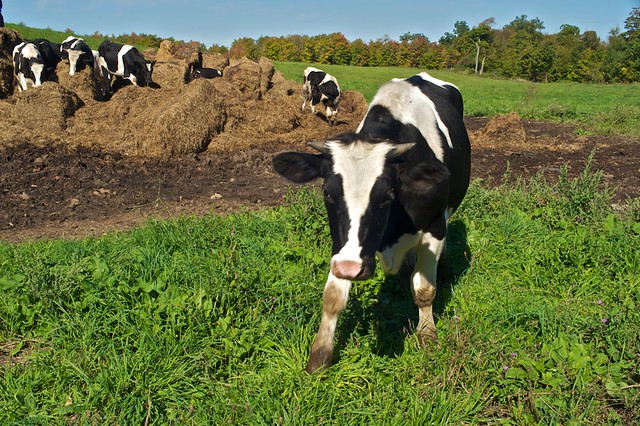
I was standing by the side of a backroad near Clockville when a cow came up to me (true story). I’ve been struggling with trying to get some sort of perspective on what I want to do next. The majority of my adult life I would have tagged myself as a photographer. It’s sort of a strange thing to do, considering that I have little in common with most photographers and find it hard to talk to most of them. If it’s a club, I always avoided joining because I just didn’t like the members. I do like cows though; My dad raised them pretty much as pets. As barbaric as it may sound, we did indeed eat our pets though. But I digress.

There was this sort of tableau in this field that I found interesting, but it kept changing when I tried to photograph it. I was never quite happy with any of the arrangements that presented themselves. Eventually, I just MMS’d a picture from my phone to my wife and drove on.

Cows

It seems like I can only photograph what is close to me. I’m weird that way. I remember that was a major difference between myself and Harry Wilson, one of the few “photographers” I ever really knew and liked. Harry would always travel (usually overseas) to photograph. He never liked what was next to him as subjects for photographs; he required the sort of distance and strangeness that travel brings before he felt creative.

I have become fond of traveling, particularly cross-country, in the last few years. It really helps to clear your head and allows you to think complex issues through. But when it comes to photographing things, I am always drawn to those things that I already know. I feel that if I can just look closer at those mundane things, if I can see them from new perspectives I can learn useful things. So when I travel, rather than looking for the unusual, I tend to be drawn to the usual. Like cows. And blue or yellow flowers. Krista and I came up with that theory travelling across the upper midwest: this country is really composed of cows and blue and yellow flowers.

Then again, I know that I fall prey to one of the central myths of photography. Most everyone of a certain age knows it. In the movie Blow-Up, a photographer just keeps zooming in to find more and more detail in one of his negatives. Eventually, he finds evidence of a murder. Robert Capa famously claimed that if your photographs aren’t good enough, you aren’t close enough. The basic tenet of photorealism is that photographs are seamless, containing endless meaning if we just keep zooming in.

I was shocked to find, searching my blogs, that I never have really written anything about Chuck Close. In the last few years, he has been increasingly thought-provoking to me. He went through a phase of photorealism in his painting, but soon moved to breaking things down into blots and motifs mapped on a grid. I think he has one of the best theories of near and far of any artist I know. Up close, things are personal and idiosyncratic.

You have to step back to really get the sense of Chuck Close’s paintings as “images.” Looking closer doesn’t really tell you something new. It tells you something different.

Cow Cube

My mom kept a little photo cube with pictures of our cows. It dawned on me, reflecting on my time in Clockville, that the problem of near and far (and locating a meaningful perspective) is not simply a matter of space, but also of time. We are never the same from one moment to the next, and even though there seem to be some constants (like cows), meaning is always contingent and fleeting. But the universe isn’t quite as random as it seems, if you can locate the right place to stand.

On that same drive down Oxbow Road, I passed a farm that claimed to be the birthplace of the first registered holstein cow. This place feels more like home all the time.

Nonsense

Syracuse was inundated with 4.2 inches of rain last Sunday, the most ever for an August 22 and from the 2nd to 4th highest rainfall in a single day (depending on who you listen to). There was a small river in my basement, though things did drain effectively without much problem other than some damp rugs that are now getting a little fragrant. They tore up the main road on Monday, effectively stranding me on my little island. It’s always tempting to look for meaning in such things. That’s what people do, I think — we search for meaning in ways that would puzzle the majority of the animal kingdom.

It’s difficult to accept nonsense.

A few months back, I figured something out that had been bugging me for a while. One of my favorite songs of all time is “Preachin’ Blues,” the Robert Johnson and Son House versions as well as the cover by The Gun Club. As transcribed in the Columbia Robert Johnson  box set (a marvel of insensitive compilation)  the lyrics are something like this:

The blu-u-u-u-ues
     is a low down shakin’ chill
     spoken: Yes, preach ’em now.
Mmmmm mmmmm
     is a low down shakin’ chill
You ain’t never had ’em, I
     hope you never will
Well the blues
     is a low down achin’ heart disease
     spoken: Do it now.
          You goin’ do it?
          Tell me all about it.
Let the blues
     is a low down achin’ heart disease
Like consumption
     killing me by degrees
I can study rain
     oh, oh, drive, oh, oh, drive my blues
I been studyin’ the rain and
     I’m ‘on’ drive my blues away
Goin’ to the ‘stil’ry
     stay out there all day
Notes: 1 The underlined are phonetically correct, although meaningless.

That footnote has bugged me for years. Just what do you mean meaningless? I guess I could grant them the “let.” However, if blues is a disease then it is an agent rather than an object. Perhaps grammatically sound to “let the blues,” though in this context it doesn’t make a great deal of sense. But I must strenuously protest that “studying the rain” is nonsense.

As I started to say, I was studying the rain a few months ago (not the latest deluge) when it occurred to me that rain suggests that relationships, though often tenuous, are generally followed by new relationships. The drops falling from the sky are individual, but they always seem to coalesce and flow together until they reach the earth (or the sea) for their final dissipation. A single drop can evaporate, I suppose, but rain, like people, tends to seek out a more stable group project— streams, lakes, rivers, etc.. Of course, rain can also be distilled into firewater, though if you’re not careful that stuff can make you blind.

Cold Souls

coldsouls1_large.jpg

I really enjoyed Cold Souls, though I notice that a lot of people don’t find it that funny. Perhaps it’s the lack of an ending, or mapping the appearance of Giametti’s soul onto a chick pea that grates. Personally, it seemed a bit fitting that the soul would be equated with a seed. I think Plato thought along those lines as well.

On an In Our Time BBC podcast. Mary Beard suggested that the best way to understand ancient Greek myth is that it provides “a convenient way of thinking about life.” No matter how much we try to rid ourselves of myth, it always seems to creep back in because it provides  sort of “testing ground” for moral concepts that can be contingent on  context. There can be no “accurate” myth because good concepts survive best when they can be deformed to fit the circumstances of a continually renewed audience.

Perhaps the modern soul is indeed cold, hard, and beige. But soul’s transformation into an object is the real trick. Like myth, soul makes no sense as an object. It makes a great deal of sense as a practice.*

*See also What is Soul by Funkadelic.

Adhesive

I’ve been spending a lot of time looking at old snapshots lately. It begins to matter very little if I actually recognize the people in them. There’s just something about looking at pictures that sticks with me. Removing a bunch of them from adhesive album pages has been instructive. There are sometimes captions on the back, but usually not. Most of the time, you’re just left with your own thoughts about the picture.

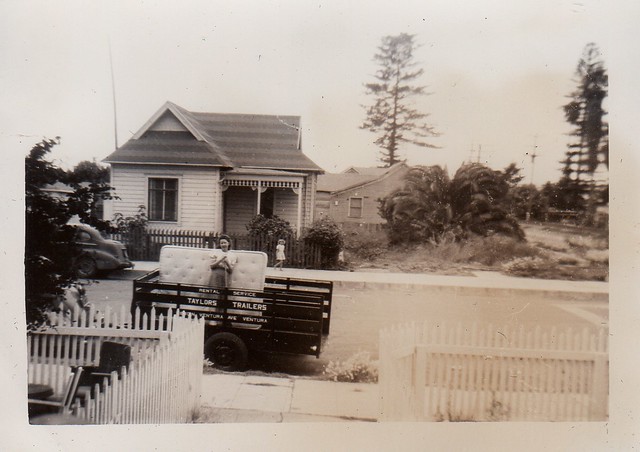
It dawned on me this afternoon that no one really takes a picture because they want to forget something. At one time or another, these children (whoever they are) were important to someone. The someone in this case is my mother; but even she couldn’t remember who most of them were. They date from a time when she first moved to California and was living in a little apartment complex in Ventura. She was twenty, I think, and had a child of her own— my eldest brother David. She remembered that a woman in the complex was always volunteering to take David off her hands; she loved him.

This could be a picture of David, but I’m not sure. Probably not. As I captioned some of these photos, it dawned on me that there isn’t anyone alive to care. Almost everyone is dead, so what does it matter? David had two sons and a daughter; I don’t know what became of his daughter. His sons are alive, but he’s not. I keep scanning and posting these photographs mostly because I like them. I also liked David, but I didn’t know him that well. He was 13 years older.

David always nagged me to go to college. I couldn’t afford it, really. David understood that. It took him six or eight years to get his associates (two year) degree and another four or five to get his BA. He did complete a masters after about fifteen years or so of trying. He stuck to it, and encouraged me to do the same. He was accepted into law school and had just started that when one of his sons was hit by a car, causing severe trauma, brain damage, and a coma. He had to drop out that time and never made it back. He eventually lost a battle with alcohol.

David wasn’t alive when I got my masters. But my mother was.

Mom and mattress in Ventura

Music and photographs are often found in albums.

easy-mount.jpg

I’ve been working on sorting through some of my mother’s photo albums. This sort of work often triggers thoughts. And there are always curiosities. Item #1:

Where Jesus is Buried, Canute OK

The caption on the verso makes you wonder just which Jesus (I have no relatives by that name) is buried in Canute, Oklahoma, circa 1929. I did a little digging and found this:

Continue reading “Music and photographs are often found in albums.”

Binocular viewing

Microscope.jpg

Loren’s comment yesterday put some issues in relief for me. He responded to an aspect of what I wrote that I had thought of as a background bit– considerations of the past as narrated vs, experienced. Writing on the internet for many years now, I have come to appreciate that every reading of someone else’s words is truly unique. The person you’re reading isn’t you. In fact, part of the fun of putting all my old crap back online is that my old writings aren’t me either. The me that wrote those things doesn’t exist anymore. There are similarities between him and the person typing today, but we aren’t the same. In some ways, as I go back to keyword them I might not like that person at all.

That post seems very chaotic to me now. I thought I had a point, but it took a long time to find it. It actually began when I was thinking about tubes and writing about why I really want to build more gear that uses them. One reason why is that they are easier than solid state circuits in terms of complexity and fussiness. I have a little IC amp I want to build, and one look at the PC board told me that I had better get a binocular microscope to check my soldering since my eyes are not as good as they once were at picking out tiny details.

Particularly with “comprehensive usage” (sic), technology does increase our knowledge of the world. The correlative point, however, is that  it often stands as a barrier which isolates us from the things we’d like to know. Technology facilitates gaps and distortions, particularly when applied to the problems of memory. Language is a technology. Translation is a complex affair, and it is naive to think of a static “message” (or point) moving from place to place. The places it leaves from, as well as the destinations it arrives at, are always moving. The world (and ourselves) are not the same across time.

The primary lesson of tube technology is that lower distortion isn’t always better. Tubes are frequently far more engaging to listen to than solid state. The distortion with solid state devices are orders of magnitude lower, but music often just sounds better through glowing tubes. Ask any electric guitar player. The sound is quite different, and though you can always chalk it up to “taste” there are reasons why a technology over a hundred years old persists — the sound is involving and fun.

Some distortions are more euphonious than others. Loren’s reading of what I had written so clumsily was a case in point. I have no problem with it. I have been less lucky in the past. The cacophony of the internet often drowns out the slightest kernel of civility with echoed distortions considered by their contributors as “feedback.”

If we accept that all communication is distorted and that all technologies used to further/preserve that communication are flawed, where does that leave us? I think it leaves us searching for the most pleasing forms of distortion, such as tidy stories with easily digested morals.

But, with binocular vision we can see more depth in those things we choose to examine.

Memory technologies

800px-Kennedyb.jpgMy oft recounted earliest memory is of watching the assassination of John F. Kennedy on the TV over and over when I was five years old. Perhaps that was the beginning of my fascination with memory technologies.  Television in its earliest form was not a particularly good one. The video tape technology used to record/repeat the same few seconds of video over and over was better, but still less than perfect. Most early television programs are lost to history because video tape technology was always regarded as disposable. Tape was particularly important in the United States because of the differentiation in time zones; in order to facilitate shared experiences of prime time programing, live broadcasts needed to be delayed. Once the “live” content had been rebroadcast, the tapes were considered expendable and erased. The previous short-lived silver technology, kinescope, was actually far more practical as a memory technology.

There is a gap in our cultural memory there. Some programs from the fifties were committed to film, but in the early sixties when tape took over few made the cut. A huge gap exists between the early years of television, and the later years of secondary markets and syndicated resale. “Broadcast live” was largely a death sentence. There is an analogous situation in the fade of color snapshots. Early silver nitrate black and white technologies were far more permanent than later chromogenic dye technologies. Digital technologies, because of their replicating and broadcast proclivities, will most likely survive fairly well (aside from DRM and encryption concerns) into the future leaving a huge gap in the middle— just like TV.

I find it useful to distinguish two modes of memory here— transmission and fixation. There are early versions of both, in the form of oral traditions and stone or clay tablets. I’ve been joking lately that having lost interest in the internet, I’m looking forward to working with stone tablets. That is only partially a joke. Fixation (as a memory device) lends itself to a sort of intensive study that is absent when the primary means of memory is transmission/replication. Transmission is by definition extensive.

I think it is possible to argue that cultural memory is primarily extensive. Attempts to fix something as indicative of a culture is always doomed to degenerate into fetishism and its evil twin, nostalgia. Nonetheless, it seems that elements of the intensive come in to play in instances such as memorial sites. Such sites might be labeled as fetishes, but they have a cultural value that is peformative and not fixed (though they are by definition, fixed). Architecture and monuments have a curious relationship with memory which does not fit neatly in the intensive/extensive distinction. That complexity centers on the level of consciousness involved in the performance of memory. Do we mindlessly repeat the narratives we are given, or do we consciously live them?

No matter which method is used, memory is always distorted. In order to fix memory, we must kill it first. To survive by repetition, memory has to be dumbed-down and stripped of most of its complexity. If we reflect on an actuality, it is never the same from one moment to the next– what we think we know is always subject to revision by the new.

If my mother were still alive, she might tell me that I didn’t actually watch TV that day.