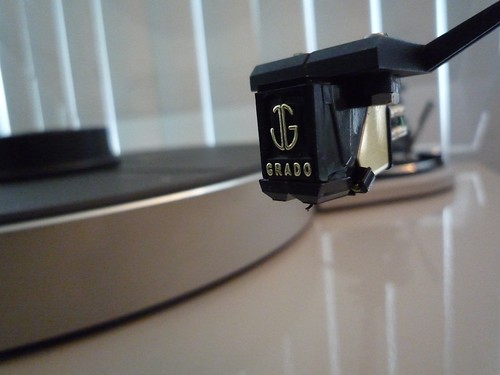
Rediscovering Vinyl

Grado Gold 1+

When Barack Obama moved into the White House on January 20th, he gained access to five chefs, a private bowling alley — and a killer collection of classic LPs. Stored in the basement of the executive mansion is the official White House Record Library: several hundred LPs that include landmark albums in rock (Led Zeppelin IV, the Rolling Stones’ Let It Bleed), punk (the Ramones’ Rocket to Russia, the Sex Pistols’ Never Mind the Bollocks, Here’s the Sex Pistols), cult classics (Captain Beefheart’s Trout Mask Replica, the Flying Burrito Brothers’ The Gilded Palace of Sin) and disco. Not to mention records by Santana, Neil Young, Talking Heads, Isaac Hayes, Elton John, the Cars and Barry Manilow. . . .

On January 13th, 1981, the LPs — each in a sleeve with a presidential seal — were presented to Jimmy Carter at a White House ceremony. But the collection — placed in a hallway near the third-floor listening room, complete with a sound system — didn’t remain upstairs long. When Ronald Reagan took office that year, the LPs were moved to the basement. Depending on the source, the reason was Nancy Reagan’s distaste for shelves of vinyl, or the edgy choices themselves. A spokesman for Obama said it was too early to comment on whether the president would revive the library. But Obama may be pleased to learn that at least a few of his favorite albums — Bob Dylan’s Blood on the Tracks, Bruce Springsteen’s Born to Run — are there if he wants them on pristine slabs of vinyl.
Rolling Stone

Not Suspicious?

WilliamFoxton_1295004c.jpg

William Foxton, 65, who had served in the British Army and more recently worked as a defense contractor in Afghanistan, died from a single bullet wound to the head in the southern English port city of Southampton on Tuesday, police said.

“A pistol was recovered at the scene. Police do not believe the death to be suspicious,” a police statement said. . . .

“I want Madoff and others involved to know that they have my father’s blood on their hands,” Willard Foxton was quoted by The Daily Telegraph as saying.

“I’m very angry. My first thought was to show up at Madoff’s trial in New York and throw my father’s medals in his face.”


MSNBC

During much of the 1990s and earlier this decade, the father-of-two worked in the Balkans, where he was the head of the European Commission Monitoring Mission. In Kosovo he worked with aid worker Sally Becker, known as ‘The Angel of Mostar.

Miss Becker, who helped rescue 170 wounded children and their families from an orphanage during the Balkans war, yesterday (THUR) said: “Bill was one of he most exceptional men I have ever met, He was a larger than life character who worked tirelessly on behalf of the victims of war. He would not hesitate to risk his own life for others.”

Emrys Davies, 74, a former British ambassador who headed the British delegation to ECMM in 1995, said Mr Foxton once crawled across a minefield to save a trapped child.

He said: “The news of his death really is desperately sad. It was an honour to know Bill. I’d like to wring Bernie Madoff’s neck.”

Telegraph

Hard Times

The troubled Village Voice laid off three employees Tuesday, including Nat Hentoff, the prominent columnist who has worked for the paper since 1958, contributing opinionated columns about jazz, civil liberties and politics.

. . .“Nat Hentoff wrote liner notes for every great musician that I’ve ever loved, from Billie Holiday to Bob Dylan and Aretha Franklin, and that’s not even what he’s been writing about for the last 30 years,” said Tom Robbins, a Voice staff writer.

. . . “I’m 83 and a half. You’d think they’d have let me go silently,” he said. “Fortunately, I’ve never been more productive.”


Village Voice Lays Off Nat Hentoff and 2 Others

Minneapolis, China

The latest update is that the equipment has been returned, but this still seems like flagrant prior restraint.

Do these incidents raise the possibility that authorities are using the RNC as an excuse to overstep constitutional rights?

“Arrogance doesn’t need an excuse,” said St. Paul attorney Ted Dooley. “These types of incidents happen frequently. The difference now is that people are watching them, witnessing and giving testimony.”

Dooley also said that these actions aren’t about intimidation. “It’s a straight out challenge. It’s not really a coincidence that they went after someone who had a history of exposing just this kind of behavior by the police,” he said. “It just seemed a little bit planned.”

Indeed, residents of the Northeast neighborhood where the incident occurred, as well as National Lawyers Guild members stopping by Tuesday, said it appeared that undercover surveillance has been occurring there this afternoon.

“It’s very ominous,” said Dooley. “The attack on these three was outrageous. One of them from New York said, ‘The police in New York can be assholes, but even there, they don’t just walk up and take stuff.’ It’s dumbfounding.”


Minnesota Independent

Nostalgia and Utopianism

I think the Lincvolt is an interesting confluence of things. Young’s comments about his latest CSNY movie seem to have a reasonable handle on the effectiveness of nostalgia:

The film will be given worldwide cinema release, but Young has no illusions about its box-office appeal. “I don’t expect it to last long,” he admits. “I mean, let’s be realistic: it’s a film about war and a bunch of old hippies, so that’s the way the public will view it. We spent a lot of time on it, and it means a lot to us, but in the overall scope of things . . . it has a moment, and this moment is coming up, and after that it’ll be a DVD, then it’ll be gone. It’ll be a piece of history.”

And yet nostalgia persists in the choice to modify a classic car to meet future needs. We need both a future and a past, I think. But we also need to be able to tell them apart.

Utopians

I think a lot of people go through a sort of utopian phase— I know I did. Joseph Duemer pointed at a NYT obit for Kathleen Kinkade today, and it brought back memories. While I was in high school, I read both Walden Two by B.F. Skinner and A Walden Two Experiment. I definitely preferred the latter; it had a pragmatic edge that wasn’t as “hippy” as most of the other commune experiments of the time.

What I remember most was the idea that the more disgusting a job was, the more it should be worth—garbage collectors should make more money than CEOs. It seemed reasonable to me at the time. The arc of the obit is interesting, and the memorable spots for me were:

Continue reading “Utopians”

Coming Attractions

Stanley Fish’s article in the NYT struck a chord, given the way that I so often “miss” the glory of Shakespeare:

Shakespeare does many voices but identifies with none of them. (His, as Keats said, is a negative capability.) He’s hard to find, as his would-be biographers well know. Milton has many characters, but they all speak with one voice — his. You don’t have look for him; you can’t get away from him. Despite the variety of scenes and genres there’s always just one guy talking to you; the conversation goes on and on and it is a conversation in which, as Barrow first said, everything is at stake. This is a poetry that reads you.

One of my great flaws as a reader is my inability to track massive casts of characters during a story—I’ve always been drawn to lyric, to one voice that sings its own song. Conversation, in my experience, is always more rewarding in small groups rather than massive crowds. Fish continues:

Continue reading “Coming Attractions”