Romantic to Revolutionary

Romantic to RevolutionaryI’m around a hundred pages in on E.P. Thompson’s massive study of William Morris, and so far I’m really impressed.

It cites his letters and minor publications profusely, and though it’s obvious that it has the major goal of establishing Morris as an important communist/socialist, so far it’s hitting right at the heart of what I’m looking for in Morris.

I’m really looking for his attitudes toward craft and labor. Though I’m really not that interested in politics, I am interested in the things that constrain our lives. Morris was too, as indicated by this excerpt from one of Morris’s letters (1883):

 “In spite of all the success I have had I have not failed to be conscious that the art I have been helping to produce would fall with the death of a few of us who really care about it, that a reform in art which is founded on individualism must perish with the individuals who have set it going. Both my historical studies and my practical conflict with the philistinism of modern society have forced on me the conviction that art cannot have real life and growth under the present system of commercialism and profit-mongering.” (98)

Thompson observes that what drove Morris into his political views was actually the success, not the failure, of his commercial ventures. It’s easy to look at a rich man like Morris, making niche products for rich people, as someone detached from social problems. His fortune came from coal mining, initially. Something that Thompson spends much time establishing the background for, as well as his escapist tendencies. But when it comes to craft, Morris seems grounded and well informed. It isn’t clear if this bit comes from the same letter (I need to locate the volume of letters to check) but I appears as if it is:

“It would be well if all of us were good handcraftsman in some kind, and the dishonour of labor done away with altogether . . In each several profession, no master should be too proud to do its hardest work.” (99)

There will be a lot more to say about this tome, at 800+ pages it’s going to take a while to sort through.

Looking Backward

Looking BackwardFinished Looking Backward as the year ended. It has a fun romantic twist ending, but for the most part, it’s one of those books that has me slapping my head at how much I disagree with its sentiments.

An upper class man is mesmerized (hypnotized) in order to get some sleep in 1887, because he is upset that the labor unrest will force him to cancel his wedding. He wakes up in the year 2000.

All strife is gone. The trusts have all been absorbed into one massive trust, which becomes the government.

All citizens are conscripted into the “great industrial army” and must work from the age of 21 until 45; then they are free to do what they want. The gross domestic product is divided up equally among all citizens, regardless of whether they are currently working or not. No more money, perfect equality, no social problems. People who refuse to work are imprisoned and fed bread and water till they agree to go along; this is not considered to be a problem. Housework and cooking have been done away with, though he never really explains how! Everyone is happy as an industrial soldier.

“Know, O child of another race and yet the same that the labor we have to render as our part in securing for the nation the means of a comfortable physical existence is by no means regarded as the most important, the most interesting, or the most dignified employment of our powers. We look upon it as a necessary duty to be discharged before we can fully devote ourselves to the higher exercise of our faculties, the intellectual and spiritual enjoyments and pursuits which alone mean life. Everything possible is indeed done by the just distribution of burdens, and by all manner of special attractions and incentives to relieve our labor of the irksomeness, and, except in a comparative sense, is not usually irksome, and is often inspiring. But it is not our labor, but the higher and larger activities which the performance of our task will leave us free to enter upon, that are considered the main business of of existence.

“Of course not all, nor the majority, have those scientific, artistic, literary, or scholarly interests which make leisure the one thing valuable to their possessors. Many look upon the last half of life chiefly as a period for enjoyment of other sorts; for travel, for social relaxation in the company of their lifetime friends; a time for the cultivation of all maner of personal idiosyncrasies and special tastes, and the unperturbed appreciation of the good things of the world which they have helped create.

Edward Bellamy, Looking Backward (1888) Penguin ed. 1986 p. 148-9

Morris disliked the book because it was an exposition about “state communism”; Bellamy calls it “nationalism”. I dislike it primarily because of his idea that things like cooking, cleaning and such are dismissed as being pretty much meaningless, and no thought whatsoever is given to the idea that work might be fun and an essential part of life.  The Nearings really got that part right, I think. Bread labor (as they called it) was part of the core of what it means to be alive. We have to feed, clothe, and shelter ourselves. Why shouldn’t that be as rewarding as other more “valuable” pursuits? It seems as if Bellamy has anticipated the mystification of these things which we currently accept as “normal.”

To be fair, Bellamy anticipates things like credit cards (as a payment system instead of money), and places music as a central part of day to day life. It seems that each house as a device on the wall where you can turn screws and fill the house with music, chosen from a variety of programs performed live. No need to go the the concert hall, it is brought to you. He also anticipates radio preachers, because on Sunday you can tune into the services.

There were Bellamy societies  that sought to make this utopia real at the turn of the twentieth century. There are fascinating predictions the book, if you can get past its embrace of National Socialism. Many of Bellamy’s contemporaries didn’t see any problems with that; time has given most of us a different perception.

The Invalid Corps

The Invalid CorpsI should not fail to mention, “resumed the doctor, “that for those too deficient in mental or bodily strength to be fairly graded with the main body of workers, we have a separate grade, unconnected with the others—a sort of invalid corps, the members of which are provided with a light class of tasks fitted to their strength. All our sick in mind and body, all our deaf and dumb, and lame and blind and crippled, and even our insane, belong to this invalid corps, and bear its insigns. The strongest often do nearly a man’s work, the feeblest, of course nothing; In their lucid intervals, even our insane are eager to do what they can.”

“That is a pretty idea of the invalid corps,” I said, “Even a barbarian from the nineteenth century can appreciate that. It is a graceful way of disguising charity, and must be grateful to the feelings of its recipients.”

“Charity!” repeated Doctor Leete. “Did you suppose that we consider the incapable class we are talking of objects of charity?”

“Why, naturally,”  I said, “insamuch[sic] as they are incapable of self support.”

But here the doctor took me up quickly.

“Who is capable of self support?” he demanded, “There is no such thing in a civilized society as self-support. In a state of society so barbarous as not even to know family cooperation, each individual may possibly support himself, though even then for a part of his life only; but from the moment that men begin to live together, and constitute even the rudest of society, self-support becomes impossible. As men grow more civilized, the subdivision of occupations and services is carried out, a complex mutual dependence becomes the universal rule. Every man, however solitary may seem his occupation, is a member of a vast industrial partnership, as large as the nation, as large as humanity. The necessity of mutual dependence should imply the duty and guarantee of mutual support; and that it did not in your day constituted the essential cruelty and unreason of your system.”

Edward Bellamy, Looking Backward (1888) Penguin ed. 1986 p. 109-110

I started this book yesterday. I’ve always meant to read it, and prompted by a somewhat disparaging review of it by William Morris, I decided that now was the time. Morris called its utopian view “state communism” and I believe it is. In the future, i.e. the year 2000, the trusts and robber barons have coalesced into a giant mega-corporation which is the government. Curiously, for Bellamy, this is a good thing. Much more to say later, but I found it interesting that this “invalid corps” in the great industrial army (his description of the workforce) is rooted in the Civil War; the Union found its invalid corps in 1863, the confederacy in 1864.

The new system

modern-timesI have said that the eighteenth century perfected the system of labour which took the place of the mediaeval system, under which a workman individually carried his piece of work through its various stages from the first to the last.

This new system, the first change in industrial production since the Middle Ages, is known as the system of division of labour, wherein, as I have said, the unit of labour is a group, not a man,; the individual workman in this system is kept life-long at the performance of some task quite petty in itself, and which he soon masters, and having mastered it has nothing more to do but go on increasing his speed of hand under the spur of competition with his fellows, until he has become the perfect machine which it is his ultimate duty to become, since without attaining that end he must die or become a pauper. You can well imagine how this glorious invention of division of labour, this complete destruction of individuality in the workman, and his apparent hopeless enslavement to his profit-grinding master, stimulated the hopes of civilization; probably more hymns have been sung in praise of division of labour, more sermons preached about it, than have done homage to the precept ‘do unto others as ye would they should do unto you’.

To drop all irony, surely this was one of those stages of civilization at which one might well say that, if it was to stop there, it was a pity that it had ever got so far. . . .

. . . However, civilization was not going to stop there; having turned the man into a machine, the next stage for commerce to aim at was to contrive machines which could widely dispense with human labour, nor was this aim altogether disappointed.

William Morris, “The Hopes of Civilization,” News from Nowhere and Other Writings (1993) p.316-7.

Good Work

Here, you see, are two kinds of work— one good, the other bad, one not far removed from a blessing, a lightening of life, the other a mere curse, a burden to life.

What is the difference between them, then? This: one has hope in it, the other has not. It is manly to do the one kind of work, manly to refuse to do the other.

What is the nature of the hope which, when it is present in work makes it worth doing?

It is threefold I think — hope of rest, hope of product, hope of pleasure in the work itself; and hope of these also in good abundance and of good quality; rest enough and good enough to be worth having; product worth having by by one who is neither a fool nor an ascetic; pleasure enough for all of us to be conscious of it while we are at work; not a mere habit, the loss of which we shall feel as a fidgety man feels the loss of a bit of string he fidgets with.

William Morris, “Useful Work Versus Useless Toil,” News from Nowhere and Other Writings (1993) p.288.

Rot in the granary

Corn Rot

I do not want art for a few, any more than education for a few, or freedom for a few.

No, rather than art should live this poor thin life among a few exceptional men, despising those beneath them for an ignorance for which they themselves are responsible, for a brutality that they will not struggle with, — rather than this, I would think that the world should indeed sweep away all art for awhile, as I said before I thought it possible she might do; rather than the wheat should rot in the miser’s granary. I would that the earth had it, that it might yet have a chance to quicken in the dark.

I have a sort of faith, though, that this clearing away of all art will not happen, that men will get wiser, as well as more learned; that many of the intricacies of life, on which we now pride ourselves more than enough, partly because they are new, partly because they have come with the gain of better things, will be cast aside for having played their part, and being useful no longer.

William Morris, “The Lesser Arts,” News from Nowhere and Other Writings (1993) p.253

Back from nowhere.

Morris, News from NowhereI just finished “News from Nowhere” by William Morris, and I’m still digesting it. I generally dislike most utopian books these days, though I read many of the standards growing up. The short novel contains a crystallization of Morris’s political views, which helps understanding his version of the “ideal” but there is a pollyannaish quality to it all, a romaticiation of the feudal economy that I find hard to stomach. Of course, everyone is beautiful and the clothes are fine as the people toil in the fields.

There are some interesting aspects, to be sure— a gift economy of sorts, sparser populations, a reversal of the movement into cities and back to the country, etc., but it’s clearly written from the perspective of a fellow who has known privilege his whole life. It’s been said that most of the early twentieth century theories of craft are reactions for/against William Morris and Ruskin, and that makes it important to deal with. There are a lot of finer points in Morris that get lost in the translation.

The aestheticism of of the Arts and Crafts, the connoisseurship that surrounds what it became is all that’s left once the complex social theories are stripped away. It’s a shame. It is clear, reading the pieces that I’ve read so far from Morris, that he really wanted to return to the essential goods that we all need and should take care with. The real enemy in “News from Nowhere” is mass production with it’s attendant spiral of unnecessary and unneeded products. It’s not just a diatribe against capitalism, it’s a position statement regarding the expenditure of energy creating massive market economies. Too many factories churning out too much unnecessary crap: a worthy sentiment, somewhat prophetic for 1891.

Well worth looking at, even with its flaws and alarming veiled sexism.

The Good Life

The Good Life

It’s been a busy few months, and in a “new years resolution” sort of mood I thought I’d try to use this space again. No promises regarding my ability to sustain it. I’m trying to work out better habits, and get more done than I usually manage to.

One of the things I miss most about the stresses of these past months is reading; another thing is writing. I’m trying some self-assignment type things to help improve the situation.

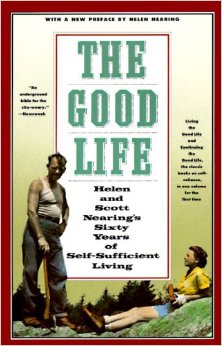
The first book I assigned myself was The Good Life by Helen and Scott Nearing.

The modern edition contains two books, the first published in 1952 and then its sequel from 1970. One of the tenets of the Nearing approach is budgeting your time to “bread labor” and also budgeting time for study and relaxation. I like that a lot.

In the first book, the division is firm between “bread labor” and the activities that make life worth living, like music and reading and such. The Nearings suggest limiting ourselves to four hours of each. In the later book, this is refined a bit to three four hour segments– bread labor, self labor, and then community labors. The sort of good life they’re aiming for is simply subsistence— aiming to avoid any sort of profit or surplus. This of course runs counter to a capitalist lifestyle.

Needless to say, the Nearings were political radicals, but there is relatively little of that in this book. It’s a bit like Walden, which the dust-jacket blurb compares it to, wherein they account their modes of living for a much longer span of time. I liked it better myself, because it was more pragmatic, longer term, and less dependent on borrowings from others. (living in Emerson’s back yard, using only borrowed tools, etc.).

Reading it reminded me a lot of the books I read as a teenager, including B.F. Skinner’s Walden Two and the usual suspects of hippie culture. But this goes back further, deeper, and is in most ways richer than most of those books. Perhaps I’m working toward my fiftieth adolescence, or something thereabouts. Looking for something though I’m not sure what.

Constraints

Solnit: I feel a great affinity for photographers and I was told gently early on that I wasn’t  good at interpreting paintings and I never had a real affinity for them. You have to get into the cult of painting, both the craft of it and the lineage of it, neither of which interest me very much. Photography and non-fiction feel very close because, as you say, there is a very direct relationship to subject matter, which was taken in earlier eras as meaning they weren’t creative. There is a tremendous responsibility that goes with that. As a photographer I know if I take a photograph of you and I make it public, people will expect it to be true. If I Photoshop it so that you look like you are snorting coke, I know that will impact what people will believe, the historical record, and your life. Therefore I have tremendous creative possibility but I also have tremendous creative responsibility. When that responsibility is seen as confinement it bugs me—when people who are supposed to be doing non-fiction tweak the facts I feel that is a creative failure. You do not have to make shit up or misrepresent what happened to tell a fantastic story that has literary form. You just have to be good at it, be good at your job and let the constraints give you a more interesting solution. Constraint is often read like the word compromise, but there is a way of compromising that is like collaborating, finding common ground, where you serve truth and vision both, and those feed rather than sap each other.

I sense, just beneath the surface of this response, the core of the “Q” question— can rhetoric be defined as “a good man speaking well”? I hadn’t really thought of “truth” as a constraint before, but yes, I suppose it is. I’ve always felt that constraints are often a good thing.

Education of a Woodworker

At the utmost, the active minded young man should ask of his teachers only the mastery of his tools. The young man himself, the subject of education, is a certain form of energy; the object to be gained is economy of his force; the training is partly the clearing away of obstacles, partly by the direct application of effort. Once acquired, the tools and models may be thrown away.

The Education of Henry Adams (2007), xiv

In the author’s preface, Henry Adams sets up a model of the author/narrator as a mannequin, a stand-in that should be discarded once an adequate level of skill is achieved. This device has replicated itself over time, but has frequently been ignored or overlooked. Chris Schwarz, in his first book The Anarchist’s Tool Chest, declares his “anarchist” manifesto with the admonition “disobey me.” It is difficult, however, to discard or disobey his assemblage of a tool kit that he substantiates historically, even annotating it across other authors covering centuries. Just what does “disobey me” mean when all paths, apparently, lead to the same conclusions as he has reached?

I think I have read the opening chapters of Schwarz’s book a few dozen times in the past few years. In fact, I am putting the finishing touches on the sort of English tool chest he describes right now, not because I think it’s the best solution to the problem of tool storage but simply because it seemed  like the right thing to do. He’s right of course, this sort of chest makes a lot more sense once you start to use it. It’s rich with the sort of “economy of force” that Henry Adams was on about. The patience and practice that you acquire while pursuing this sort of project is priceless, really. But the fact that Schwarz looms large as a person instead of a persona obscures the “anarchist” agenda that he seeks to pursue. The more I visit the book, the more I see how he got there. Like his basic tool assortment, Schwarz’s anarchist disposition is an easy journey to support historically.

Right about the time of the first publication of The Education of Henry Adams, at the dawn of the twentieth century there was a basic shift in the perception of “craft” among its proponents. William Morris, a devout socialist saw the onslaught of industrial production driven by capitalism as an evil to be defeated by traditional crafts.  Interrogating the social benefits of “hand” crafts versus machines was a the center of a lot of writing in the late nineteenth century (particularly Hawthorne). However, as the Arts and Crafts movement began to falter in the early twentieth century, socialists were replaced by anarchists (and capitalists like the Stickley brothers) with a more machine friendly stance.

The anarchist Herbert Read, writing in Art and Industry (1949) suggests that Morris was simply asking the wrong question. We shouldn’t be asking if the machines are damaging our society, but rather if the machines can give us the art we need. He thought yes. The merits of individualism/anarchism vs. socialism frequently generate ripples across the discussion; they are models that seem to consistently provide a sort of touchstone to rub. Is this really useful in the long run? I have mixed feelings. As Henry Adams remarks, politics as a practice has always been the systematic organization of hatreds (6). However, as the truism goes, the personal is always political.

For myself, perhaps the strongest urge is always what I’ve come to call the “hunter gatherer” impulse. The draw of The Anarchist’s Tool Chest is its well researched set of tools; most people reading the book, I suspect, use it as a starting point to figure out what tools they should be proficient with. It’s much easier to hunt and gather tools than it is to develop skills, so we gather them up and then and only then attempt to use them. Overcoming the frustration when they don’t work the way we think they should, well, that’s a problem.

Schwarz is really no help there; he and most of the dons of the the woodworking forums online suggest that you simply must have the best tool. There is no substitute. Schwarz, as he so succinctly points out in his book, due to the circumstances of his profession, found himself buried alive in tools. His book is about stripping away those things that he found he didn’t need, including “tool-resembling objects.” For most, readers they’re gathering tools, not getting rid of them.

For some reason though, I just keep coming back to Schwarz’s first book. I’ve read and enjoyed his latest book, Campaign Furniture, and there is much to say about it. But the more I read around, the more I can see why that first book had to happen for him.

Manifestos usually bore me, but for some reason this one doesn’t; it irritates me in the best sense of the word. I constantly wonder if there is a better way to get there. The path that his education follows is fairly straightforward, and in its own way traditional. But I do not think that you can cast away your tools and models once you get there, which makes it flirt dangerously with dogma.