The ornamented snake

I dreamed this past night that a strange young man urged me to enter a house where he would show me that he could charm snakes. He went ahead. Naturally, I followed him.

In there, I actually saw him standing in the center of the room, and in front of him, raised almost as tall as he, a thick gigantic cobra moved its head, following the beats of unheard music.

In the dimness of lights and smoke behind them I could faintly discern a group of spectators. Apparently they were convinced that the snake charmer had the dangerous snake completely under control.

I did not. Arriving late and totally alone, I suddenly found myself standing quite close to the actors. I felt unpleasantly insecure and would have liked to be outside again.

For a moment, I closed my eyes and thought: “The snake has noticed you particularly.” I feared it might be coming close…and then…and then I felt it close to me. It had slithered to my feet….It rose along my body…it chilled me and filled me with terror. I knew that one sting meant immediate death, namely if I showed the slightest fear.

“Introduction” Carl Larsson: The Autobiography of Sweden’s Most Beloved Artist, 1

This seems a strange way to commence the story of your life. After all, this isn’t Jim Morrison we’re talking about here, but a man known primarily for painting placid domestic scenes. No wonder many have described this book as “dour.”

Rather than a snake, it seems to me that the story of domestic design at the turn of the twentieth century is more like a hydra with many heads. The northern outpost of Arts and Crafts differs sharply from the English or Mediterranean variants. But snakes? What gives?

1388425712tumblr_lz4y0k1VjF1qafz6ro1_1280

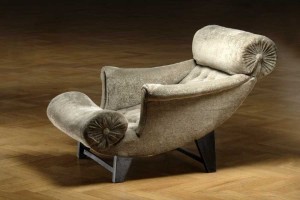
In the center of the “snail room” exhibited by Italian furniture designer Carlo Bugatti (father of the carmaker) there reside three “cobra” chairs. There is an  example of one in Chicago; I’ll have to look for it the next time I pass through.
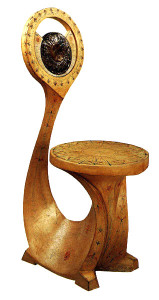
bugatti-chair

This piece is completely covered in parchment, a technique which hid all joints. Decorations are made of hammered copper, pencil and paint, and it is covered with parchment and leather.

The snail room was meant for games and conversation. The chair was shaped like a cobra, inscribed with floral and geometric motifs reminiscent of Islamic art. The chair’s open design served a practical purpose, allowing men’s coattails and women’s trains to hang down behind the seat.

It’s not really Arts and Crafts, but rather Art Nouveau, emphasizing ornament over the more self-consciously “honest” styles of the north.

Though they are sometimes lumped together, there seem to be some very important distinctions between the complex emergent styles of the late nineteenth and early twentieth century.

I opened my eyes, and now the head of the snake was close to me, facing me. How magnificent it was! The colors, glittering in the most wondrous shades, were blinding me. The most elegant ornaments were forming in front of my eyes. They curled downward to more rigidly geometrical planes, and on the lower parts of its body, where the colors turned more vulgar, the patterns became coarser and more abhorrent.

But the evil little head with the shield around the neck, which is so peculiar to the cobra, offered overwhelming richness of lines and color.

I had to look at it with an admiration close to rapture. The small eyes of the snake were glittering maliciously. They peered almost laughingly into mine. The head was rocking from time to time, sometimes shooting forward and then pulling back, and then I felt its repugnant spongy body pressing itself closer and closer to mine!

I knew that my life was not worth much by now. However, I seemed to myself triumphantly proud, felt that now I would be able to show those present what kind of man I really was.

Or was I?

Oh no, it was so thoroughly terrible, the tension was horrifying! If only the loathsome garishness would disappear! But if all turned out well, what a hero I would turn out to be! (ibid. 1-2)

It is extremely unlikely, I think, that Carl Larsson and Carlo Bugatti were familiar with each other. Nonetheless, it seems almost as if Larsson’s downright weird introduction to his autobiography might be productively be read as a critique of Art Nouveau. There’s a curious love/hate relationship with ornament across all these different threads of design.

Mackay Hugh Baillie Scott, writing in Houses and Gardens (1906) discusses two popular modes of decoration: heraldry and organic motifs. Heraldry, with its deep ties to the English manor house traditions, was old; natural motifs (decorating around some sort of common organic shape, like lotus flowers) were emerging (thanks to the pre-Raphaelites) as a plausible choice to those setting up a home.

Carl Larsson embraced Gustavian design (a situated Swedish variant of rococo), which is perhaps close to an embrace of the sort of traditional heraldic motifs gestured at by Baillie Scott. At the same time, there was a rustic naturalism to his designs. What the English and Swedish outlooks both share is a desire to ornament in such a way that connects with their national identities.

But the cobra did not release me. Now it approached my face, I felt its tongue as if it were fluttering against my lips, but I smiled and remained courageous.

Ah, but I was petrified, and so was my wide smile. Now, now, it stole its narrow, thin, thin, tongue between my lips. I felt it against my tongue. Now I could take it no longer.

I…woke up.

Fortunately it was only a dream, a nightmare.

I immediately realized it was an allegory of my life, as good as any.

You must try to decipher it yourself after reading the memories I have determined to write down.

My steadily smiling face. My hidden horror of life. I certainly was not a snake charmer. It was the snake—life—that charmed me. (ibid. 2)

Not many artists open their autobiography by spinning a tale about french-kissing a snake. I would be curious why Carl Larsson chose this dream, or why Carlo Bugatti chose the cobra as his totem, or the snail. But some things are certain.

The snail room was exhibited at Prima Esposizione Internazionale d’Arte Decorativa Moderna  in Turin in 1902.  It’s primary dictate:  “Only original products that show a decisive tendency toward aesthetic renewal of form will be admitted. Neither mere imitations of past styles nor industrial products not inspired by an artistic sense will be accepted.”

Both Art Nouveau and Arts and Crafts stress connections, through ornament, to the lands that birthed them. Larsson had his folk styles and Gustavian ornament, Baillie Scott had heraldry and pagan naturalism, while Bugatti was more connected with Moorish traditions. All are situated in ways both intellectual and geographic.

Carlo Bugatti Throne

A Democratic Axe

A Democratic axe

One of the best books I’ve read in recent memory was William Coperthwaite’s A Handmade Life. In trying to figure out what made sense for me, his particular brand of “enlightened selfishness” resonated. A key component in Coperthwaite is accessibility.

In a sidebar I keep revisiting, Coperthwaite laments the accessibility of the small broad axe. I must confess that my least favorite tools are striking tools—things like hammers and axes— because they always seem to go horribly wrong for me. Wood splits (and not where you want it to) or worse still you hit yourself with them. They make loud noises and crush things, etc. However, axes are a frequent matter of discussion among green woodworkers for spoon carving and other activities which I am deeply interested in.

The hard part is that they are really designed to operate on green wood, which I don’t have easy access to. There are only small scrub bushes on my property and trashy pine trees. The only two decent trees, a maple and a pear, aren’t large enough to contribute branches of any size. Also, good axes are expensive. I bought a small swiss hatchet for splitting kindling, but I’m terrible at using it and it’s not really designed for delicately shaping wood. A good axe would cost far too much for me, given my timidity on the topic. Peter Follansbee has excellent recommendations on axes, I suspect, but I’m really not ready to go there. I was surprised that he didn’t mention Coperthwaite’s democratic axe.

Coperthwaite tells the story of searching for a decent broad axe. He carved a model from pine, and found that a blacksmith friend in Japan agreed to forge him one. After two years, the axe never materialized and he was traveling in Italy and found an old blacksmith there that would make one for him. This one was delivered, but Coperthwaite lamented:

Now, these are far from democratic tools. To get one you first have to design it and then know a smith in Japan or Italy or wherever who can—and is willing to—make an axe from your design.

It was doubtful that the axe from Japan would materialize, and the Italian smith was very old and sick and would probably not make another. A good broad hatchet for students and friends who wanted one was as elusive as ever. And though this axe adventure was exciting, and I had acquired some fine ones, we badly needed to have some inexpensive ones available. (17)

The primary difficulty in engineering and axe is the “eye” which attaches it to the handle; this can be avoided by making the blade from a flat plate of steel bolted to a handle. Then, the only technical challenge is hardening and annealing the steel once it is cut out, but a small propane torch and normal household oven can manage that. I note that John Wilson has a similar type of design for an adze, another difficult to find and expensive classic tool.

The importance of the sidebar isn’t really the design of an axe and presentation of easy to follow instructions so that anyone might accomplish it, but the philosophy behind the creation of this tool:

This experience with the broad hatchet is important for me on several levels. First it has been an exciting adventure all along the way, from learning to appreciate the variations in different forms of such a basic tool, to designing my own which others ultimately made, to ultimately making my own. Another level of the adventure is to be able to help others make their own hand axes and in the process gain the confidence that comes from making a tool. This process demonstrates how we can have adventure in a variety of ways: designing, working with the hands, and working with the mind as we carry the concept of democratic things further.

Another value this experience had for me is the breaking of mental and social barriers, which we need to be able to do if we are to solve our problems and create a society that works for all people. (18)

While I was trying to put all this together, I was a bit distracted by a podcast that Chris Schwarz linked— Looking Sideways. What fascinates me about Coperthwaite’s axe isn’t the tool itself. It’s the attitude toward toolmaking and tool sharing. Andrew Sleigh’s interview with Deb Chachra actually dovetailed nicely (stealing one of her hook phrases). She argues that we need to reassess making things in the emphasis we place on the things themselves to rebalance ourselves. Thirty minutes in, she offers the observation that “nice stuff that lasts forever is valuable, but so are the sort of day-to-day experiences that people have.” That’s similar to what Coperthwaite is arguing here. He’s championing not only the physical labor, but also the social and mental labor involved in his search for a serviceable axe.

In her Atlantic article “Why I am not a maker” (not her title, according to the podcast), she makes some really important assertions in the section that the title is misleadingly extracted from:

I am not a maker. In a framing and value system is about creating artifacts, specifically ones you can sell, I am a less valuable human. As an educator, the work I do is superficially the same, year on year. That’s because all of the actual change, the actual effects, are at the interface between me as an educator, my students, and the learning experiences I design for them. People have happily informed me that I am a maker because I use phrases like “design learning experiences,” which is mistaking what I do (teaching) for what I’m actually trying to help elicit (learning). To characterize what I do as “making” is to mistake the methods—courses, workshops, editorials—for the effects. Or, worse, if you say that I “make” other people, you are diminishing their agency and role in sense-making, as if their learning is something I do to them.

There is a quote that Coperthwaite offers up in his book that places the problem in a deeper context:

My teaching is a raft whereon men may reach the far shore.

The sad fact is that so many mistake the raft for the shore. —Buddha (53)

What is important about Coperthwaite’s democratic axe isn’t his methods—securing the the assistance of other artisans, learning how to harden and temper steel, etc.— but rather the effect of solving a difficult problem with easily sourced material, and better still, teaching anyone to solve similar problems themselves. It’s not limited to those who can afford to take a workshop, or travel miles to sit at his feet. A Handmade Life includes how to make an axe, how to bake a loaf of bread (with a recipe) and much more.

I feel incredibly blessed to live in a time where so many share so much on the Internet providing not only access to things, but methods of doing things that I really wouldn’t have invented on my own. It’s not just about having the tools, it’s knowing what you want to do and why. And it’s also important to value all forms of labor, not just the ability to make, except in the sense of making your own life.

The Democratic Kitchen

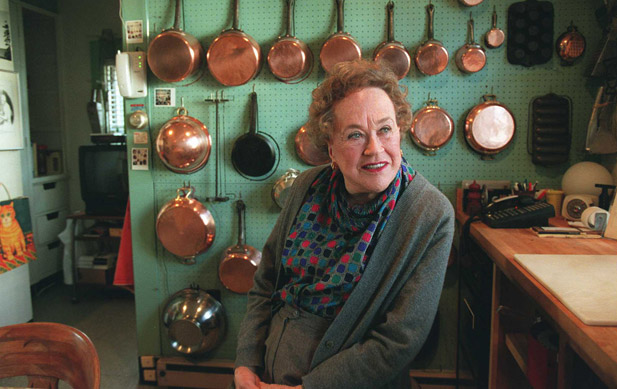
Julia Child's Kitchen at the Smithsonian
Julia Child’s kitchen at the Smithsonian Institution

Julia Child’s kitchen presents an interesting case in domestic design. There is a clearly delineated philosophy behind it. In itself, that’s not rare; however, to have it reflect so directly the philosophy of  a practitioner and influential teacher is not as easy to come by. It’s a workspace, and a democratic one at that.

It’s quite fitting that it was bequeathed to a national museum. As far as I can tell, virtually all of the Smithsonian’s facilities are free from admission charges (except the Cooper Hewitt Museum in NYC) and are open virtually every day of the year except Christmas. Access has no barriers. That, of course, was the centerpiece of the efforts of Julia Child. In the foreword to Mastering The Art of French Cooking from 1961, she began:

This is a book for the servantless American cook who can be unconcerned on occasion with budgets, waistlines, time schedules, children’s meals, the parent-chauffeur-den-mother syndrome, or anything else which might interfere with producing something wonderful to eat. Written for those who love to cook, the recipes are as detailed as we have felt they should be so the reader will know exactly what is involved and how to go about it….No out-of-the-ordinary ingredients are called for. In fact the book could well be titled “French Cooking from the American Supermarket,” for the excellence of French cooking, and of good cooking in general, is due more to cooking technique than anything else. And these techniques can be applied wherever good basic materials are available.

The 1983 introduction of the revised edition remarks that the new advances in technology, such as the food processor, have further lowered the barrier to cooking excellence by simplifying the drudgery; the recipes, in many cases, were revised to reflect that. But from the beginning, it seems as if Julia’s first rhetorical task was to remove the aura of preciousness from fine cooking:

We have purposely omitted cobwebbed bottles, the patron in his white cap bustling among his sauces, anecdotes about charming little restaurants with gleaming napery, and so forth. Such romantic interludes, it seems to us, put French cooking into a never-never land instead of Here, where happily it is available to everybody. Anyone can cook in the French manner anywhere, with the right instruction. Our hope is that this book will be helpful in giving that instruction.

The emphasis, as in most craft literature, is on education about materials (ingredients), tools (batterie de cuisine), and technique. What is also striking though, is that as her career moved on, she also gave a lot of attention to discussing her rationale for her work environment and mise en place. In other words, it wasn’t just about raw materials, tools, fixtures, and skills—attention was also given to workflow and the assortment of jigs that shape it.

In the “Design Anatomy” issue on Julia’s kitchen from 1977 in Design Quarterly composed by Bill Stumpf and Nicholas Polites, the delineate some of the difficulties in finding good analysis of workspaces:

Industry has a tendency to pander to immediate market interests, seeing research narrowly through product eyes; government has a fixation on consumerism and regulation; and, designers rarely have the time, motivation or money required to carefully analyze a philosophical question. (12)

They go on to assert that Julia’s kitchen is “artless,” because it reflects not only successes but failures; it is also “easily perceived,” “small scale,” and “productive”(13). The analysis they offer is useful to anyone interested in domestic design. Throughout, I was reminded of a lot of contemporary writing about woodworking tools and materials.

Julia in her kitchen

Julia Child’s batterie de cuisine, translated by some on the Internet as referring to “pots and pans” is impressive to say the least. But she wasn’t what you would call a tool collector, nor was she snobbish about perfection. The labeling of her tools as a batterie is telling; one does battle with the food, and the tools are the artillery. In Mastering The Art of French Cooking, she suggests that a cook seek out a restaurant supply to acquire good serviceable tools. Obviously she had a big assortment of things (enough to equip a couple of restaurants by some estimations) but they were acquired over the course of a lifetime. Stumpf and Polites summarize her attitude on tools:

Julia’s kitchen is remarkably affordable. This has been achieved by applying four principles. The first deals with the feeling for what is elegant and common and the fact that these qualities are not mutually exclusive in an environment or object. Julia hangs her array of fine French skillets and pots on common pegboard. The cupboards are of pine, yet the drawer slides are of commercial quality, the wine collection is racked on common pine wood shelves and labeled with masking tape. Good quality chinaware is set upon an oilcloth table covering, and so on.

One of my favorite tricks pictured in the analysis is the labeling of all spice jars with the first letter of the name of the spice written large on masking tape, to assist finding and replacing the jars on the spice rack. This seems an essential innovation for less than perfect eyes like mine. I noticed that many people who visit the display at the Smithsonian comment on the oilcloth table covering. It’s a far cry from the carefully woven Arts and Crafts table drapes of not so many years before.

The second principle deals with the long term value of tools. She will buy the least expensive if it works well and endures under heavy and prolonged use.

The third principle focuses upon sources of supply that deliver good value. Julia’s stove was purchased used, and she shops for utensils in professional shops and hardware stores,not design conscious boutiques. In short, Julia loves her tools but is not dominated by them. First, she loves good food and is a good cook. That perspective is never lost on the best of everything kind of environment.

The arguments among hand tool woodworkers regarding boutique tools is something that grates on me like fingernails on a chalkboard; this is where the real bourgeois privilege rears its ugly head in tool geek land. I have nothing against those who can buy a $250 panel gauge (ultimately just two sticks attached together with a bit of brass), but it just doesn’t seem to be a solution for the vast majority of workers. There are obviously tools that are worth more than the sort of mass market “tool resembling objects” that the primary gurus of woodworking rail against, but it troubles me that there is seldom a middle ground in these discussions. A person can buy used (as Julia Child did on some items) if and only if one has the expertise to do so.

That’s hard to acquire when a craftsman first starts out. There have been attempts to address this, but Julia Child’s second principle, of “buying the least expensive if it works well and endures under heavy and prolonged use” is generally lost on woodworkers. Also conspicuously downplayed (though sometimes addressed) is the fourth principle:

The last principle deals with the gradual acquisition of good quality objects. One doesn’t buy a collection of cooking tools and then hope to cook with them. One learns slowly, adding tools to suit new recipes and processes. Only by knowing how to cook can a cook truly evaluate the worth of a tool. . . particularly a new tool. (18)

The Design Quarterly articles go on at great length about her stove, with extensive photographs as if it were a sculptural object, but in the end the detailed discussion of workflow in Julia’s kitchen is the real pay off. I will have much more to write about that later.

Julia’s kitchen is indeed a philosophical space. It’s not at all anarchistic, it’s structured in such a way to generate as much of a dialog as possible all the while keeping a sort of easy expertise in flux, ready to be modified and experimented with. It’s a democratic kitchen, which like Julia’s recipes, is within reach of everyone.

Julia’s Kitchen

Julia Childs

Until the last year or so, I was completely unfamiliar with Julia Child. My only real exposure to cooking shows was Martin Yan —”If Yan can cook, so can you!” I managed to make a fairly decent lo mein twenty or thirty years ago from that. Modern cooking programs do very little for me. The whole “cooking challenge” nonsense that seems to dominate these days really leaves me cold, and haven’t found much in the genre that really excited me.

I had thought, until I started watching (perhaps due to her screechy patrician voice), that Julia Child was too precious for me. Besides, I had never (as far as I knew) eaten French cooking, so my interest in the subject was low. But I couldn’t have been more wrong about Julia.

One of the best tangents that Witold Rybczynski triggered for me lately was the Walker Museums “design anatomy” issue on her kitchen from 1977. Julia’s kitchen was a habitation that just screams “I am alive!”

julia-jacques500I’ve been watching Julia Child videos for the last year or so, and Jacques Pepin too. What’s different about them from most of the cooking shows out there is that they present an environment that is not hostile or competitive, an environment where everything is simple and possible.

Cooking is about being alive, and celebrating life—not winning prizes or celebrating rare ingredients or techniques. It’s all very average and normal—the opposite of precious. Part of what makes this possible is the environment in which it is enacted, the kitchen.

Building on the essay by David Kirsh I linked previously, Matthew Crawford describes the kitchen as a jig deployed by an expert in an interesting way:

A physical jig reduces the degrees of physical freedom a person must contend with. By seeding the environment with attention-getting objects (such as a knife left in a certain spot) or arranging the environment to keep attention away from something (as, for example, when a dieter keeps certain foods out of easy view), a person can informationally jig it to constrain his mental degrees of freedom. The upshot is to keep action on track, according to some guiding purpose, one has to keep attention properly directed. To do this, it helps a great deal to arrange the environment accordingly, and in fact this is what is generally done by someone engaged in a skilled activity. Once we have achieved competence in the skill, we don’t routinely rely on our powers of concentration and self regulation—those higher level “executive” functions that are easily exhausted. Rather, we find ways to recruit our surroundings for the sake of achieving our purposes with a minimum expenditure of the scarce mental resources.

High level performance is then to some degree a matter of becoming well situated, let us say. When we watch a cook who is hitting his flow, we someone inhabiting the kitchen—a space for action that has in some sense become an extension of himself. (The World Outside Our Heads, 33)

This cuts to the heart of what I’m trying to figure out through my reading and research. My home, as Krista describes it, is a “co-habitat.” I would like it to be a place for skilled work in living. Wendy Hitchmough’s The Arts and Crafts Lifestyle and Design triggered a new round of research into specific rooms beyond the kitchen, but for starters, the kitchen works. In Julia’s case, it’s a workshop but it’s also a social and collaborative space.

On what would have been Julia Child’s 100th birthday, Jacques Pepin wrote a touching memoir about their relationship for the New York Times;

Julia and I started teaching together at the university. We argued on stage, stealing each other’s mise en place. We felt comfortable together, had a good rapport, a good time, and we respected each other. Our affectionate disagreements resulted in heated, opinionated discussions; we had conviction, enthusiasm and passion for our métier. This resulted in our doing a couple of three-hour PBS Specials called “Cooking in Concert,” both of which were filmed at B.U.

Eventually, these specials led to our doing a series together for PBS at Julia’s house in Cambridge. Both the series and companion cookbook were called “Julia and Jacques Cooking at Home.”

I find it interesting that the sort of special spatial arrangement that Crawford was writing about, a cook’s “mise en place” is featured in Jacques memories. And in deep sympathy with the sort of situated and contingent world view that the articles about expert intelligence that the AI articles I recently mentioned, Julia and Jacques worked with no plan:

We did not follow recipes, creating them as the shows were filmed. We cooked like friends, spouses or couples do: cooking and drinking together, arguing, then sitting down and sharing the food.

Using Crawford’s framework, it seems safe to say that inhabiting a kitchen means being comfortable enough with the arrangement to admit contingency and disagreement, but also embracing the sort of synergy that comes from not being in total control of events as they unfold. It’s about having a loose sort of arrangement within a carefully specialized regimented environment that allows a maximum of creative potential. Knowing where things are enough to be comfortable, but not being so attached to a planned layout that you can’t release control and allow chance and character to enter the world.

In short, as Van Gogh would say, the kitchen and the people and tools in it should have character. The latest round of readings I’ve been doing have brought out a lot of interesting aspects to the character of various kitchens. Julia’s now resides in the Smithsonian, with good reason. Jacques is out there on Facebook, and the world will really be diminished when he’s no longer in it.

No Sense of Crime

adolf-loos-grave-480x360

The Papuan tattoos his skin, his boat, his paddles, in short everything he lays his hands on. He is not a criminal.The modern man who tattoos himself is either a criminal or a degenerate.  There are prisons in which eighty per cent of the inmates show tattoos. The tattooed who are not in prison are latent criminals or degenerate aristocrats. If someone who is tattooed dies at liberty, it means he has died a few years before committing a murder.

The urge to ornament one’s face and everything else within reach is the start of plastic art. It is the baby talk of painting. All art is erotic.

The first work of art, the cross, was erotic. The first work of art, the first artistic act which the first artist, in the urge to rid himself of excess energy, smeared on the wall. A horizontal dash: the prone woman. A vertical dash: the man penetrating her. The man who created it felt the same urge as Beethoven, we was in the same heaven in which Beethoven created the Ninth Symphony.

But the man of our day who, in response to an inner urge, smears the walls with erotic symbols is a criminal or a degenerate. It goes without saying that this impulse most frequently assails people with such symptoms of degeneracy in the lavatory. A country’s culture can be assessed by the extent to which its lavatory walls are smeared. In the child this is a natural phenomenon: his first artistic expression is to scribble erotic symbols on the walls. But what is natural to a Papuan and the child is a symptom of degeneracy in the modern adult. I have made the following discovery and I pass it on to the world: The evolution of culture is synonymous with the removal of ornament from utilitarian objects. I believed that with this discovery I was bringing joy to the world; it has not thanked me. People were sad and hung their heads.

Adolf Loos, “Ornament and Crime”

The French and the Germans obviously couldn’t be further apart on these issues. Van Gogh and Gauguin had a completely different perception of “primitives” than Hermann Muthesius and Adolf Loos; the same could be said of other European artists like Picasso and Braque.Joan Miro’s embraced of children’s drawings, and it’s also worthwhile to note that Paul Klee, a Swiss-German, didn’t have any difficulty as seeing children’s art as worthwhile and even “progressive.” Further, even Loos himself deployed ornament on utilitarian objects, despite this shrill protest.

Knieschwimmer chair
Knieschwimmer chair

Aesthetic puritanism never seems to work out, but nonetheless, Loos was its most impassioned advocate:

If I want to eat a piece of gingerbread I choose one that is quite smooth and not a piece representing a heart or a baby or a rider, which is covered over with ornaments. The man of the fifteenth century won’t understand me. But all modern people will. The advocate of ornament believes that my urge for simplicity is in the nature of a mortification. No, respected professor at the school of applied art I am not mortifying myself! The show dishes of past centuries which display all kinds of ornaments to make the peacocks pheasants and lobsters look more tasty, have the opposite effect on me. I am horrified when I go through a cookery exhibition and think I am meant to eat these stuffed carcasses. I eat roast beef.

A fan of roast meat and boiled vegetables, Loos had a big impact on kitchen design, although somewhat indirectly. Loos outlook was utopian in the extreme. He sought to conserve the labor expended in ornamenting things to use it more productively furthering humanity. He did concede that some did get pleasure in the creative labor invested in ornament, and claimed that he would wear ornamented products to please others, though he took no pleasure in it himself. But he stood by his claim that the urge to ornament was counterproductive and wasteful, a primitive affectation for the masses.

The Taylorist “Frankfurt Kitchen” designed by Margarete Schütte-Lihotzky was thought to be a liberatory design— freeing women to work in factories instead of the house. The simplified version of a kitchen, which dispensed with most food storage, sought to streamline the social habits and inheritance of the kitchen in the same way that Loos sought to strip away ornament.

Historical culinary practices were thought by the German modernists to be a “primitive” affectation with no place in modern life.

The most telling comment, as translated by Wikipedia, was this:

On her 100th birthday Schütte-Lihotzky commented “You’ll be surprised that, before I conceived the Frankfurt Kitchen in 1926, I never cooked myself. At home in Vienna my mother cooked, in Frankfurt I went to the Wirthaus [restaurant/pub]. I designed the kitchen as an architect, not as a housewife.

Schütte-Lihotzky worked closely with Loos in the 1920s, and the changes to the kitchen wrought by her designs and the emerging new philosophy of the kitchen have had a deep influence on domestic design. Schütte-Lihotzky conceived the kitchen as an integral part of the living area, though it could be partitioned off if need be. This is in stark contrast to the English manor house tradition of a completely separate wing for domestic activities. This change presents interesting problems, both socially and architecturally.

Loos offered his solution in a 1926 lecture entitled “The Modern Settlement” suggesting that unpleasant cooking smells were best avoided, not by separating the kitchen from the living areas, but rather by only cooking foods which had pleasant aromas—ham, eggs, and beef steak. His argument for a rationalized system of food production and management has echoed across the twentieth century, with many unwanted side effects. I’m trying to track down much more material on this.*

Curiously, there seems to be an obsession among German architects of the early twentieth century with fire. Hermann Muthesius goes into great detail on the subject:

But an open fire is still indispensable for several activities at the English stove. First among these is the toasting of bread that forms so important an element of the English breakfast; toast entirely replaces our continental breakfast bread and rolls. The English are also still very fond of roasting meat on an open fire, a method of preparation that undoubtedly has great advantages; for the juices remain in the meat and meat prepared in this way is tastier and more easily digested. It would not occur to the English to add any kind of sauce to roast meat; and indeed, it needs none. At most they use one of the piquant sauces that can be bought ready-made such as the famous Worcester sauce. Consequently an important aspect of the higher culinary art, the preparation of sauces, is practically non-existent in the English kitchen. If one adds to this fact that vegetables are also simply boiled in water with nothing added and that all the dishes consisting of several ingredients combined and cooked together which our German cooking is so rich, are entirely unknown, it becomes obvious that English cooking is extremely simple, almost primitive. (The English House, 97)

So, the conclusion is—open fires, no sauces, no fancy breads, plus boiled vegetables equates with “primitive.” For culture, the English are (according to Muthesius) dependent almost entirely on the French. However, this doesn’t mean that their aren’t good things to say about this “primitive” English life:

But all English dishes are made from the best raw materials. Nowhere will you find a leg of mutton to equal that in England and their beef and vegetables are also excellent. Good materials make up for the lack of style; indeed, once one has become used to the artless English cooking, one has the feeling that embellishments would not find favor there; and once has made its acquaintance, the sophisticated French cuisine seems spineless, almost insipid. (ibid.)

It’s easy to see from this that the lack of embellishment in English cooking is the most positive thing about it, an aesthetic trend grasped by the Germans with a revolutionary zeal. Stripped down kitchen facilities, and stripped down food, become the hallmark of the twentieth century. Rationalized kitchens go hand in hand with rationalized food.


*After writing this, I discovered this passage in Adolf Loos’ 1910 essay titled “Architecture”:

If we were to come across a mound in the woods, six feet long by three feet wide, with soil piled up in a pyramid, a somber mood would come over us and a voice inside would say, “There is someone buried here.” That is Architecture.

Life, death and habitation

RIP, Renato Bialetti


438-COVER-OF-RAMESES-II-SARCOPHAGUSEven in death, there’s a social impulse that insists that we must inhabit something. While a moka pot is an unusual choice for an urn, it’s somehow fitting. The choice of a utilitarian object to me is far less precious than say, a jewel encrusted sarcophagus.

Each choice, in its own way, is precious though. To dwell in the shape of your significance on earth, be it a un unusual urn or decorated monument or tomb, is motivated by a desire to make it known that to be in a place was your choice. It didn’t just happen by accident. Either you wanted it, or someone else found the need to adore and celebrate you. 

That’s one of the things I found most compelling about Vincent Van Gogh’s dream of home. He didn’t want it to be precious, but he wanted it to be recognizable as his.

Van Gogh’s proclamation of “nothing precious” is the most curious demand though, for an artist who was hoping to decorate nearly every surface. What Van Gogh was striving for, in his own words, was character. Invariably, we always look to appearance to find clues.

The Mummy of Ramses II.

“King of Kings am I, Osymandias. If anyone would know how great I am and where I lie, let him surpass one of my works.” Works, loosely defined, surely must include all those things we do to form and deform the space around us. Van Gogh wanted to shape not only the space of the canvas, but also the space he and those who knew him would inhabit. Decoration plays a part in this.

As far as I know he didn’t follow through on it, but Van Gogh’s naked ladies adorning the bed would have been an unusual choice for the late 19th century. From what I’ve been reading, the movement was to de-sexualize the sleep chamber in most countries. Bedrooms, instead, were generally striving to look and be clean places. Though the Arts and Crafts parlors were dark and heavy woods, I was a bit surprised that even they wanted to paint the bedroom white. Habitations always tend to follow conventions and deviation is usually the proclamation of an “artistic” taste. The foundation of these conventions is not just a matter of decoration, but also of spatial placement.

Feng Shui, the Chinese science of spatial arrangement deployed for both buildings and interiors, has deep roots in the graveyard. The Zangshu, or Book of Burial is perhaps its oldest surviving text:

VIII. The Cardinal Aspects

A. The Four Aspects

1. Bury with the Cerulean Dragon to the left, the White Tiger to the right, the Vermilion Bird in front, and the Dark Turtle in back.

2. The Dark Turtle hangs its head; the Vermilion Bird hovers in dance; the Cerulean Dragon coils sinuously; the White Tiger crouches down.

3. If contours and features do not conform to this, according to the art of fengshui, there will be destruction and death.

4. Therefore the crouching tiger is said to hold the corpse in its mouth.

5. The coiled dragon is said to be jealous of life.

6. The Dark Turtle that does not droop will reject the corpse.

7. The Vermilion Bird that does not dance will soar off.

The Chinese developed the compass, not for navigation, but rather to figure out how to situate themselves and their dead in the world.  The curiosity about optimal orientation by cardinal direction is persistent. In The English House from 1904, Hermann Muthesius discusses the optimal arrangements for bedrooms at length:

A south-easterly aspect is again considered best for the bedroom. The bedroom is a room in which we spend about one third of our lives in continuous periods of between seven and nine hours. Consequently its position must be a particularly healthy one, which means, most importantly, that it must be sunny by day. Yet the afternoon sun in the summer would make the room too warm. Since people like to salute the morning sun as they rise, an easterly aspect would seem to be indicated. But that room may get continuous sun for several hours after the occupant has left it, it is better that it should face south east rather than due east.  (91-92)

Not quite as poetic and nuanced as the Chinese positioning literature, but consummately well reasoned as is fitting the western approach. Also predictable is the certainty of the discussions of position:

Yet there can be no doubt that the only proper position for the bed is with the head against a side wall and the plan of the room must without fail provide for this. This having been established, English opinion further requires that the left side of the bed be near the window. The reason for this is that the conjugal bedroom in England is always used as a dressing-room by the woman and the furniture that she needs for her toilette such a wash-stand, dressing-table and wardrobe stand next to a window. As we shall see, the dressing-table indeed, stands right in the window. The woman therefore takes the side of the bed nearest to her part of the room and since by ancient custom the woman sleeps on a man’s left, the bed must stand with its left-hand half on the window side. The position of all the bedroom furniture and of the doors and windows is now firmly established. The door into the man’s dressing room is in the wall nearest to the right-hand side of the bed. (92)

East or West, we expend a great deal of energy attempting to divine the best positions for ourselves, both in life and death. I hadn’t really expected a book ostensibly about architecture to discuss furniture arrangement in such detail, but it makes sense. Our habitations are essentially matters of habit.

The Impressionist Home

sidewall.jpg__1072x0_q85_upscale
A web piece from Smithsonian Magazine, “Step Into Van Gogh’s Brilliant Bedroom” lead me down an interesting cul-de-sac this morning. I’ve been wondering about rooms as jigs that shape behavior for a while, and I’m really interested in the Art Institute of Chicago’s airbnb project that allows you to stay in a replica of this famous interior. Would a person start to think like Van Gogh if they slept there?

It reminded me of a song by David Byrne, “Social Studies”, which I used a long time ago to teach extended possibilities for rhetorical analysis. It was never the hit with students that I hoped it would be.


The basic premise is that in order to understand people, you might become them if you consume what they consume. It’s not that outlandish, really. Marketing companies depend on getting us to buy products that allow us to be like the model or spokes-celebrity who shills for them. My longstanding interest in shopping malls stems from the belief that understanding what people choose to buy and how they buy it is important to the understanding society as a whole.

However, lately I’ve taken a deeper turn. I think that lived environments are important not because of what we buy to put in them, but because of the historical reasons why we need/choose these objects to begin with.

Sometime soon, I want to start writing about Wendy Hitchmough’s The Arts and Crafts Lifestyle and DesignI really like the organization of the book as well as the content—it moves from room to room to discuss not only the decoration and furnishing of the rooms, but the social rituals that furnished reasons for the rooms and their contents. It’s focus on the British strain of Arts and Crafts has really filled a gap in my education in that regard.

In reading about Carl and Karin Larsson recently, I cited a passage from an essay by Gillian Naylor that cites Herman Muthesius proclamation that the real innovation of the English was the creation of “the artistic house.” Wendy Hitchmough begins by invoking Muthesius as well, but from a different angle:

Hermann Muthesius concluded that the English derived their confidence and easy assurance from a tyrannical system of rules and customs which dictated what people must wear and how they must behave, and this determined the furnishing and arrangement of their surroundings. It was never necessary to worry about formalities—about where to put the display cabinet, for example, or which room would be auspicious for a proposal of marriage—because the matters were ruled by strict social conventions. “The most striking characteristic that the foreigner notices about the English is that their patterns of life are immutable and fixed for all time. . .Not only  is the domestic routine in the individual and as punctual as clockwork throughout the year but all households of similar economic standing are as like one another as peas in a pod.” (8, 10)

The only way to break free from this regimentation, Hitchmough argues, was “the artistic home.” In the last few decades of the 19th century, it seems that the artistic home was an often repeated trope. It’s there in Van Gogh’s letters as well. His thoughts about home are amazingly profound. From Letter 674:

How I’d like to set myself up so that I could have a home of my own! I never stop telling myself that if at the start we’d spent even 500 francs on furnishing, we would already have recouped all of it, and I would have furniture and I would be free of lodging-house keepers by now. I’m not pressing the point, but what we’re doing now isn’t wise. There will always be artists passing through here, wishing to escape the harshness of the north. And I feel myself that I’ll always be among that number. True that it would probably be better to go a bit further down, where you’d be more sheltered. True that it won’t be entirely easy to find, but all the more reason; if we set ourselves up here, the costs of moving shouldn’t be enormous. From here to Bordighera, for example, or somewhere near Nice. Once we’d settled, we’d stay there for the rest of our lives. Waiting until you’re very rich is a sorry system, and that’s what I don’t like about the De Goncourts, although it’s the truth — they end up paying a hundred thousand francs for their home and their peace of mind. Now we’d have it for less than a thousand, in that we’d have a studio in the south where we could put someone up.

But if we have to make a fortune first……… we’ll be totally neurotic by the time we reach that sort of tranquillity, and that’s worse than our present state, in which we can still stand all sorts of noises. But let’s be wise enough to know that we’re getting dull-witted all the same.

It’s better to lodge others than not to be lodged ourselves here, especially lodging with an innkeeper, which even when you pay doesn’t provide you with a lodging where you feel at home.

The reference to the De Goncourts is a matter of some discussion among Van Gogh scholars, apparently, as to how much or little Van Gogh had read of their work. In describing Van Gogh’s strategies and rhetoric as a letter writer, the suggestion has been made that Vincent might have viewed Edmond and Jules De Goncourt as a sort of crusading role model for the Van Gogh brothers, and they had written about “the artistic house.”

Félix Nadar, Portrait of Edmond et Jules Goncourt

References tothe De Goncourt brothers occur in several of Van Gogh’s letters. I found the Wikipedia entry on  them interesting. French naturalism has had a lot of impact on many visual artists. The 1911 Britannica describes their specific flavor in this way:

“To the Goncourts humanity is as pictorial a thing as the world it moves in; they do not search further than ‘the physical basis of life,’ and they find everything that can be known of that unknown force written visibly upon the sudden faces of little incidents, little expressive moments.”

This aligns closely with Richard Sennett’s assertion that character, for the Victorians, is something that can be “read” from the external appearance of things.  It’s a shift to the visual coupled with an embrace of the emotional and contingent:

“The soul, to them, is a series of moods, which succeed one another, certainly without any of the too arbitrary logic of the novelist who has conceived of character as a solid or consistent thing. Their novels are hardly stories at all, but picture-galleries, hung with pictures of the momentary aspects of the world.”

This returns full circle to the “situated” versus “planned” worldview in the AI articles I was exploring yesterday in remarkable ways. Recall that Muthesius spoke of an English “planned” lifestyle that Hitchmough counterpoised with an Arts and Crafts “artistic house” alternative. Life, for an artist, is contingent and arbitrary. Nonetheless, Van Gogh had big plans:

It’s not the least little bit urgent, but I have my idea. I really want to make of it — an artists’ house but not precious, on the contrary, nothing precious, but everything from the chair to the painting having character.

So for the beds I bought local beds, two wide double beds, instead of iron beds. It gives a look of solidity, durability, calm, and if it takes a bit more bed-linen, that’s too bad, but it must have character.

Most fortunately I have a charwoman who’s very loyal; without that I wouldn’t dare begin the business of living in my own place. She’s quite old and has a mixed bunch of kids, and she keeps my tiles nice and red and clean.

I wouldn’t be able to explain to you how pleased I am to find a big, serious job this way. Because I hope it’ll be a true decoration that I’m going to undertake there.

So, as I’ve already told you, I’m going to paint my own bed, there’ll be 3 subjects. Perhaps a naked woman, I haven’t decided, perhaps a cradle with a child; I don’t know, but I’ll take my time.

I now no longer feel any hesitation about staying here, because ideas for work are coming to me in abundance. I now plan to buy some article for the house every month. And with patience, the house will be worth something for the furniture and the decorations. (Letter 677)

The plan, ultimately, was to exhibit both studies for the decoration of the house, and then the house itself. Van Gogh’s emphasis on physical decoration is supported by a definite amount of reading on the subject:

I read in the literary supplement of Saturday’s Figaro (15 Sept.) the description of an Impressionist house. This house was built, as would be the bottoms of bottles, of bricks of rounded glass — purple glass. With the sun glancing off it, the yellow glints flashing from it, it produced an extraordinary effect.

To support these walls of glass bricks in the shape of purple eggs, they had devised a support in black and gilded iron, representing strange shoots of vines and other climbing plants. This purple house was right in the middle of a garden, all of whose paths were made of a very yellow sand. The beds of ornamental flowers were naturally most extraordinary in their coloration. This house, if I remember well, must be in Auteuil. Without changing anything at the house, either now or later, I’d nevertheless like to make it, through the decoration, an artist’s house. That will come. I shake your hand firmly. (Letter 681)

Scholarly notes trace this reference to “an Impressionist house” back to the De Goncourts, but it doesn’t really matter if it’s correct or not; the article Van Gogh refers to actually describes “a modernist house,” so suffice it to say that the house is beginning to develop into an extension of beliefs, attitudes, and predilections of the designers and inhabitants. Van Gogh, like many others at the time, was concerned with putting together a well considered lived space.

At present I’ve also bought a dressing-table with all the necessaries, and my own little bedroom is furnished.

Gauguin’s or another lodger’s — we’ll still need a dressing-table and a chest of drawers, and downstairs I’ll need a large stove and a cupboard.

None of that’s at all urgent, and as a result I can already see the goal, to have the means of having a roof over my head for a good long time.

You wouldn’t believe how much that calms me; I have such a passion to make — an artist’s house — but a practical one and not the usual studio full of curios.

I’m also thinking of planting two oleanders outside the door, in tubs.

Anyway, on this studio we’re probably spending several hundred francs less than Russell, for example, who spends thousands.  And actually, even if I had the choice between the two, for my part I’d prefer the few-hundred-francs method, as long as each piece of furniture was four-square and substantial. But still, the room in which I’ll put up those who pass through here will be like a boudoir, and when it’s finished you’ll see that it’s not a haphazard creation, but a job done that way deliberately. (Letter 685)

The sense of hope in these letters is almost palpable. Like any good frugal house-husband, Van Gogh is striving to shape his surroundings by careful selection and decoration, to make everyone know he meant to do that. This is nearly contemporary with Carl and Karin Larsson and most of the British Arts and Crafts designers.

There was something in the air internationally regarding intelligent domestic design and everyone wanted in on it.

Getting Jiggy with it

When I first read Chris Schwarz’s The Anarchist’s Tool Chest I really wanted to like it. Instead, I found myself arguing with it constantly, not because it is filled with bad advice (it’s tremendous advice, actually) but because of its libertarian posturing. Following most of his strictures closely, one would either have to become a collector of vintage tools or a boutique consumer of specialized products. It always struck me a bit like the big Mercedes SUV’s one sees all over Ithaca with “save the whales” or “go green” stickers on the back.

I suppose I wanted to either love or hate the book, and in the end I just couldn’t. I learned from it instead. I learned a lot, though I confess to using Shinwa sliding bevels over  Vesper tools.

I built the old-school joiner’s tool chest he describes. I originally thought that I’d use it to store kitchen supplies and tools in, believe it or not, because I already have several mechanic’s tool chests, including a full on rolling cabinet (not pictured here). What I found was that this tool changed the way I work, and changed the efficiency of my shop much as he described it would. I figured out that it was far too big to use in the kitchen, so I might as well use it somewhere, right? I still want to take a “workshop” approach to kitchen storage, but that’s a story for another day.

I loved using this box so much that I never bothered to take the time to paint it or finish it in any way. As you can see from the picture, the rolling tool cart and small chest next to it are a total mess. Nothing put away, crap just laid everywhere, etc. In contrast, using this chest I almost automatically put my tools away. No mean feat, when you’re as big of a slob as I am. In fact, I’ve become such a convert to traditional tool chests that my next project may be to build one of the Dutch small chests to go next to the big chest, to replace the mess here—so that I can move the mechanic’s chest and cart where it belongs, into the garage.

The trick is that the traditional chest isn’t just a box to put stuff in, it’s a jig that promotes efficient work habits. Schwarz knew that, and I suspect a lot of people who have built them have figured it out too.

Yesterday, I was remembering Matthew Crawford’s discussion of jigs and decided to revisit the book. I never took the time to do reading notes for it, and I keep wanting to do that since I read it in January. Today won’t be the day I start that; I’m still wrestling with a larger octopus. Funny how thinking and writing about kitchens and houses can send you straight back to the shop.

Crawford notes that his definition for “jig” is adapted from “The Intelligent Use of Space” by David Kirsh, and recommends it strongly. This paper, published in the journal Artificial Intelligence in 1995 makes distinct claims about the way that experts function in the world:

  1. The agents we observe are experts, or near experts, at their tasks, despite these tasks often being everyday tasks.
  2. Experts regularly find that enough information is available locally to make choices without having to plan on-line, using conscious analytical processes.
  3. Experts help to ensure that they have enough information locally by partially jigging or informationally structuring the environment as they go along.
  4. The human environments of action we shall be examining, the equipment and surfaces that comprise each workspace, are pre-structured in important ways to help compensate for limitations in processing power and memory.

Crawford doesn’t cite this directly, but using it allows him to argue that a cook in the kitchen structures his environment in such a way to facilitate the tasks he needs to perform. It’s a spatial usage of the term “jig” that is quite powerful when trying to explain how we negotiate the world as agents of change. Following Kirsh’s sources lead me to Philip Agre, who made even more explicit claims about the structure of the world implied by this mode of thought.

In his doctoral thesis from 1988, “The Dynamic Structure of Everyday Life,” Agre summarizes the historical thinking on negotiating everyday life, which he calls “the planning view,” in this way:

If an agent’s activity has a certain organization, that is solely because the agent constructs and deploys a symbolic representation of that activity, namely a plan.

Everyday activity is fundamentally planned; contingency is a marginal phenomenon.

An agent conducts its everyday activity entirely by constructing and deploying plans.

The world is fundamentally hostile. Life is a series of problems to be solved (11)

As an alternative (and a way of breaking through problems in the development in artificial intelligence) Agre proposes “the situated view” thusly:

Everyday life has an orderliness, coherence, and laws of change that are not the product of any representation of them.

Everyday activity is almost entirely routine, even when something novel is happening.

Everyday activity is fundamentally improvised; contingency is the central phenomenon.

An agent conducts its everyday activity by continually re-deciding what to do.

The world is fundamentally benign. Life is a fabric of familiar activities. (11)

In the universe Agre constructs, a plan is simply one possibility among many others in negotiating any activity. The world has an order and coherence independent, and unaffected by symbolic representations. We improvise our way through, depending on what happens. Thus, as Kirsh builds from this, jigging is introduced to control in a limited way the possibilities inherent in a given situation. Jigs either afford or constrain  outcomes in any given set of contingent circumstances.

In the case of my floor tool chest, I put things back most likely because it’s simply the most direct and logical thing to do. I can’t really balance them on the surface of the chest, as I tend to do with the mechanics chest. To put things back inside drawers as you go is counter-intuitive, because drawers do not afford easy access in the same way that trays do. What seems really attractive about my future dutch tool chest plans is the way it can constrain behavior as well;  one really can’t pile anything on top of the sloped lid, or its mating surfaces, the way you can in a mechanic’s chest.

Crawford uses and explains the technical terms affordance and constraint (taken from the visual theories of Jerome Gibson) admirably. From a practical standpoint, Chris Schwarz does a great job with toolboxes, workbenches, and tools in general; the only real complaint I have is the lack of a richer discussion of potential theories as to why they work the way that they do, e.g. what are the particular affordances and constraints of tools, jigs, and fixtures? To be fair, he does (like any good tool reviewer) discuss the good parts and bad parts of particular classes of tools, but he doesn’t do so in anything approaching a consistent fashion.

In the run-up to the release of The Anarchist’s Design Book, Schwarz claims to only have feelings about craft while standing at his bench, rather than when writing. I don’t see that working leads to any sort of feelings that might be symbolically represented, so I suppose he’s essentially justified in his evasion of discussing them.

I’m too busy dealing with contingencies in my shop to have anything remotely resembling feelings, theories, or plans. I do, however, develop theories regarding the best way to jig things to achieve some level of success, before I enter the workshop; I have a lot of feelings and theories in that aspect and I don’t understand why Schwarz insists on being anti-intellectual and evasive in that regard.

My favorite discovery through all this reading is the distinct possibility that “The world is fundamentally benign. Life is a fabric of familiar activities”—this sure beats the idea of a canned response to a hostile world.

Without theories of the everyday world, our understanding of intelligence (either human or machine) is impoverished, and sometimes the simplest theories are the most powerful.

Tools, Jigs, and Fixtures

I went through a little research tangent a few months ago regarding precise definitions of tools, jigs, and fixtures. As near as I can nail it down, a tool is the device that actually cuts, abrades, splits, or simply impacts the material at hand. A fixture, according to machinist’s encyclopedias from the late 19th century forward, is a device that holds the material while it is being subjected to tools. Jig is a much more difficult term to nail down, from the standpoint of both usage and etymology.

Matthew Crawford, in The World Beyond Your Head, uses jig in an interesting way—when a cook lays out his tools and ingredients in a precise spatial array, he is creating a “jig” for the particular task he is performing. Crawford’s usage seems intuitively correct, although reading and internalizing David Pye’s discussion of “self-jigging” tools in his infamous elaboration of the workmanships of risk and certainty makes Crawford’s unorthodox usage an interesting twist, moving the term jig beyond the use of tools. Just what does jig mean precisely?

slide_321122_3009619_free

Scalia’s re-introduction of “jiggery pokery” into the popular lexicon highlights the dual nature (and root) of the term. Time Magazine’s etymology doesn’t seem completely right:

Editors at the Oxford English Dictionary traced this particular phrase back to the Scottish word jouk, which means to skillfully twist one’s body to avoid a blow—to manipulate oneself like an acrobat. Scalia, in this case, insinuates that his colleagues bend themselves and dissemble in order to work around the truth by misinterpreting words of the law.

Among the Scots, the word jouk led to the notion of joukery or jookery to describe underhanded dealing or trickery. Pawky is another Scottish word, meaning artfully shrewd. A pawk, on its own, is a trick. And by 1686, some inventive Scottish speakers had combined the words in the phrase joukery-pawkery, which they used to refer to clever trickery or slight of hand.

One key feature of this etymology is that movement is featured, i.e. “twisting to avoid a blow.” This would mesh genetically with the received usage of “jig” as a method for guiding a tool, or in Crawford’s usage, guiding action through a placement that facilitates specific movements. What’s missing in this definition though, is that the English had a completely different  usage (and spelling) for “joak.” And, what seems more connected to the matter at hand, a “jig” is also a dance— a rhythmic movement up and down, which connects with the English usage of joak in a rather suggestive way.

Joak, in England and Wales at least, meant female pubic hair. There were many popular bawdy songs like “The Black Joak” from the 17th and 18th century. Joak is also spelled “joke,” as in “The Nut Brown Joke”:

No Magick has so mighty a Force,
Both Person and Heart, for Better and Worse,
In a Circle to lock,
As her Nut-brown Joke
Where Ages are lost,
And Pleasures engrost,
Where Soul and Sense their Paradise find.

Jokes of many colors were popularized in song, a fact that I find quite amusing. Jig, as reported by other online etymologies has a similarly checkered past:

From 1580s as the music for such a dance. The extended sense “piece of sport, trick” (1590s), survives mainly in the phrase the jig is up (first attested 1777 as the jig is over). As a generic word for handy devices or contrivances from 1875, earlier jigger (1726). Other senses seem to be influenced by jog, and the syllable forms the basis of colloquial words such as jiggalorum “a trifle” (1610s), jigamoree “something unknown” (1844), also jiggobob(1620s), jiggumbob (1610s); and compare jigger (n.). “As with other familiar words of homely aspect, the senses are more or less involved and inconstant” [Century Dictionary].

I wasn’t able to confirm that the road that leads out of a mine was also once called a “jig” though I found reference to that a few places, and I also found it interesting that the most extensive discussion of mechanical jigs in the 19th century referred to mining jigs, which were devices that directed the ore over a screen and moved it mechanically to separate material by size. Jokes aside, in every case definitions of jig seem to be connected to movement of one kind or another, lascivious or not.

To this day, prostitutes turn tricks, so the term jig seems to be caught up in a universe of terms that are layered in meanings that may or may not be relevant to the usage at hand. From a craft standpoint, it seems suffice to say that a jig is a device that guides or facilitates the motion of a tool. That’s the best I can come up with, after all that (admittedly fun) research.

For some reason, Scalia’s death reminded me of it all, so I felt compelled to write it down.

Upcycling

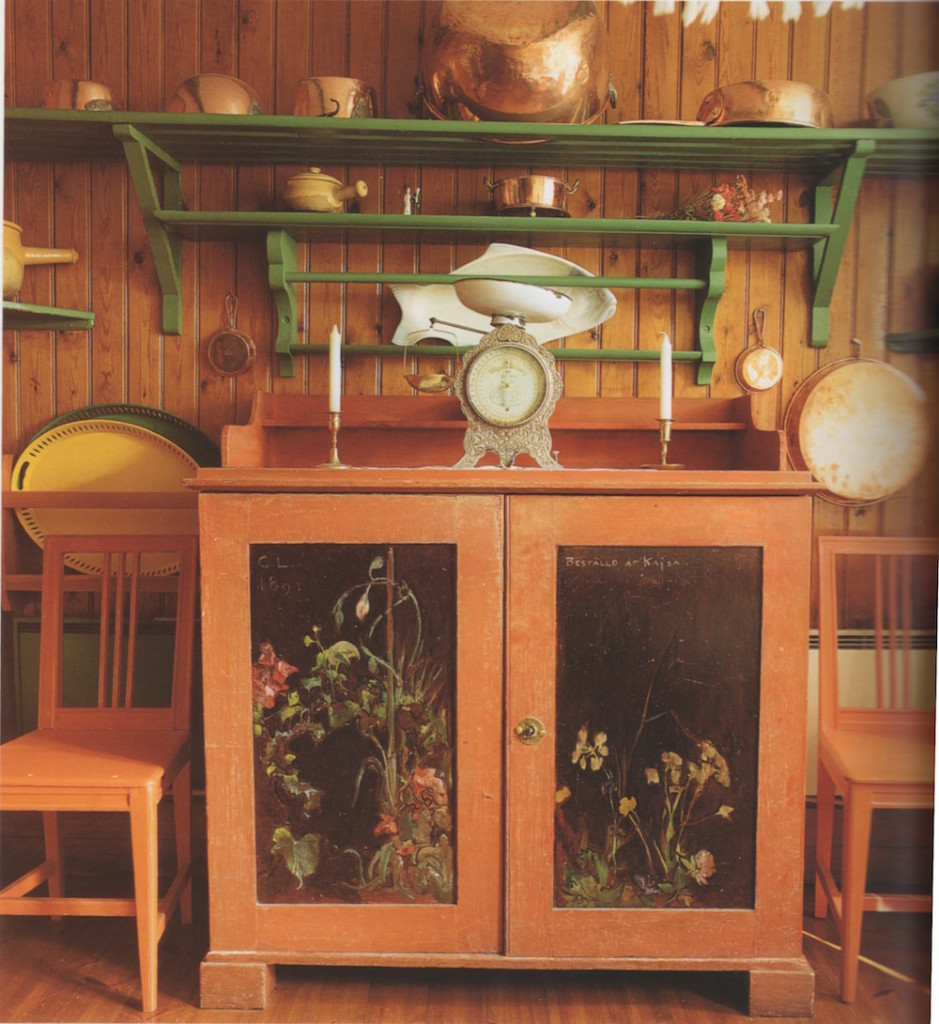
Carl Larsson's upcycled kitchen cabinet
Carl Larsson’s upcycled kitchen cabinet

Carl Larsson could make a work of art out of even the simplest piece of furniture. The very plain cupboard, which was painted in China red, and the door panels were black-lacquered and decorated with growing flowers, in a clearly Japanese-inspired, asymmetrical composition. This piece of furniture expresses much of the young Carl Larsson’s freedom and inspiration.

Carl and Karin Larsson filled their house with old furniture, bought or given at different times. Nearly every room has a piece of furniture radiating a Baroque exuberance and a feeling for constructional clarity characteristic of peasant master craftsmen. Many of the heavier pieces of furniture probably belonged to mine shareholders, well-off land-owning farmers with a share in the local mine and arable land. Several corner cupboards and mouldings on the doors came from farmer’s homes in Dalarna. Such furniture was inexpensive at that time, and Larsson sometimes bought furniture in such bad condition that it had to be restored by his handyman. On the other hand, most of the old furniture bought for his home was well-made, of solid materials and good craftsmanship, stable and intended for practical purposes. These items are a reflection of Larsson’s nationalism, an expression of his pride in Sweden’s period as a great power in the seventeenth and early eighteenth centuries. (Elizabeth Stavenow-Hidemark,  “The Larsson Approach to Old Furniture,” Carl and Karin Larsson: Creators of the Swedish Style 187)

It’s very weird to me how the books I read tend to overlap. Chris Schwarz’s The Anarchist’s Design Book is filled with a celebration of the sort of workaday vernacular furniture gestured at (with some more ornate examples as well) in the book on Larsson I’m trying to save some snips from. I’ve never liked the word “upcycling” (apparently this term was coined circa 1994) but the practice has been commonplace for a very long time.

In fact, it’s a centerpiece of Mackay Hugh Baillie Scot’s strategy as well. In House and Garden (1906) He repeats exactly the same strategy:

The best way to secure a satisfactory result in furnishing is to have the furniture made specially for its position—a few things soundly and simply constructed which shall seem a part of the whole scheme. In many parts of the country old furniture of a simple type—gate tables, rush-bottomed chairs, bureaus, &c.—may be obtained at a very reasonable cost; and such things, with a few special made furnishings which cannot be obtained in this way, will always be at home in a house such as I have described. This old furniture has a sort of human character about it; and the varied planes of its surfaces, with its strong construction and evidences of careful leisurely work, make it inviting and homely. The modern ” Art” furniture bears testimony, on the contrary, that it is the work of a drilled automaton. Its pretence to finish is a mere superficial deceptive smartness. No human being ever loved or lingered over its completion, and its Art is the bait held out to the purchaser as a substitute for real excellence of design or manufacture. (40)

Schwarz’s “movement” towards home made furniture is not really all that new, and neither is his ranting against Ikea. It seems to me to be Arts and Crafts, through and through. What I wasn’t really expecting was to find that  a bit further on, Baillie Scot comes out in full support of what Schwarz labels as “boarded furniture.” For those who haven’t been following the woodworking magazines, translates to furniture built with nails:

In the making of furniture there are two principal methods of construction in the joining of its woodwork. The simplest is that now used in making packing-cases, the wood being joined by means of nails. The more complicated is that in which the wood is joined by letting one piece into another by the use of what are called mortices and tenons.

It is a foregone conclusion nowadays that the simplest way of doing a thing is necessarily the worst way, and the nail in modern woodwork has been considered a thing to be hidden. While in all other details of construction a virtue has been made of frankness, and while the pegs of the tenon are displayed to view, the nail is sedulously concealed by all kinds of artifices. In the making of the simple kinds of furniture in which the wood is joined by nails of the kind known as clout-headed, made by a blacksmith, these might be shown without shame, and form a feature in the design, and nothing could be reasonably urged against this simple and direct “packing-case” construction for a chest or cabinet. (41)

So there you have it. Not only does he suggest boarded furniture, he also suggests traditional blacksmith-made nails over machine made wire nails. The old cliché about the more things change comes immediately to mind. But, it’s just as certain to say that craftsmanship never goes out of fashion.

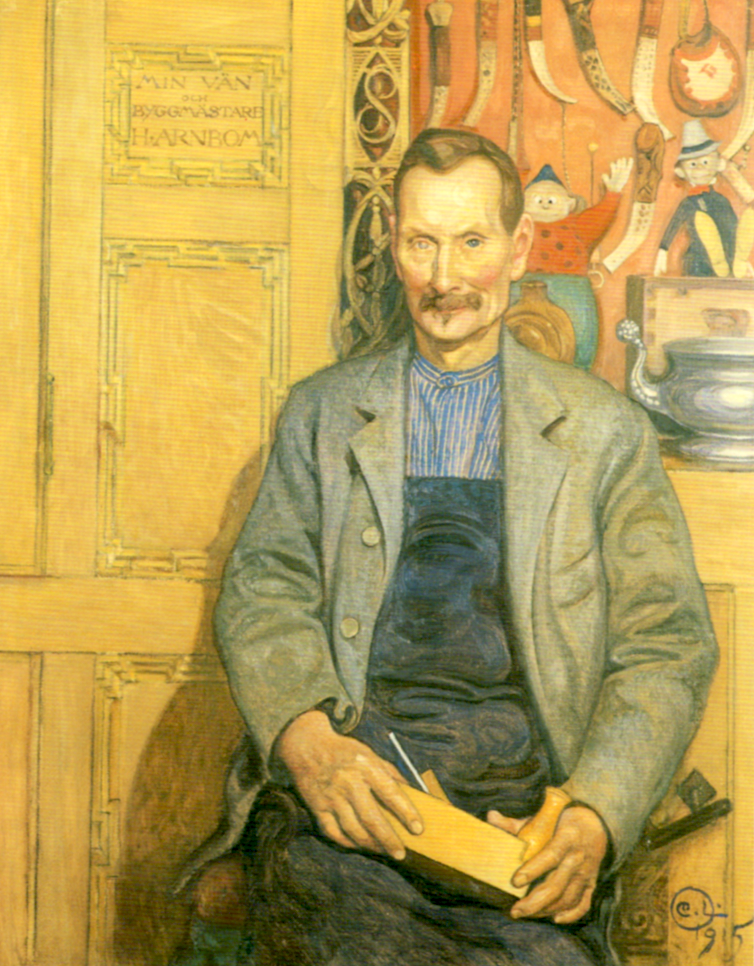
Carpenter Hans Arnbom, 1915
Carl Larsson, Carpenter Hans Arnbom, 1915. The paneling is inscribed ‘my friend and builder H. Arnbom’

Postscript: In the final essay in Carl and Karin Larsson: Creators of the Swedish Style, “The Larsson Design Legacy: A Personal View” by Lena Larsson, she tells this anecdote:

When I went into the business in 1940s [interior design], I was often asked where one could buy ‘Carl Larsson furniture.’ ; the answer was that you had to make it yourself. In 1944 Carl Malmsten published a whole set of drawings for general use. (225).

The designer/craftsman Carl Malmsten, who first encountered Carl Larsson’s books in 1907, was apparently very taken by the interior scenes created by the Larssons. James Krenov, a saint to many contemporary builders, was a pupil of Malmsten. The connections are really fascinating to me.