Object-oriented


My way of working is just a long series of personal discoveries. I can’t give anyone any secrets, something that I promise will work, because, finally, it depends on one’s skill and intuition, and other things. But I can give hints, the benefit of some experience in the things that have happened to me. . . .

Many people don’t realize these truths because they have never been close enough to real wood, beautiful wood in its natural state. They’ve seen veneered surfaces; they’ve lived with wood secondhand, and they are just not aware of the richness that is to be found in individual pieces, logs, and planks. So part of my struggle through the years, both with visitors in my shop and in some of my brief writing, has been to remind people of these things, to tell them not only about the richness of the material, but the connection between the material and how some few people, a very few people, work. In a way I can prepare them to receive these objects, or to meet these objects, and expose themselves to them with a degree of sensitivity which these objects, I hope, deserve. (A Cabinetmaker’s Notebook, 12-13)

I have been building a basement wood shop for about a year now. I have little to show for it in the manner of objects (save shop fixtures and jigs), but the philosophy has enriched me immeasurably. I suppose it began when I moved to the village of Fayetteville, one of the centers of the Stickley universe. The Arts and Crafts Movement coincides with the historical period that fascinates me in photography though prior to locating myself here I had never really thought much about furniture design. I was immediately drawn to the beefiness and practicality of the Stickley designs, but wasn’t really quite sure what to think about Krenov’s spare bird-like pieces.

What becomes instantly apparent when you read much woodworking literature is that it is dominated by machine expediency. The philosophy of people like Gustav Stickley is stripped away in favor of quick-and-dirty methods of replicating the Arts and Crafts look. One has to search pretty hard to find Stickley’s thoughts on craft and life, but it’s findable (though a subject for another day).

Reading Krenov has been a revelation. His thoughts on originality, composition, and materials are first rate concepts for consideration for anyone considering matters of craft. In making sense of things, I cannot help but compare Krenov’s concepts with the craft I dedicated such a huge swath of my life to: photography.

This might seem a bit forced, given that wood is an organic material and photography is currently dominated by talk of megapixels and evanescent virtual bits, but I think that the real gist of photography is just as organic due to the shaping of its human subject. The materials that all photographers work with are primarily time, space, and light.1 The education of a photographer should always begin with a sensitivity and embrace of those three essential elements.

Fall Drive

I am reminded of an incident shooting outside CaTony’s diner last week.

A woman (perhaps “Cathy” of CaTony’s) came out and interrogated me: “What are you taking pictures of?”

“The light, mostly. Isn’t it beautiful?” I answered. The blank look on her face just broadcast suspicion and a complete failure to grasp what I was saying at all. Most people aren’t all that sensitive to light, I guess. If I had answered that I thought her ice-cream shaped lights were distinctive and novel, I might have gotten a more collegial response; it was as if I was speaking a foreign language to her.

Photography is most easily understandable when it addresses the novel, the unusual, the out-of-the-ordinary (celebrity, unusual natural phenomena, etc.). The actual materials of it are subsumed in searching for matters of more impressive visuality. Krenov actually centers this emphasis on visual novelty geographically as the passage quoted above continues:

This is truly an unexplored chapter in the United States. Expression in wood, if I may say so, is a bit heavy handed there; oversimplified. So often the emphasis is on form— as in sculpture. It is primarily a visual experience, with the wood not always having its say, not always as important as it should be—sometimes not important at all. Some artists in wood order their material by telephone, and admit it is not of that great importance. This is not a criticism; it is merely stating that there are different relationships to the material. (13)

Krenov expands his thoughts on visuality and originality in his second book, but this early passage really seems to dig at the bulkiness of most of the Arts and Crafts furniture as exemplified by Stickley and his imitators. Sensitivity to objects, and sensitivity to the tools that create them is central to Krenov. He has little love for the perfection of machines (a quality that Stickley embraces to a much greater degree than his English/European counterparts in the Arts and Crafts Movement). But it would be facile to take this as simply a matter of preferring one sort of form over another. The relationship of material in form (as objects) is what Krenov emphasizes:

So we talk about tools, we talk about objects, and I hope that gradually I can get across this relationship, this love affair or whatever you will. How it comes to be that woods whisper to you about tools and methods and shapes—shapes within shapes, really, because when you become aware of certain ways of using wood, then you realize something about a straight line. To me there is no real life in a perfectly straight line or a perfect circle. But in wood you can make a rectangular object, give it tension and countertension and balance without complete symmetry, and you can give it rhythm by choosing the wood. You may have just a rectangular frame, but you can make it almost soft, almost a sensation of oval for the eye, if you choose the wood in the right way. And you can do the opposite; make it unpleasant by making the wood bow slightly upward and inward so that the corners appear extremely sharp to the eye; this will be disturbing, whereas the other is harmonious. But it is not dead, or lax, because wood is a living material when used in this way. You are always experimenting. You are playing with textures, tensions, the things that happen, and, if you are sensitive, if you are lucky enough, then you exceed your expectations. (14)

I will never forget my first impressions of the work of my mentor Harry Wilson— it seemed as if space itself curved in his photographs, as if you could sense the bulge of the earth. But it was not a lens distortion, or an optical illusion caused by strong and predictable lines. It was a subtle thing, a palpable feeling about space that was not a formal thing, but rather a subjective quality. This quality was real to me, though no one I ever tried to describe it to sensed it in quite the same way (even Harry himself). I just could tell that it was a Harry Wilson photograph because of the space and tensions within that space. It was personal, but at the same time it seemed to be more than that. It was not that Harry “invented” this space, but rather that he identified arrangements of objects in the world that were evocative of that particular space. The space was apparent even in his multiple exposure work, so it seemed to me a matter of selection rather than invention.

I’ve never believed that you have to be all that inventive. Form, for me, is not the primary thing, form is only the beginning. It is the combination of feelings and a function; shapes and things that come into one connection with the discoveries made as one goes into the wood that pull it together and give meaning to form. (Krenov, 14)

The materials of photography are, for me, the world itself which greets us with time and space and light. Photography, for me at least, is about the love affair that I have with the world. I tend to look at photographs as utilitarian objects that give me the chance to examine the world more closely, to know certain aspects that would be invisible without this recording technology.

The difficult thing, then, is dealing with the utter loss of photographs as objects in the contemporary schema of the world. I miss holding them, looking at them, and furnishing my space with them. I have yet to find the skill I need in ink jet printing (or furniture making for that matter) so I feel myself at an impasse. But one thing is certain: I want to focus my effort at creating, rather thans simply consuming, in the space and time that avails itself to me.


1These distinctions have been with me since I first confronted the problem of trying to teach photography at the University of Minnesota. It was a short class, but useful I think both to me and my students. It surprises me that I have never written anything about that (that I remember or can find).


Contriving the exclusion

Mumford.jpg
Lewis Mumford

The pleasure of the text is that moment when my body pursues its own ideas—for my body does not have the same ideas I do. (17)


Roland Barthes, The Pleasure of the Text

When I read Vicki Goldberg’s excerpt of Lewis Mumford’s thoughts on the economy of images emphasizing the curmudgeonly proclamation that the proliferation of images had placed us all in hades, my gut feeling was that his view must be more complex than that. Three quarters of the way through his lecture series published in Art and Techics there is indeed polemic. But he sneaks up on it, making his way through photography on the way as a democratic process:

Now, by perfecting a mechanical method, the “taking of pictures” by a mere registration of the sensations was democratized. Anyone could use a camera. Anyone could develop a picture. Indeed, as early as the 1890s the Eastman Company went a step further in the direction of automatism and mass production, by saying to the amateur photographer—this was their earliest advertising slogan—you press the button we do the rest. What had been in the seventeenth century a slow handicraft process, requiring well trained eyes and extremely skilled hands, with all the rewards that accompany such highly organized bodily activities, now became an all-but-automatic gesture. Not an entirely automatic gesture, I hasten to add, lest any photographers in this audience squirm in agonized silence or break forth into a loud shout of protest. For after all it turns out that even in the making of the most mechanically contrived image, something more than machines and chemicals is involved. The eye, which means taste. The interest in the subject and an insight into the moment when it—it or he or she—is ready. An understanding of just what esthetic values can be further brought out in the manipulation of the instrument and materials. (92)

Mumford equivocates photography with “registration of the sensations,” masking his overwhelming bias toward photography as monosensual: visual to the exclusion of all other sense records. I suspect this is because it allows him to paint photography as gestural, contingent on a button press. Lately I have been thinking that the athletic edge to photography (street photography, as a prime example) invites examination of the invocation of multiple sense modalities. Taste, in its broadest sense, can be stretched to the appreciation of the spatial qualities of representation (beyond trompe l’oeil)— and thus be forced to confront the problems of bodies in space and their relations. The impact of scale, for example, as explored by many contemporary photographers can create special types of comfort, discomfort, and sensual response that are not, strictly speaking, visual. Esthetic values involve more than just the eyes.

The effort to understand the visual often tries to leapfrog over the body to get to the eye stalk. Nonetheless, it is admirable that Mumford does recognize the human qualities of photographs, and has a sense of photography’s history/pleasures

All these human contributions are essential. As in science, no matter how faithfully one excludes the subjective, it is still the subject that contrives the exclusion [emphasis mine]. All this must be freely granted. But this is only to say that in photography another machine art like printing was born; and that the standards of esthetic success in this art are not dissimilar than those in printing. If we consider those standards for a moment we shall have a clue to one of the most essential problems connected with automatism and reproduction.

As with printing, photography did not altogether do away with the possibilities of human choice; but to justify their productions as art there was some tendency on the part of early photographers, once they had overcome the technical difficulties of the process, to attempt to ape, by means of the camera, the special forms and symbols that had been handed down traditionally by painting. Accordingly, in the nineties, American photographs became soft and misty and impressionistic, just when impressionism was attempting to dissolve form into atmosphere and light. But the real triumphs of photography depended on the photographer’s respect for his medium, his interest in the object before him, and his ability to single out of the thousands of images that pass before the eye, affected by the time of day, the quality of light, movement, the sensitivity of his plates or film, the contours of his lens, precisely that moment when these factors were in conjunction with his own purpose. At that final moment of choice—which sometimes occurred when a picture was taken, sometimes only after taking and developing a hundred indifferent prints— the human person again became operative; and at that moment, but only at that moment, the machine product becomes a veritable work of art, because it reflects the human spirit. (92-93)

What this passage makes clear is that Mumford is concerned with the improper use of symbols and the clear role of human choice in art as opposed to technics, his word for technology deployed without the human element. That’s the primary reason for his coinage of techics— it is neither techné nor technology, though it is derived from them— it is the deployment of mindless or inhuman means of reproduction. It’s a shame that Goldberg neatly skips this part (quite photographer friendly) in her anthology.

It is this human element that interests me most in all this; to center photography on one sense (vision) tends to render it mechanistic. The sensual/bodily side of it is difficult to address without resort to subjectivity or spirituality. I think there are objectively verifiable, physical elements involved in perception that are ignored in discussions of reproductive technologies due to a tendency to compartmentalize the sense modalities. That’s why I can’t seem to stop jumping between audio/music reproduction, photographic and sculptural reproduction, textual production and reproduction, etc. It seems like it should all fit together as furniture for living.

Archie and Jughead

Riverdale, CA

I’ve been obsessing a bit about Lewis Mumford lately, partly because I always encounter his writing in oft-anthologized inflammatory “theory bites.” I couldn’t help but think that there was more to it than a simple case of iconophobia. A used copy of Art and Technics, the source for Vickie Goldberg’s anthologized snippet I blogged about a few days ago, showed up yesterday. I don’t often just rip through things like I ripped through this book (a series of lectures)— but I read a hundred pages in about two hours. When it’s had time to digest a bit (and I finish the remaining 50 pages), I’d like to say more. But for now I have to comment about this bit:

Each art has its technical side, and technics involves calculation, repetition, laborious effort, in short, what would often be, were it not for the ultimate end of the process, sheer monotony and drudgery. But in the period when handicraft dominated, the artist and the technician arrived, as it were, as a happy compromise, because, for one thing, their roles were assumed by the same person. By this modus vivendi, the artist submitted to the technical conditions of fabrication and operation, schooling himself to do a succession of unrewarding acts in return for two conditions: first, the comradeship of other workers on the job, with the chance for chaffer and song. companionship and mutual aid in performing the work; and second, the privilege of lingering with loving care over the final stages of the technical process and transforming the efficient utilitarian form into a meaningful symbolic form. That extra effort, that extra display of love and esthetic skill, tends to act as a preservative of any structure; for, until the symbols themselves become meaningless, men tend to value, and if possible save from decay and destruction, works of art that bear the human imprint. (49)

The distinctions that Mumford strives to make in his binary art/techic framework make for an interesting grid: arts are subjective, technics are objective; arts are human, technics are inhuman; arts are orphic, technics are promethean; arts are symbolic, techics are utilitarian; etc. He doesn’t argue for the abolition of either, but rather suggests that they are codependent and in danger of losing balance in the contemporary (1952) world. The case that he makes in this section is that symbolic value has greater durability than utilitarian value. Which reminded me of a photographic series I was working on in the mid 1990s.

Songs from the Valley Towns was my name for a group of mostly square format images taken with my Rollei as I drove back and forth between Bakersfield and Fresno visiting my friend Slim, who had recently completed a collection of songs with the same title. What became clear to me was that there was a symbolic San Joaquin Valley, and there was an actual one. The two things were often at odds with each other. I remember passing through Riverdale, which was primarily a two or three block stretch of nondescript stucco strip malls and open farm fields, and laughing inside.

Riverdale was famous! This was the ancestral home of Archie and Jughead in the comics. I didn’t see any sign of Riverdale high, where Betty and Veronica would have hung out though. Just a TV dealership, and I think a gas station on the corner. The symbolic content of the place (false documents, after all, because comic books don’t exist) overwhelmed its actuality for me. Riverdale wasn’t the only revelation, there was also Pixley, which I blogged as far back as 2002. Pixley was the home of Petticoat Junction on TV.

Pixley, CA

There was no sign of a railroad track for miles, just a note on the door of the unattended used car lot that payments could be made at the Pixley Cafe next door. There was a playful dissonance to all this. I remember reading somewhere that Paul Henning, creator of Petticoat Junction, Green Acres (coincidentally a suburb of Bakersfield) and The Beverly Hillbillies, had simply looked at a road map and pulled his place names from that. Many of the places in the popular imagination could be found, in their less than symbolic form, scatted across the San Joaquin. The symbol, as Saussure has so assuredly demonstrated, is strictly arbitrary.

This amused me greatly then. It still does now; one of these days I need to do some decent scans/ fresh prints of these images. But, back to Mumford:

Now, the dynamic equilibrium on which all life depends is a difficult one to maintain, and nowhere has this been more true than in the balance between art and technics. Esthetic symbolism for a long time seemed to man either a short-cut to knowledge and power or an adequate substitute. So he applied it, not merely to things that could properly be created or formed by these methods—works of poetry and art, systems of conceptual knowledge like mathematics, or patterns of law and custom—but also to the physical environment and to natural forces: he foolishly invoked art and ritual to bring on rain or to increase human fertility. Without the counterbalancing interests and methods of technics, man might have easily gone mad, in that his symbols might have progressively displaced realities and in the end have produced a blind confusion that might have robbed him of his capacity for physical survival. At some point in his existence man must leave his inner world and return to the outer, must wake up, so to say, and go back to work. [emphasis mine] The tool tended to produce objectivity or matter-of-factness, as my old teacher, Thorstein Veblen, used to call it, and objectivity is a condition for sanity. (50-51)

Thinking about Slim’s semi-fictional songs, and the semi-fictional nature of the San Joaquin Valley tended to suggest that the world was filled with facades, and behind these facades there are a lot of ghosts. Mumford’s insights are not wholly negative and technophobic, they are strikingly insightful and progressive for their age. I am drawn to Mumford’s thinking, which tends to steer across the poles of print culture, photography, and sound reproduction technologies as lightning rods for productive discussion. There are no hard and fast lines between art and techics, between subjectivity and objectivity, and it seems a shame that he is colored as a curmudgeon.

Human history, unfortunately, discloses many symbolic aberrations and hallucinations. Perhaps the fatal course all civilizations have followed so far has been due, not to natural miscarriages, the disastrous effects of famines and floods and diseases, but to accumulating perversions of the symbolic functions. Obsession with money and neglect of productivity. Obsession with the symbols of centralized political power and sovereignty, and neglect of the processes of mutual aid in the small face-to-face community. Obsession with the symbols of religion the neglect of the ideal ends or the daily practices of love and friendship through which these symbols would be given an effective life. (51)

I think this anticipates Habermas’s concern with systematically distorted communication and the disjunction between system and lifeworld. The real treat for me is that Mumford faults not the systems, but the deployment of symbols inside them.

In a lot of ways, California was a sustained hallucination that lasted 37 years for me. My means of coping with it was primarily photography.

Pleasure, of a sort

OildaleBreckenridge Mountain views

Reflecting on the two photographs I chose from the cloud of images I took when I visited Bakersfield in 2008, my first return after a decade or so, I suppose the only criteria was that both pictures please me. It is tricky to speak of images as “texts” (I do not wish to offer a “reading” of either picture) and yet it is pleasing to locate the studium and punctum, a la Barthes.

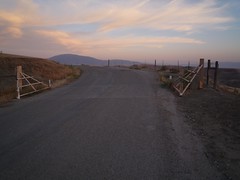
On the left, the studium dominates— when I think of the California I knew it is punctuated with parking lots (in this case a Dairy Queen) and palm trees. These are the “facts” which I never really tired of studying, a perverse sort of pleasure in their constancy. On the right, it is the painted cattle guard as a sort of border between the valley and the mountains, what pricks me (punctum) is not an emotional connection with a pretty sunset, but rather an intellectual pleasure in the knowledge (only found outside the frame on a map) that this is a more than symbolic boundary1 between the open ranges of mountains and my fenced valley home suggestive of its properties. In both cases, reducing the images to symbolic content leaves a taste— a remainder from the division— of a place I once called home. The pleasure “for me” is complex and as Barthes suggests “neither subjective nor existential”:

If I agree to judge a text according to pleasure, I cannot go on to say: this one is good, that bad. No awards, no “critique,” for this always implies a tactical aim, a social usage, and frequently an extenuating image-reservoir. I cannot apportion, imagine that the text is perfectible, ready to enter a play of normative predicates: it is too much of this, not enough of that; the text (the same is true of the singing voice) can wring from me only this judgment, in no way adjectival: that’s it! And further still: that’s it for me! This “for me” is neither subjective nor existential, but Nietzschean (“. . . basically, it is always the same question: What is it for me? . . .”).


Roland Barthes, Pleasure of the Text (13)

When I read this passage a couple of days ago I puzzled over his usage of “Nietzschean.” It took quite some effort to track down the passage he quotes assuming everyone knows. Asserting that the”what is it for me?” question— in matters of pleasure— is not subjective seems to contradict the definition of subjective. After all isn’t all pleasure contingent on the existence of the self? It’s easy to accept that pleasure can’t be existential (because pleasure cannot exist outside the self). The implication that pleasure can be tactical or strategic (or have any sort of pragmatic dimension) is rightfully discarded, enhancing the connection with aesthetic pleasure. But why isn’t pleasure subjective? Perhaps only because of his disclaimer: pleasure in this Barthesian sense has no use and therefore is not a matter of personal benefit/perspective. So the pressure is all the stronger on the for me: to what end, if not a personal utility?

The answer, near as I can tell, is in the passage in Will to Power he quotes so ambiguously and imprecisely:

The answer to the question, “What is that?” is a process of fixing a meaning from a different standpoint. The “essence” the “essential factor,” is something which is only seen as a whole in perspective, and which presupposes a basis which is multifarious. Fundamentally, the question is “What is this for me?” (for us, for everything that lives, etc. etc.)

A thing would be defined when all creatures had asked and answered this question, “What is that? concerning it. Supposing that one single creature, with its own relationship and stand in regard to all things were lacking, that thing would remain undefined.

In short: the essence of a thing is really only an opinion concerning that “thing.” Or, better still; “it is worth” is actually what is meant by “it is” or “that is.”

One may not ask: “Who interprets then? for the act of interpreting itself, as a form of the Will to Power, manifests itself (not as “Being” but as a process, as Becoming) as a passion.


Will to Power

I am certainly not an expert on Nietzsche, and I have many quarrels with most of his interpreters, but it seems to me that most of this is fairly easy to grasp— up to a point. To say that something “is” always entails an opinion and a corresponding value judgment. But the conclusion alludes to (this is a fragmentary and incomplete text) a sort of metaphysical (at least it seems to me) resolution of the problem of missing universal things: universal will. Described here as a passion, it seems to me that what Barthes is summoning in his “Nietzschean sense” is a sort of will to pleasure that exists beyond the existential and the subjective.

Thus, Barthes’ parenthetical benefits from the more emphatic/complete substitution from Nietzsche’s notes

. . . that’s it! And further still: that’s it for me! This “for me” is neither subjective nor existential, but Nietzschean [Fundamentally, the question is “What is this for me?” (for us, for everything that lives, etc. etc.)]

So the aesthetic impulse (pleasure) in this case a universalizing one, a conjecture that the pleasure might be something more than personal/subjective feeling. I like this idea a lot; the possibility that taste, in some way, might transcend its social/communicative utility. But this is a big leap. The commentators I have read on Barthes’ text emphasize the pleasures of text as a way of escaping the subject position, the possibility of liberation— but no one I have read seems to notice that this path leads through universals.

Universals just aren’t Barthesian. The dissonance jars me; I don’t have that much problem with universal claims, as long as they are identified as such. This way of circumventing universals is sly: his claim is for universal processes rather than universal values. Nonetheless, following Nietzsche’s suggested substitution of “it is worth” for “it is,” there is no escape from value judgments and pragmatic utilities. Barthes core claims are at odds with each other.

Who interprets? I think we are doomed to ask that question. 

1Although the lines are an illusory barrier, they are nonetheless a physical presence in the world and not merely a symbol.

Close your eyes

Rock Out.jpg

A screen capture of this Shure ad has been sitting on my desktop for a year or so now. It bothers me a great deal— historically, I think music has been a way of connecting with the world not blocking it out. But music is also linked to escapism and flight to a sort of internal spiritual realm. The dichotomy doesn’t resolve itself neatly. There are a lot of things that I could suggest about this image. For one, music began as a social activity that has been gradually marginalized into privatized spaces, culminating in its domain being simply the distance between your ears. It seems like a rip-off and impoverishment of experience when looked at from that angle.

But in the space between your ears, and more importantly with your eyes closed, there is a sort of purity to it. Metaphorically speaking, it’s as if god whispers to you. To block out the world requires closing your eyes. But closing your eyes—returning to the dark side— suggests a form of death. Not an actual death, but deep separation from our social natures. I am reminded of a song by Steve Wynn about the ending of a relationship:

When they bring down the curtain
In an hour and 45 minutes
we can talk about the play
and pretend that we were never in it

flashes lit up the skies
thunder and then surprise
you can close your eyes

when the earth shakes,
opens up and swallow itself
I won’t be thinking about anybody else

fury and fire flies
it’s too late for compromise
you can close your eyes

words turn to anger,
anger comes to blows
nobody feels the hit but everybody knows

when nothing can tantalize
it’s gonna take a new set of lies
you can close your eyes

Close Your Eyes, from Dazzling Display

The complexity is rewarding. Part of what I read into this is a sort of necessary blindness in the name of moving forward, in the name of getting to the next sort of fiction you have to believe to be safe within a social relationship: “a new set of lies.” The implication is not that closing your eyes grants purity, but rather simply that it shuts out the previous deception. The headphone listener closes their eyes— a different sort of deception, a different relationship with music.

The title track, and indeed the entire LP Dazzling Display nestles in the shadow of its cultural preconditions: the first Gulf War. Many of the songs reflect the shallowness of a television war, with all it’s deceptions and facades. But it seems fallacious to suggest that if we close our eyes to outside stimuli and “block out the world” that the messages we receive will have greater purity, particularly if what concerns us is this world rather than the next. It is a conundrum. Music is a communicative phenomenon that unfolds in space and time, not outside it— just like relationships and wars. Both require massive leaps of faith— suspensions of disbelief, or at the very least, cynicism. Nonetheless, we are easily deceived. Try this video for example:

Even when you know the trick involved, you still can’t help but be deceived. Unless you close your eyes. But live musical events are seldom experienced with eyes closed. Deception is a core feature of the aesthetic experience. If we knew precisely what the experience was, it would lose its attractiveness.

Fidelity

1953a.jpeg

The term “high fidelity” attained broad usage in the 1930s, and the post-war years are often labeled as a golden age of hi-fi. In a synoptic history of reproductive technologies, it should be noted that the documentary genre emerged in the 1930s, and in those same golden years picture-magazines (and socially concerned photography) graced the coffee tables of most middle-class homes. The common thread between both enterprises is a quest for particular notions of fidelity.

An examination of the etymology and history of fidelity as a description is useful. According to the O.E.D., the word was borrowed from the French fidelis in the early 16th century to describe faithfulness and fealty to a person, party, or bond. The connection to oath or bond falls away quickly, but it retains a connection with testimony. Nonetheless, its usage as a faithfulness to truth and reality disappears in the late nineteenth century. Concurrently, it becomes attached to reproductive technologies, at first the telephone and then radio. Fidelity to voice is recognized in Marconi’s 1878 patent on radio.

The evolution is an interesting one; instead of a fidelity to a static truth or reality, fidelity is used most frequently to identify a sort of exactitude of message, a faithfulness to an original. Truth abruptly drops out of the equation. In a historical context, it seems to me that documentary was introduced as a remedy for truth. By that I mean that “true stories” (including true romances and true crime) was the growth segment of the publishing market in the 1920s and 30s and documentary film and photography countered with faith (as in faithfulness and exactitude) rather than truth claims, a counterrevolution of a sort.

I think that this suggests an interesting thing about documentary and musical recording techniques. They are not necessarily married to concepts of fact and truth, as is so often assumed. The facile reference to the presence of fiction in documentary, or artificiality in sound reproduction, doesn’t really stick as damning evidence against them. Documentary (and high fidelity) claims are more directly connected to asking a viewer/listener to make a leap of faith in accepting that the worlds they portray as significant. The criterion of faithfulness refers to a faith in a message worth hearing/seeing, not to “truth.”1

Hence, there is a deep connection to what Wordsworth and Coleridge termed “the momentary suspension of disbelief that constitutes poetic faith” in both recorded music and documentary film/photography. Perfection and authenticity are a matter of subjective rather than objective perception. In fact, it seems to me that “objective perception” is oxymoronic when applied to human receivers. 

It makes sense to keep the gulf between fidelity and truth wide and deep. Claims of quasi-scientific truth work for accuracy of waveforms, or correspondance of brightness zones, but these things do not tell us much about human perception (and the attendent attachment of meaning). They contribute, of course, but ultimately fidelity is a matter of faith not truth. Perfection is in the eye/ear of the beholder.

An interesting sidebar emerges with the survival of an arcane sense of fidelity: fidelity insurance is insurance against dishonesty (such as employee theft). Rather than making the claim that all documentary photographs are false or untrue, one might suggest that some messages are dishonest and exploitive. That makes much more sense to me.

1The rhetorical campaigns of Lewis Hine against child labor springs to mind here— the effectiveness of Hine’s photo-textual broadsides rests not on the truthfulness of his depiction of conditions, but rather in the faith that those conditions were abhorrent and in need of change.

Secondhand World

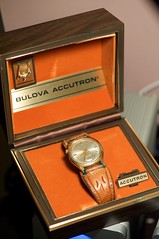
30 year watch
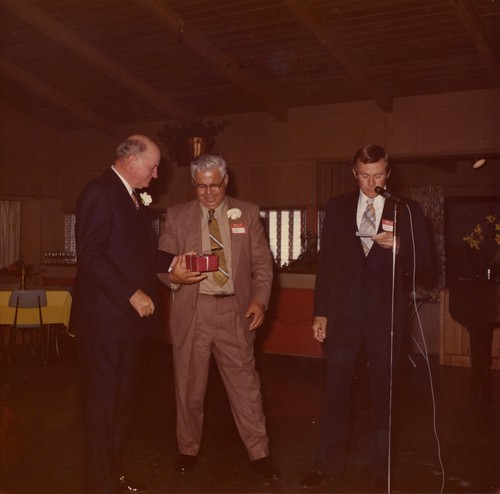
My father receives his thirty-year watch for the benefit of the cameras

Deliberately, on every historic occasion, we piously fake events for the benefit of photographers, while the actual event often occurs in a different fashion; we have the effrontery to call these artful dress rehearsals “authentic historic documents.”

So an endless succession of images passes before the eye, offered by people who wish to exercise power, either by making us buy something for their benefit or making us agree to something that would promote their economic or political interests: images of gadgets manufacturers want us to acquire; images of seductive young ladies who are supposed, by association, to make us seek other equally desirable goods, images of people and events in the news, big people and little people, important and unimportant events; images so constant, so unremitting, so insistent that for all purposes of our own we might as well be paralyzed, so unwelcome are our inner promptings or our own self-directed actions. As a result of this wholly mechanical process, we cease to live in the multidimensional world of reality, the world that brings into play every aspect of the human personality, from its bony structure to its tenderest emotions: we have substituted for this, largely through the mass production of graphic symbols—abetted indeed by a similar multiplication and distribution of sounds—a secondhand world, a ghost-world, in which everyone lives a secondhand and derivative life. The Greeks had a name for this pallid simulacrum of real existence: they called it Hades, and this kingdom of shadows seems to be the ultimate destination of our mechanistic and mammonistic culture.

Lewis Mumford, Art and Technics excerpted in Vicki Goldberg’s edited collection Photography in Print (381-382).

I continue to be fascinated by Mumford’s iconophobia, as he channels Plato’s mistrust of mimesis. To Mumford’s credit, as the passage continues he makes it clear that what he fears is not the iconography of art and artists but rather the symbols created for and by the masses. What I wonder is this: is the smiling obligatory snapshot the symbol, or is it the watch?

30 year watch    

The damn thing never kept time. It never had any utility as a watch; regardless of the claims of the commercials. It was a symbol, and not a happy one for my father. My father always smiled in pictures, even when he was irritated. The whole concept of a secondhand world, filled with technologies (either of accuracy or reproducibility) would have been incredibly foreign. You took the watch that the world offered for your service, and you moved on. He was bitter, because in the end everyone he knew was dying and the company that awarded the watch would not grant him what he really wanted: a transfer back to his home state of Oklahoma. He wore cheap Timex watches until he died, but he never threw the Accutron away. It was symbolic.

The conferring of the watch was also symbolic, but not in any particularly damaging way. I think Mumford really exaggerates that part. Dad had to get dressed up and go to a studio photographer in town to get his likeness taken for the company newsletter. Mom happily hung onto that picture as well. The significance, I think, is not in the symbols but in the way we act. Symbolic inducement, to use the old speech-com term for visual rhetoric, is real. But what we do matters much more than what our social rituals symbolize.

We have never lived in a non-multidimensional space. Such theories of simulation (as manifest in Baudrillard more recently) are to me, worse than useless. They distract us from the reality of our rituals and the physicality of our products—especially our recorded products. The symbolic has never been the center of action, but its periphery.

A symbol-worker never grew a tomato. My father did. He didn’t live in a secondhand world. Symbols remained in their place, reserved for special occasions or filed in a seldom revisited drawer.


June 26, 2000

Symbolic Imperfections

imperfection.jpg Jeff Ward, 1976

I thought of this picture today while reading an excerpt from Lewis Mumford’s Art and Technics (1952):

The fact is that in every department of art and thought we are being overwhelmed by our symbol-creating capacity; and our very facility with the mechanical means of multifolding and reproduction has been responsible for a progressive failure in selectivity and therefore in the power of assimilation. We are overwhelmed by the rank fecundity of the machine, operating without any Malthusian checks except periodic financial depressions; and even they, it would now seem, cannot be wholly relied on. Between ourselves and the actual experience and the actual environment there now swells an ever-rising flood of images which come to us in every sort of medium—the camera and the printing press, by motion picture and by television. A picture was once a rare sort of symbol, rare enough to call for attentive concentration. Now it is the actual experience that is rare, and the picture that has become ubiquitous.

. . . We are rapidly dividing the world into two classes: a minority who act, increasingly, for the benefit of the reproductive process, and a majority whose entire life is spent serving as the passive appreciators or willing victims of this reproductive process.1

Around 75 or 76, I was engaged in trying to make sense of William Blake’s collected works (in a pilfered Modern Library Edition without illustrations). Like many I suspect, when I found S. Foster Damon’s Blake Dictionary at the local Pickwick bookseller down at the Valley Plaza Mall I thought I had found the keys to the kingdom. All a person had to do is figure out what his symbols meant, and you could extract the meaning, right?

I didn’t really think of it in those terms, I suspect— it was more a matter of figuring out what the words meant and why he chose those specific ones. I didn’t really know what a semiotic or symbolic approach was at the time; I was in that cusp between high school and college. My photo teacher, Chris Burnett had recently stepped down as chair of the English department at Foothill high and was willing to help me with both Blake, and photography. He didn’t really know that much about Blake, so he didn’t really discourage me from relying on Damon, nor did he say anything about trying to read the words apart from Blake’s images. For all I knew, Damon’s magic decoder ring actually worked. I think I spent most of the fall of 1975 trying to make sense of Blake, culminating in reading Milton’s Paradise Lost in the spring of 76 in a last ditch attempt to figure Blake out. I wanted more context.

The oblique connection between the Mumford passage and the Blake story is simply this:

The Giants who formed this world into its sensual existence and now seem to live in it in chains; are in truth. the causes of its life & the sources of all activity, but the chains are, the cunning of weak and tame minds. which have power to resist energy. according to the proverb, the weak in courage is strong in cunning.

Thus one portion of being, is the Prolific. the other, the Devouring: to the devourer it seems as if the producer was in his chains, but it is not so, he only takes portions of existence and fancies that the whole. But the Prolific would cease to be Prolific unless the
Devourer as a sea recieved the excess of his delights.

William Blake, MHH16; E40

Blake saw the same division into creative/consuming classes from the opposite side. The “cunning” labor under the illusion that they are exploiting artistic products when the process is ultimately more symbiotic in nature. Artistic production, in Blake’s estimation, is connected with courage: the courage to be taken, and as is often the case, to be taken wrongly. Note that Blake also references sensual existence as the antecedent to  these difficulties. 

Which brings me to the photograph at the top of the entry, a bit of juvenilia really. My brother David thought that this picture could be read symbolically. “You should call it ‘follow the leader’,” he claimed. With typical irony, David’s point was that the guy in front always gets beaten-up the worst. I never thought of that. I was simply attracted to the funky silver spray paint that was dressing up the old poles, creating odd textures in conjunction with the asphalt (and oddly congenial to the “N” surface matte paper that I printed the original on). 

Context explicates attempts to explain the image, not the image itself. David was a technician for IBM and well-versed in corporate culture. I had departed high school, and was working on prints for review at Bakersfield College for my first class with Harry Wilson. It’s pretty understandable that we’d look at the same image different ways. To his credit, I never once heard Harry Wilson offer a symbolic critique of a photograph. He looked at this one  for a moment, solicited reactions from the other students (they liked it) and then as I recall we simply moved on. Years afterward, I think the image popped into my head when I started noticing triadic compostions, but not for long. I can think of far better examples (with regression even). Retroactively, I suppose I can always generate some reason to find this image interesting

Harry was right. It’s best to just move on. The problem with the search for symbolic meanings in a symbolically saturated world is that they tell us more about the person doing the interpreting than they do about the true sensual condition of the world. Though one could make a case for iconology or iconography, it seems a better move to be prolific.

Mumford’s paranoia seems largely unfounded to me. It is a sort of knee-jerk, reflexively imbuing images with symbolic rather than actual significance that is the problem, not the attendant multiplication and reproduction. The divide between producer and consumer may or may not be exacerbated by technology– but it seems pollyannaish to suggest that this gap will ever be closed.

Symbolic contexts never explain the pragmatic deployment of communication strategies. Twenty-years on, taking many classes with R. Paul Yoder at the University of Arkansas, I remember invoking Damon’s symbolic approach to Blake. Yoder’s response was always to say, “that may be true, but what actually happens in the text?

Why do we care about certain things and have aesthetic sensual reactions to them? I don’t think that semiotics can ever get you closer to understanding that. One of the biggest ways of defusing the energy of aesthetic responses is by classing them as symbolic action rather than action.

Now I look at the picture, and the implied action: “why would anyone paint those beat-up poles bright silver?” and move on, quickly. There are more profound actions/questions to address.

Harry was right. I’ve had lots of teachers who were right over the years. The further I get away from the days that made me, the more I understand the context. But the real kicker is feeling like I still don’t understand the text at all.

1 Reprinted in Vicki Goldberg’s edited collection Photography in Print (381-382).

A product that would fail you


From I Need that Record (bonus material)

One of the most common critiques/observations about photography is that it interferes with experience. It is commonplace to assert that all photography is elegiac in nature; it is only slightly less commonplace to compare photography with collecting. It seems productive to examine the relationship of shithoarding (Mike Watt’s colorful description of collecting), time travel, and experience.

Watt’s observes that young people don’t think about the future (and the certain loss of the past) much, favoring instead to dwell on experience and social interaction is well placed. But when it comes to music, we all are not blessed with having tons of live venues just outside our doors. Most of us, historically, have had to rely on records (or CDs, or MP3s depending on your vintage). In that way, the modern experience of music is also elegiac. As a kid, I was just becoming aware of the majesty of Jimi Hendrix’s music when he died. He was long dead by the time I had collected all of his records. It’s not always that extreme, but I think more people discover bands after they don’t exist anymore than discover them in their prime. Does that make these musical experiences elegiac or otherwise inferior to the sense of discovery of new art? Is music appreciation always tied to nostalgia, to shithoarding, to shadow worlds imitating more primal experiences?

From this perspective, recordings (visual, verbal or textual, and musical) are always products that fail. They aren’t originary experiences; they are commodifications of experiences: products meant to be consumed and thrown away or perhaps hoarded. MP3s certainly seem disposable. They are infinitely replicable, and therefore not precious. The same is true of CDs (as a storage medium rather than objects). Vinyl still has that mystique as collectable objects, but it’s connected to the imperfect (read physical) nature of their production and distribution. Paper fades, but it also holds a sort of physicality of touch that more pure repositories of data don’t have. The physical, like life, is riddled with imperfection.

What is missing in this theoretical cul-de-sac is the idea of recordings as social artifacts. As social artifacts, recordings attain a degree of perfection beyond the data they contain. A record doesn’t just simply have value as a commodity, it has exhibition value. It’s interesting to me that Chuck Close from the beginning sought museum sales far more than collector sales for his laborious works. In fact, the lovely self portrait of his that I admired in Minneapolis originally sold for a paltry $1500 or so, just so more people would see it. No one seems concerned about limiting their art experiences to “live painting” rather than dead ones. 

Regardless of replications, I would argue that sincere confrontations with recordings are atemporal rather than elegiac. It’s a matter of how the recording is performed in a social context. Paintings are grouped and regrouped incessantly; so are record albums. Photographs are the most disposable of all though— without an elegiac function, most photographs have difficulty maintaining sustained interest. That is, unless you are a working photographer trying to hone your craft, or an educator or historian attempting to illustrate or simply understand another place and time. The time machine factor always lurks; but we always experience recordings now rather than then. Yes, they have a documentary (or record) value that can be commodified, but the experience of records is social and atemporal.

An interesting take on these matters was recently published (in a buyer’s guide, imagine that!) by Robert Harley of the Absolute Sound:

My friend Mike was at a hi-fi show with the manufacturer of an expensive turntable when a showgoer asked the manufacturer how much the turntable cost. When he was told that it was $75,000, the showgoer replied in shock, “That’s a lot of money for a turntable.” Mike instantly shot back, “Yes, but it’s cheap for a time machine.”

My friend’s view, in addition to being a brilliant witticism, is dead-on perfect; audio components are not things to be possessed, but facilitators for connecting you with music. A turntable doesn’t spin records, it transports you across time and space to those magical moments when extraordinary music-making occurred. It lets us in on the exuberance, tenderness, joy, and despair that can be felt by human beings.

I disagree that the time machine metaphor is “dead-on,” simply because most modern recordings are synthetic; rather than being any sort of event that can be recaptured, they are imaginative products that cannot be located precisely in time. This nostalgic and wistful review of a Mazzy Star album is a case in point. But Harley also explores music as shithoarding vs. social activity:

I see high-end audio from my friend Mike’s perspective. Quality audio equipment isn’t about consumption and materialism, but about experiencing and enjoying one of life’s fundamental pleasures. Sitting at home listening to music (and sharing it with others) is as much a return to simplicity, basic ideals, and valuing experience over possessions as I can imagine. A high quality audio system isn’t a shrine to technology or wealth, but a vehicle for exploring the world of music.

With that different view of high-end audio, the contemporary trend toward experience over possessions, of nourishing our core needs rather than encouraging mindless consumption, should embrace what high-end audio brings to the table— hearing your favorite music wonderfully reproduced night after night. Whether a turntable (of any price) is a thing on your equipment rack or a time machine isn’t determined by the turntable (the object) or it’s owner (the subject), but rather by the relationship between the two. The message from our community needs to be more about time machines and less about gear.

The peroration is decidedly odd, given this is from the 2011 High End Audio Buyers Guide which is filled with stratospherically priced hardware. There are several articles claiming a “democratization” of experience (by low-cost home theater, no less) but little evidence to support the claim that good sound can be had on the cheap. A “bargain” in here has many zeros behind it, save a few token items which are consistently trotted out (including my favorite speakers, the Magnepans). Where is the content that isn’t about “consumption and materialism”? The only article that qualifies is the recommended recordings list.

I fail to see any contemporary trend for “experience over possessions” at work right now. People simply have less money to hoard possessions, or to spend on experiences for that matter. Music rates highly on my list of simple pleasures, and I enjoy good gear— not as a time machine but rather as a sort of “study aid” to the human experience.

Music’s products have seldom failed me; neither have photographs. Both reward sustained attention.

The most perfect place is where you are right now.

April 1983
A motel next to an RV dealer on Union Avenue, Bakersfield, CA

I’ve been thinking a lot lately about places (and perspectives on them). I don’t think that I approach place in the same way as a lot of people, perhaps because of where I grew up. Coming of age in the 1970s, the tradition in photography (especially in California) was dominated by Ansel Adams and his descendants. Not that there’s anything wrong with that.

But those photographs did not describe my world, my home. When I looked out the window I saw something completely different. But it would be myopic to suggest that place is simply a matter of geography/time. People are mobile creatures, and perhaps always have been. It shocked me how far many photographers of the nineteenth century were able to travel, aided by technology or not. But perhaps it’s communication media that have had the greatest effect on leveling things, creating uniformity when there wasn’t any uniformity before.

I remember taking linguistics classes that explored the subtleties of inflection/pronunciation and meaning vs. places of origin (i.e. home). California is fairly nondescript linguistically, but I didn’t even test positive for California idioms. My speech patterns contained artifacts of most of the regions in the US. Talking to my mom, she told me that I learned most of my language and pronunciation from the TV. I watched a lot of TV growing up. The dissonance between the images I saw on television (those people didn’t look like anyone I knew, though the places seemed oddly familiar) and the images I saw in real life was pretty jarring. Just the same, I learned a lot from the box.

No one I knew ever confused TV with real life; “reality TV” is the ultimate absurdity. I think that what TV homogenized is not our lives, but rather our dreams. It sets a horizon that most of my generation never strayed far from. What has this to do with the places we live? Not much, I suppose, other than to promote a disconnect between ideal places and actual places: since we don’t live in pristine nature we make pilgrimages to it and some even fantasize about living there. Sometime around age 18, I turned the box off; I didn’t own one for a while, until they decided to put music on it (but that’s a different story).

I’ve mentioned before that I started collecting and sorting images when I was a teen. Again, these were idealized images and I was always trying to figure out just what made them ideal. Then, for lack of anything else to do I suppose, I went to Bakersfield College (the high school on the hill) and met Harry Wilson. Harry was a firm believer in the “garbage in, garbage out” school of picture viewing. Looking at crap images all the time drove you to imitate and produce more crap advertising images. This sort of penchant for imitation over innovation seems like a given now. The cornerstone of a liberal arts education is to view/read only the best and brightest so that you can converse with the best and the brightest. I dropped out of college then, but I developed more refined viewing habits when I was there (1976-77).

It was during those years that I was first introduced to conceptual art, and really became fond of the practice of landscape photography. When I first saw Friedlander and Winogrand it was like an icepick in the forehead, but what made me fall right over was interaction with my high school photography teacher who had taken a sabbatical in those years to complete his MFA at Cal State Bakersfield. It was Chris Burnett that introduced me to the idea of conceptual landscapes. I started following formulas of a sort, plotting coordinates on a road map of Bakersfield and Kern County to drive to random locations and take photographs. This odd procedural move helped take the idealization out of the process. While it was hard to stop idealizing the locations, being confronted with decidedly non-ideal subject matter constantly forces you to come up with more interesting ways to represent the world. 

The problem with this maneuver, is that it forces your thinking into a sort of grid. Not that there’s anything wrong with that (it works fine for Chuck Close). This just didn’t satisfy me totally, so I would head out to the Kern River. I was always torn between a gridded, systemic approach to things and an more organic and loose approach. But there has always been one constant:

I think that the best place to be is where you are. 

Going back trying to tag my ramblings, I encountered an entry from 2001 where I mentioned taking a findyourspot survey (remember surveys? How 2000!) that suggested that the best places for me to live were all in the South. I took the survey again (it still exists!) to find that the best places for me to live are all in Minnesota and Wisconsin. Give it another year, and I’ll bet it’s saying that my preference is for Central New York. Our ideal expectations are always inflected by what we are viewing/hearing at any given moment.

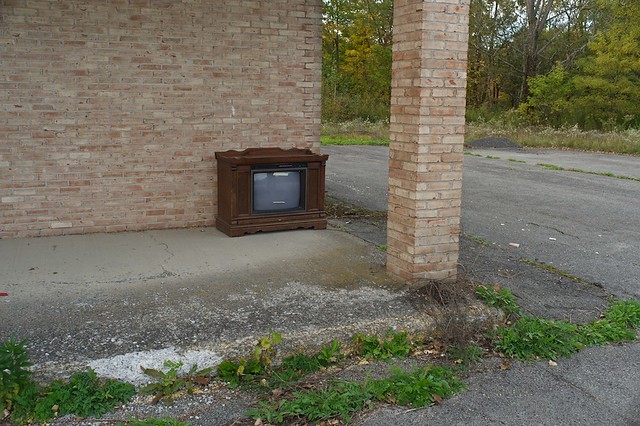
North Country Strip Mall
I was here a few days ago