
At the outlet mall
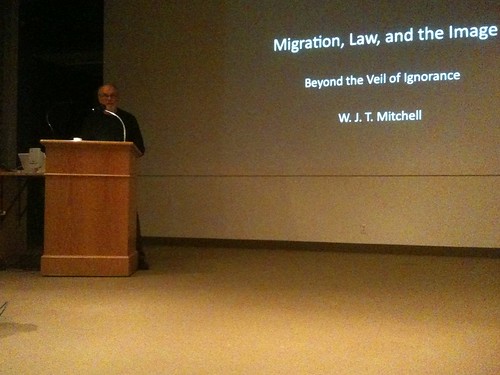
Went to a talk last night by W.J.T. Mitchell. In many ways, it just seemed to be a restatement of the same old problem: how do we reconcile the universal and the particular? I came away completely unsatisfied that this tangent really cast any light on the issue at all.
Mitchell built his talk around John Rawls original position, that of judgment through the “veil of ignorance.” Simply stated, in the liberal approach to morality we must base all moral judgments on abstractions rather than specific concerns. Law should reside outside the traditional communitarian patriarch/matriarch and rely on an imagined ignorance of the particular facts of real people living in the real world. We can only project our symbolic abstractions on a veil of ignorance. Mitchell noted that this approach seems to work within the boundary conditions of specific nations, but not as a global strategy. This, I would assume, fuels his reasoned designation of “beyond the veil of ignorance” as subtitle.
The set-up was pretty basic. One of the preconditions of Judeo-Christian law has been the prohibition of images (second commandment). Restrictions on images have been generally unsuccessful; restriction on the movement of peoples has been more successful—borders with checkpoints and immigration laws resulting in the “de-legalization” of people in specific territories. The ties between image politics and border politics was tenuous throughout the talk. The talk was probative and to my ears inconclusive. In the discussion afterward, Mitchell seemed to imply that the abstract and the specific can be held in suspension and that the veil can be upheld as a path to justice.
I was reminded of William Blake’s usage of “veil” in most of his writings. It seems odd that Mitchell, who began as a Blake scholar, was completely comfortable with Rawls’s use of the term. For Blake, the “veil” was generally held to be metaphorically equivalent to the hymen. Once rent, once you see behind the veil, it is impossible for “innocence” or virginity to grow back.


After having managed relocation to New York fairly successfully, it’s hard to figure out how to move forward. It doesn’t help, when trying to make sense of the world and my place in it, to open start catching up on news feeds to find these two stories juxtaposed:
The Independent: Damien Hirst in vicious feud with teenage artist over a box of pencils
Hard to understand either story, but for completely different reasons. There seem to be multiple worlds at work here.
Update: via Mark Woods, Bill Moyers says his piece regarding the nature of the health care debate: “We are the children of Barnum and Bailey”, to which I might add that there are several parts Three Stooges thrown in there as well.


Mark Woods posted an excerpt from Walter Benjamin’s essay “Unpacking my Library” at the exact moment that I was unpacking my own.
I’ve adopted a strategy of imposed order on my books, because as I get older I find that I can’t instantly remember where certain titles are when I need them. There is nothing more frustrating than wanting to confirm or explore something and then having to search half the day to find it. So, I use Delicious Library to record the books as I place them, for reasons of diminishing space, into numbered boxes rather than neatly arrayed (and spine bleaching) rows. Doing archival work inspired my approach. Archives generally lack a consistent organizing strategy but instead are simply placed into random arrays in numbered boxes with a finding guide. That’s how my boxes are done—simply frozen for a moment in the order they fell within reach of the computer, and easily found with a computer’s help. I found Benjamin’s Illuminations in a moment.
Once you have approached the mountains of cases in order to mine the books from them and bring them to the light of day—or, rather, of night—what memories crowd in upon you! Nothing highlights the fascination of unpacking more clearly than the difficulty of stopping this activity . . .
Oh! bliss of the collector, bliss of the man of leisure! Of no one has less been expected, no one has a greater sense of well being than the man who has been able to carry on his disreputable existence in the mask of Spitzweig’s “Bookworm.” For inside him there are spirits, or at least little genii, which have seen to that for a collector—and I mean a real collector, a collector as he ought to be—ownership is the most intimate relationship that one can have to objects. Not that they come alive in him; it is he who lives in them. So I have erected one of his dwellings, with books as building stones, before you, and now he is going to disappear inside, as is only fitting. (Zohn trans, 66-67)
What I find most interesting about the essay is that it suggests that arrangements of books share the order/disorder of memory. This order is neither alphabetic nor chronological; it is thematic and based in moments, not taxonomies. In my case, this thought was in box B018.

The largest frying pan in Iowa
I think Krista was channeling Shannon here. This photograph was taken on our first day on the road back to NY, with a slight detour towards my friends Derek and Liz in Iowa City, Iowa. This was a wonderful way to start the trip. Discovering the happy propane guy I posted from my phone on Saturday reminded me of this moment— those two should hook up!
