Door handle to the bathroom in the Military Museum in Vienna.
But does the crafts industry itself not know what it’s best products are? Oh no. It knows as little about its own production as the poet, the painter, in fact any artist at all can know about his own art. Such an artist will always value most highly those products of his muse which have cost him the most effort and vexation. Those creations, however, which he produced almost naturally, without effort, to which he was predisposed and which bear most strongly the stamp of his own individuality, his own character—these he dismisses as not particularly important. Only the unanimous agreement of the public is able to convey to him the correct opinion of his products.
. . .We in fact have something most people lack: our celebrated Viennese good taste, of which some could even be jealous. It is only those unreasonable schools of ours which are to be blamed. They have inhibited the natural development of our arts and crafts.
But the answer to that persistent question goes like this: everything that an earlier period has already produced, insofar as it is still useful today, can be imitated. But the new phenomena of our culture (railway cars, telephones, typewriters, and so forth) must be resolved without any conscious echoes of a formal style that has already been superseded. Modifications of old objects in order to assimilate them to modern uses are not permitted. And so the rule is this: either imitate or create something that is totally new. Of course, I do not necessarily mean by this that that which is new is always the opposite of what came before.
As far as I know, this challenge has never before been expressed so exactly and so precisely, even though similar statements have been made abroad and in professional circles, and even recently in the Austrian Museum. But people have actually been working according to this principle for years now. And this is perfectly comprehensible. A copy of an old master is also a work of art. Who can forget Lenbach’s magnificent imitations of old Italian Masters in the Schack Gallery in Munich? But what is totally unworthy of being called a true work of art is the conscious effort to express new ideas in the style of an old master. It is destined to fail. This is not to say that a modern artist, through an extensive study of a particular school, through a predilection or a reverence for particular period or master, cannot make that style so much his own that his work strongly bears the spiritual imprint of his master. I only have to think of the old-master feeling in Lenbach, or the Quattrocento pictures by the English. But the true artist cannot paint now a la Botticelli, now a la Titian, now a la Raphael Mengs.
What would one think of a writer who today wrote a play in the style of Aeschylus, tomorrow composed a poem in the style of Gerhart Hauptman, and the day after tomorrow, a farce in the style of Hans Sachs? And worse, what writer would have the pitiful courage to reveal his own impotence by confessing his sources? And now let us consider a state school for poets where young artists would be emasculated by being constrained to follow this doctrine of counterfeit, where this kind of literary servitude would be raised to a principle. The whole world would pity the victims of such a method. Yet such a school exists, not for poets, but for the arts and crafts.
. . .
The School of Applied Arts sets the fashion for useful objects. In Vienna it is no easy task to get a hold of a good coal scuttle or fireplace fender! And how difficult it is to find good hardware for doors and windows! I once wrote somewhere that in the last two decades we have gotten Renaissance, Baroque, and Rococo blisters on our hands because of our door handles. There is, however, one proper door handle in Vienna to which I have access; I make a pilgrimage to it whenever I am in the neighborhood. It is located in the new building on Kohlmarkt and was designed by Professor König. But do not go there, my dear reader! They would suspect that I was teasing them if you did. That is how unobtrusive this handle is. (15-17)
This book contains the essays I wrote up to and during the year 1900. They were written at a time when I had a thousand things to think about. For didactic reasons I had to express my true opinions in sentences that years later still cause me to shudder when I read them. Only at the insistence of my students have I in time come to agree to the publication of these essays.
Adolf Loos, “Foreward” Spoken into the Void: Collected Essays 1897-1900, [Vienna August 1921]
When we stick close to our own turf, we never become aware of the treasures hidden at home. That which is first-rate is gradually taken for granted. But when we have have taken a look around us, outside of us, then a sudden change occurs in our estimation of our homespun products.
I left home some years ago to acquaint myself with architecture and industry on the other side of the Atlantic Ocean. At the time I was still totally convinced of the superiority of German crafts and handiwork. With pride and enthusiasm, I went through the German and Austrian sections in Chicago. I glanced with a sympathetic smile at the budding American “arts and crafts movement.” But how that has all changed! My years of residence over there have had the effect that I still today blush with embarrassment when I think of the disgraceful representation of the German crafts in Chicago. These proud and splendid pieces of workmanship, these stylish display pieces—they were nothing more than a philistine sham.
There were, however, two crafts that saved our prestige. Our Austrian prestige, that is, not the German, for here as well the Germans have nothing good to show for themselves. These crafts were the production of the leather fancy goods and the gold- and silversmith trades. They did not operate in the same way. While the producers of the former items were inclined to perform honestly in every line of work, one encountered some of the latter trade’s products in the camp of the shams.
At the time I harbored a silent rage about these objects. There were wallets, cigar and cigarette cases, picture frames, writing implements, suitcases, bags, riding whips, canes, silver handles, water bottles, everything—all of it—smooth and polished, no ornament, no decoration. The silver was at the very most, fluted or hammered. I was ashamed of these pieces. This was not the work of the arts and crafts! This was fashion! Fashion! What an appalling word! The greatest insult to the true and proper craftsman, which I still was at the time.
Of course, the Viennese bought such things gladly. They were called “tasteful,” the efforts of the School of Applied Arts notwithstanding. In vain were the most beautiful objects of earlier periods displayed and their production encouraged. In the end, the gold- and silversmiths did what they were told. They even had their sketches made by the most famous men. But the objects thus produced just would not sell. The Viennese were incorrigible. (Of course, it was different in Germany. There the wallets were overloaded with the loveliest Rococo ornamentation and found a great market. “Stylish” was the ticket.) The Viennese individual was persuaded only with great difficulty to submit his home furnishings to the new regime. But in matters of useful objects or of his own body he followed his own taste exclusively, and here he considered all ornament to be vulgar.
At any rate, I was still of a different mind at the time. But I do not hesitate to make it clear now that at the time even the silliest fop could have surpassed me in matters of taste. The strong wind of America and England has since stripped me of all prejudices against the products of my own time. Totally unprincipled men have attempted to spoil this time for us. We were always supposed to look back; we were always supposed to take another age as our model. But all of this has now retreated from me like a bad dream. Yes, our time is beautiful, so beautiful that I could not see living in any other. Our age is beautiful to look at, so beautiful that, had I the choice of picking out the garment of any other time at all, I would reach for my own with joyful hands. It’s a pleasure to be alive.
In the midst of the general characterlessness of the arts and crafts we must recognize the great service of the two branches of the Austrian arts and crafts already mentioned. They had enough backbone not to conform to the general denial of the time. But respect must also be paid to the Viennese people, who, in spite of all the reforms in the arts and crafts, supported these two industries by their desire to buy. Today we must say confidently that it was only through the productions of leather fancy-goods and through the gold and silver industries that the Austrian arts and crafts received recognition in the world market.
Indeed, the manufacturers in these industries did not wait until the state, by introducing the English models, ended the universal commercial stagnation—a step that now has proved necessary in the furniture industry—but rather, having already gathered strength from the English ideas fifty years earlier, they were renewed and solidly established. For the furniture industry is English from A to Z. Yet, despite this fact no decline has become noticeable, as had been prophesied by pessimists in the furniture business. “England means the death of the arts and crafts.” They say the death of arts and crafts, but they mean the acanthus ornament—about which it was probably true. But our time places more importance on correct form, solid materials, precise execution. This is what is meant by arts and crafts!
(“The Leather Goods and Gold- and Silversmith Trades” Neue Freie Presse, May 15, 1898 p.7,10)
The architectural library is demanding that I give this one back, and there are many notes and expositions on craft in this slim little volume that I want to record.
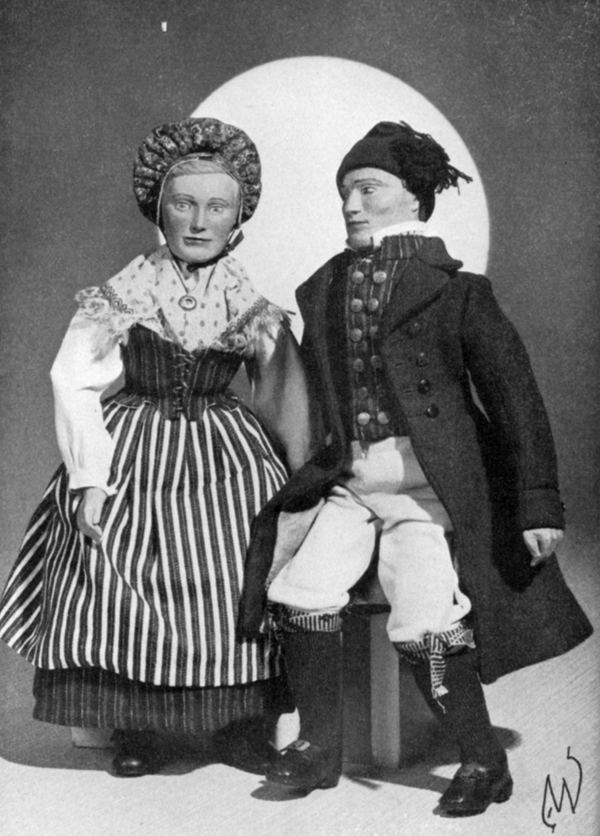
Dolls in national costumes, exact copies of originals in the collection of the Nordic Museum and Skansen, from Swedish Arts and Crafts (1939)
Other than Ikea, I really wasn’t familiar with the unique qualities of Swedish design when I steered a course that way researching domestic design. The biggest discovery of the last few years, (read: “news to me”) is that other countries not only sponsored design, but actively promoted it to improve their countries and national identities.
Not so for the U.S., sadly, where apparently our contribution is cheapening everything by cost-cutting commercial capitalism. While this happened everywhere, it was worse in the US because our government did absolutely nothing to stop it, excepting perhaps the WPA in the 1930s. But the WPA was more of a jobs program, rather than a program of “moral improvement” as the efforts elsewhere promoted themselves.
In England, they had many efforts to improve design in the twentieth century, which I encountered in my readings of David Pye and Herbert Read. In Japan, the mingei movement has elements of this, though its focus was on traditional craft rather than industrial design.
In Sweden, the effort is all the more purist and moralistic due to the socialist government structure adopted there since the 1930s. And the most interesting feature of Sweden is that it embraced both tradition and machine/industrial design. To continue from a source I located last week, Swedish Arts and Crafts: Swedish Modern —A Movement Towards Sanity In Design, I feel compelled to take a few more notes.
Clearly, they were aware of the same degradation that England was concerned with in terms of industrial products and design:
The Swedish home did not escape the debasement in taste which everywhere accompanied the advent of industrialism. The arts vegetated and handicrafts slumped with the disbanding of the guilds. The urban population rapidly grew with the great influx from the rural areas. In the dismal, crowded homes of the early industrial workers there was no opportunity for carrying on the old home craft traditions, which for centuries kept alive the feeling for form and material on the farm. Instead of being producers in a self-sufficient economy, the newly created industrial labor rapidly became the largest consumer class for ready-made factory goods. The new consumer industries were able to produce cheaply, it is true, but the output was of a low standard, due to the lack of manufacturing traditions, the debasement of material, its poor finish and form. But it was not only the recently established working class that fell victim to the first raw phase of industrialism, the taste of all groups of society quickly degenerated. (8)
Note that the crisis is not necessarily the products, but the fact that people will buy them. It’s a matter of taste. The English felt the same way, and in fact the book follows directly from this to cite William Morris. The movement to resurrect traditional craft is seen as an important element in rescuing the public taste from degradation, through the home-craft institutions. It’s a social movement, front and center—but not just of a prelapsarian nationalism, but of the desire to build a new machine society. Now, over a hundred years later, it might be considered to be a worthy “manufacturing tradition.”
Some of the reading I’ve been doing suggest that Swedish design can be productively explored along two axes: Carl Malmsten on one end, and Bruno Mathsson at the other. Carl Malmsten represents the “traditional” axis.
Carl Malmsten, Living Room interior (1939)
This interior is devastatingly familiar to me. It’s a lot like the way that my eldest brother’s first wife, Dana decorated their apartment in LA. Dana was Danish, oddly enough. Now, looking at it, all I can see is Shaker style—the clean lines, the austerity. The table really wouldn’t be out of place at Hancock Shaker village. But another interior from Malmsten, also from the New York World’s Fair in 1939, is a bit different:
This looks a lot more like modern Ikea, in terms of the wall units, but the settle in front is almost prairie style or arts and crafts. On the edge, indistinct and nearly out of the frame in the front right corner, is a more unusual cupboard type cabinet that is inlaid, which is displayed in a detail from the same catalog, Swedish Arts and Crafts:
It’s difficult to tell from the poor halftone, but, these are pastoral scenes with an almost Rocco flair. I suspect this is an homage to Gustavian design.
Malmsten, obviously influenced James Krenov’s aesthetics much more than his more famous counterpart, Bruno Mathsson.
Mathsson, though he was a carpenter’s son, embraced more industrial designs.
I was struck by his chairs with built in swing aside easels, as I’ve been trying to figure out how to manage my lap top in the evenings. There are modern variants of this, of course.
Mathsson was most famous for his chairs, and there’s much to be said on that front at a later time.
For now, what I’m really most interested in are the examples of Swedish kitchens displayed in 1939.
In this design from G.A. Berg, the kitchen has been folded into the living room. Yes, that’s a sink back there divided from the sofa by cabinetry. Perhaps the most unusual feature though, is the dining table that slides between the two halves of the room. Yes, you can slide it into the kitchen for more prep area, and then back into the “living” area for serving. The dining table is on wheels. The mechanics of it are a bit clearer by enlarging the image above, though the general plan is apparent in another view, taken from the kitchen side:
What is clear is that they wanted to innovate, not simply in appearance, but in manners of work:
Abroad, the Swedish efforts to create applied art attuned to modern man and his needs have been termed a style, Swedish Modern. However, by style is most often implied a distinct mode of presentation, something stationary and final. The present Swedish development in the field of industrial arts, on the other hand, is chiefly distinguished by its dynamic character. It is not a style, but rather a movement which we would like to define with the following statements:
Swedish Modern means high quality merchandise for every-day use, available for all by the utilization of modern technical resources.
Swedish Modern means natural form and honest treatment of material.
Swedish Modern means esthetically sound goods, resulting from close cooperation of artist and manufacturer. (13)
I had to steal this image from Urban Rancher’s blog. It’s a drawing of a cabin that became a reality, one of thousands of “tiny houses” that have been all the rage for the last decade or two. I note that this man’s plans include having a separate tool shed nearby (already built in 2010). In the future, he also wanted to add a kitchen/bathroom building with plumbing, etc. I was reminded of one of Chris Schwarz’s famous dictums (about workbenches, I think): “Invent nothing.”
It seems as if most of the the cabin porn floating around on the internet is placed there as if it were a modern invention. Researching Swedish design lately, I was struck by the downright organic progression that is commonplace in many “national” architectures—the transition from farm to manor house.
On tinyhousedesign.com, I note that some enterprising contemporary designer has come up with a “shed cluster concept”:
To make this little group of sheds habitable you’d probably want to build each shed to serve a purpose like a bathroom, kitchen, bedroom, family room, office, studio, etc. Some of your sheds could even serve a combination of functions.
I noted a similar design around a central patio for a mountain vacation cabin, implemented off the drawing board in Microshelterswhen I had that book out from the library a few weeks ago. Enterprising readers might note that we have a concept just like this already— it’s called the residential home. The drawback noted by this designer is that the central area would make it difficult to traverse from shed to shed in inclement weather, making this design more suitable for temperate climates. A common roof for the whole structure might be more practical, but you’d have to worry about snow loads and whatnot—returning, of course, to the typical residential home.
Curiously, I had noted that English manor homes were often designed around an open courtyards, or they had courtyards adjacent to the kitchen for easier management of supplies and raw materials. The temperate climate idea made some sense, that is until I started looking into Swedish farm houses. The plans in the brochure I linkeda few days ago had some intriguing configurations, buildings around a square (as drawn above) and also U and L shapes. I finally broke down and started typing the Swedish language words surrounding those drawings into a search engine with very productive results.
This is an example of a Sydsvensk gårdstyp; you might note the similarity with the “shed cluster” above. The Swedish Wikipedia page (via google translator) lists a source from 1922 for its content, noting that “The farms are characterized by a fully enclosed courtyard, normally [the] house is half-timber. Unlike the northern Swedish farms have the sydvenska traditional manure pile located inside the courtyard.” There are several listings for regional variants, somewhat corresponding the the types in the BuildLLc brochure.
The Nordsvensk gårdstyp looks essentially similar, but, as the above entry noted the manure pile is inside the courtyard. There’s more information, though:
In Dalarna, where the real inheritance principle applied, were also farm buildings in the square were missing, or siblings through inheritance broken up parts of the yard and started the construction of adjoining farm plots, which are partly assembled.
In the early 1800s begin to modern secluded rows of barns appear on the pastor farms, but it will take until the end of the 1800s before modern building techniques begin to break up the traditional courtyard pattern. Today there are almost completely preserved farm plots of heritage centers and cultural history museums, where they often reconstructed.
The oldest variant of the farmhouse compound concept in Sweden is the Centralsvensk gårdstyp. The clustered compound, from my readings on English manor houses, began as a defensive fortification strategy. The Centralsvensk gårdstyp lacks conspicuously lacks these features.
The caption for this photo is translated as:
Härkeberga chaplain farm from the 1700s is an example of a central Swedish gårdstyp. In the middle of the picture is stable that divides the courtyard of the manor house and farmyard.
So, rather than circling the wagons for protection there is a linear relation between the “manor” house and the farmyard, often with latrines and manure piles in the middle. Manor house, in the Swedish wikipedia entries, is defined as the house on a farm that is neither barn, stable, nor equipment storage. That’s a bit different from the English tradition; different social customs dictate similar structures, but different pathways from here to there.
To summarize, the Swedish farm house usually features some sort of outdoor “shared space” between buildings of differentiated functions—at the center, often, there was a pile of manure (both human and animal, latrines were usually located there as well). Excepting, of course, in the south where the manure is kept outside. Manure management is important.
Farm Inside Triberga , Hulter City parish , Oland in 1906. The farm burned down around 1925.
The impulse to “divide and conquer” by separating out functional elements is constant in human dwellings. Before the factory “assembly line” there was the farmhouse and manor house structures. Hermann Muthesius really explicates it nicely:
The most distinctive feature of any English house, even from the outside, is its domestic quarters. The continental observer may find that the residential quarters are not so very different from what he is used to, but the domestic quarters come as a total surprise. He knows the kitchen only from its insignificant status in the continental house and is now confronted by a full-grown domestic organism that amazes him not merely on account of its size but also its comprehensiveness. Whereas on the continent the kitchen is the room in which every aspect of household management takes place, the room in which not only the cooking is done but in which servants spend their time and take their meals and in which all the cleaning is done, in the domestic quarters of the English house the management of the household is broken down into a dozen different operations, for each of which a room is provided. (The English House (1908), p.95)
Obviously, for Swedish farms, manure management seems to have been the center of evolution; in the English manor house, it’s an army of human servants each fulfilling a different task requiring separate accommodations: the institution of service.
Leaving aside the complexity of the English manor house kitchen for the moment, let’s take a look at the way that Muthesius describes the evolution:
Part of the reason for this phenomenon lies in the historical development of the English house, which has largely developed out of the country farmhouse. In the Middle Ages the kitchen was always a separate building, usually centrally planned and standing on its own, whereas store-rooms were directly adjacent to the end of the hall where the entrance was. It was not until the great social changes of the fifteenth century that the kitchen was moved into the house, where it joined the other domestic quarters to form the domestic wing as it appears from there onwards. When Inigo Jones brought the Palladian house to England and abolished all practical considerations at a stroke, the domestic quarters were moved into the basement, where they had to get along as best they could. Or else they were torn apart and set down arbitrarily in outbuildings attached to the main house by colonnades. This period saw a complete break in the development of the domestic offices. So that with the arrival of Romanticism, when the English house burst the bonds of Palladianism, they extended and spread themselves with greater freedom. They surfaced once more from the cellars and were from now on grouped to form a self-contained set of rooms on ground-level. Indeed, as though by way of compensation or long years of neglect, the generation that was now at the helm treated them with redoubled affection, and the main contribution of the nineteenth century to the development of the English house may almost be said to lie in its ingenious development of the domestic offices. (ibid., 95)
One can see echoes of Muthesius’s contention that the English were more regimented than continentals, in the way he describes the matter of “domestic offices.” In discussions of domestic architecture, virtually all writing of the twentieth and twenty-first centuries for that matter places the kitchen at the center of household architecture and management.
The Swedes, particularly in the mid-twentieth century, also had strong thoughts about kitchens. That’s where I’ll try to pick this up next time. The countervailing trend against to the urge to expand homes is one which simplifies and collapses things together.
It’s easy to get pissed at Adolf Loos, especially when he passionately argues that tattooed people are either savages or criminals. The difficulty in researching him, for me, is trying to figure out some context for his polemic declarations. In the introduction to the 1982 collection Spoken into the Void: Collected Essays 1897-1900, Aldo Rossi suggests that Loos’s writings are best taken in the spirit that they were offered. Sadly, virtually every book I found, and every PDF littered about the web, has the context stripped away along with all the dates and attributions. Even recently published collections offer no documentation about where the articles first appeared.
The power to irritate is closely related to the ability to amuse oneself, and the reader who is not overly confused by the academic pedantry will amuse himself a great deal with the writings collected here. Certain pieces, written in the “journalistic” manner, have provoked me to laughter and remind me of another artist who love to confront problems with a sense of humor, namely James Joyce. There is no doubt that these contemporaries of Freud were well aware that “every joke is a murder,” and may be placed among those artists whom Manfredo Tafuri defines as “villainous.” But Loos, apart from being “villainous” in a higher sense, is often “impudent” in the usual sense of the word. While preaching the uselessness of furnishing provided by architects at the same time of the do-it-yourself method—and from this we should logically deduce that one style is as good as another—he considers Secession [art nouveau] furniture actually to be criminal: “The day will come,” he writes, “when the furnishings of a prison cell by the court decorator Schulz or by Professor Van de Velde will be considered an aggravation of the penalty.” This is a statement which, deprived of its sarcasm, could be said to contain a moralism much like that of Gropius. (viii-ix)
Henri Van de Velde Tea table, Padouk 1896
It appears to me that the designer whose ornaments are so heinous that the ought to be jailed, has produced a tea table that is far less ornamental than the designer who railed so sharply against ornament. In fact, the designs of Professor Van de Velde, a leading Belgian art nouveau designer, are far more restrained than the norm. Loos’s critique is obviously not only sarcastic, but also tongue-in-cheek. That’s the problem of reading things divorced from their context.
I find it downright irritating that there isn’t much out there that isn’t in German on Adolf Loos. Apparently, he was a big fan of America and visited the Columbian Exhibition in 1893, so like Muthesius’s obsession with the English, he provides an interesting view from the outside. The passage from Rossi continues:
In speaking of his mythic America, the significance of which we shall see more clearly below, Loos seems to be delighted with a meal whose main dish is oatmeal; elsewhere he notes the fine eating habits of his much maligned countrymen, “for the Austrians know a lot about good cooking.” This unexplained assertion is equivalent to another on German cuisine: “The German people eat what they are served; they are always satisfied, pay the bill and leave.” (ix)
I am always struck by the way that gastronomy interweaves with architecture; both, one must assume, are matters of taste. In Loos, it seems, sarcasm is a way of life.
Throughout Loos’s writings one can find many quotations of this sort, some even more amusing and sarcastic than the above, and above all supported by a rigorous sense of logic, a persistent sense of involvement, and an anger akin to disillusionment. This feeling of disillusionment is much broader than any sort of disappointment with society or personal matters; it is centered on an abstract idea, a battle in which the enemy is a priori elusive, ungraspable, and not unlike the enemy of the mystic—sin. (ix)
Rossi’s assertion here brings out an aspect I’ve really not considered before. That the punk spirit (e.g. John Lydon’s “anger is an energy”) has some shared consciousness with the puritan aesthetic. It attempts to rid the world of the sins of bad taste.
In this case the enemy is stupidity and the lack of understanding and a sense of the end of things. Speaking of Karl Kraus, Loos summed up his friend’s thought and anxiety, saying, “He fears the end of the world.” The end of the world here is also the end of a world without meaning, where the search for authentic quality involves a man without specific qualities, where the great architecture of immutable meanings carries with it a sort of paralysis of creativity and the non-recognition of any progress of reason. Truth, architecture, art, the ancients—all this is behind Adolf Loos who, like all men of this kind, was well aware that he was traveling down a road without hope. (ix)
No future? John Lydon would be proud. The name Karl Kraus rang a bell, and I eventually remembered that I read an essay by Walter Benjamin on Karl Kraus years ago, and revisiting it today I remembered that Benjamin was also deeply moved by Adolf Loos, who features prominently in critical parts of that essay. The Benjamin essay on Kraus is worth revisiting another day. Returning to Rossi on Loos, what does it mean when one is “traveling down a road without hope”?
This attitude also calls into question the meaning of trade, of day-to-day labor, and consequently, of how one earns a living. On the one hand are the static architecture of monuments, the great architecture of the ancients, and the rather complicated possibility of “becoming” an architect; on the other hand are the minor activities whose efficacy he denies, such as the ordering of a house, it’s furnishing, its interior design. Loos does not hide this contradiction—on the contrary, he posits it as a part of his working terminology, and in one of his responses to a reader of Das Andere he actually affirms that he will continue to furnish stores, cafes, and private homes, even though such an activity is not by any means architectural—especially in an era when “every carpet designer defines himself as an architect.” (ix)
This places the matter of domestic design and fine art front and center; Benjamin’s Karl Kraus essay connects this line of questioning to art and technology instead, although there’s a telling fragment from around the same time period (1931-2) which includes a citation from a book given to Walter Benjamin by Franz Gluck:
On ships, mine shafts, and crucifixes in bottles, as well as panopticons.
“While reading Goethe’s rebuke to philistines and many other art lovers who like to touch copper engravings and reliefs, the idea came to him that anything that can be touched cannot be a work of art, and anything that is a work of art should be place out of reach.” Franz Gluck on Adolf Loos in Adolf Loos: Das Werk des Architekten [Adolf Loos: The Architect’s Works] by Heinrich Kulka (Vienna, 1931) p. 9.
Does this mean that these object in bottles are works of art because they have been placed out of reach?
(Collected Works of Walter Benjamin v. 2, p. 554)
Leaving aside the mind-blowing conceptualization of surveillance as art, this unpublished fragment really highlights the complexity of these questions, and shows strong connections with Benjamin’s concept of “aura,” The separation between day-to-day labor and artistic labor—the importance of and inaccessibility of the artist’s touch—is featured in Benjamin and Loos’s writing on the topic.
What separates the carpet designer from the designer of architecture, of monuments, from the carpet designer? Rossi offers this thesis for Loos’s acceptance of the paradox:
And why does he do all this? Because his trade gives him something to live on, and because he can do it well: “Just like in America where I earned my living for a while by washing dishes. But one could support oneself just as easily by doing something else too.” The contradiction between art and trade is so played down that the argument touches on an aspect that the idealist point of view has always neglected, that of the artist’s means of subsistence. As always, Loos condemns the moralism of action that is directly opposed to the economic romanticism of the Modern Movement. Each person will live in his own house, according to his own personality, but in all probability someone will ask for advice about this or that problem, or more simply will have better things to do than furnish his own house; then the architect, trying to do his job well, will advise him. That is all. In this light, Loos’s sarcasm directed against the Secession is easier to understand; what Loos is really attacking in his contemporaries is not so much their style or their taste (even though he finds it abominable)—what he cannot tolerate is the “redemptive” value that they assign to their own actions. One trade is as good as another; and even a trade like washing dishes can be done well provided one breaks as few as possible.
This certainly is the one aspect which “modern architecture,” so committed to mythifying its relations with industry and reformist politics, has been unable to admit and unwilling to discuss. (ibid., ix, x)
It seems clearer now why arts and crafts, art nouveau, and even the modernists with their imperatives would bear the brunt of such savage critique. Read in this way, all the high minded moralizing about the value of labor seems strained coming as it does, filtered down from bourgeois artists and designers sitting on their high moral thrones. For Loos’s most scathing thoughts on the topic, read “The Poor Little Rich Man.”
Opening pages of Swedish Arts and Crafts- click to enlarge for full effect.
I was looking for furniture designed by Carl Malmsten, or any sort of book about him, when I stumbled on Swedish Arts and Crafts: Swedish Modern —A Movement Towards Sanity In Design, a public relations effort published by the Royal Swedish Commision on the occasion of the New York World’s Fair, 1939.
The Swedish manor culture, which subsequently was to have a tremendous influence on the rebirth of Swedish applied art, reached its height in the eighteenth century. French influences in furniture and interior design marked its entire development, but in the hands of excellent Swedish artists and craftsmen they were gracefully blended into a native Swedish style—simple and unpretentious, with clean lines, and a sound conception of ornamentation. This 18th century received, fittingly enough, during the last part of the century the name Gustavian, because it is a faithful reflection of the spirit which pervaded the age of the great charmer king, Gustavus III—a refined, sophisticated, if rather formal way of living. (8)
This choice of language is strangely parallel to the autobiography of Carl Larsson, first published in 1931. Gustavus III was a “charmer,” while Larsson claims that he himself was not; both also place ornament, and the control of it, at the center of their concerns. One twist here is vital though—the Royal Swedish Commission immediately cites its ties to manor culture.
Larsson appears not long after this “charming” passage:
While during the major part of the nineteenth century Swedish artists and artisans busied themselves with copying the styles of bygone days, at the beginning of the present century a new style was born. It was a romantic, Nordic nationalistic style which found its expression in a great number of monumental buildings, all needing artistic embellishment. The romantic influence was felt also in the home, and Carl Larsson, the famous painter, exercised a tremendous influence on the Swedish taste through his home, a romanticized “peasant” interior of great charm and hominess. (9)
In fact, the development of Swedish Modern design is traced through three different types of home: the manor home, the burgher home, and the farm home. I was taken by many of the farm home interiors displayed in the 1939 World’s Fair propaganda, and did a little googling to find an interesting blog post from BuildLLC, which reproduces a contemporary pamphlet on Swedish Farmhouse design with this commentary:
While the guide is regulating and pragmatic, this method of design probably didn’t feel restrictive to homeowners when these farmhouses were originally constructed — in fact it probably still doesn’t feel restrictive in Scandinavia. There are a variety of options to fulfill a homeowner’s desire to make personal choices, and ample opportunity for each farmhouse to be unique. The important element is that this design freedom all occurs within set boundaries defined by sensibility; by what works and what doesn’t, by what is available and what’s not, by the practicality of time and budget. There are six varieties of roofing, seven types of siding, and nine distinct door designs. These three variables alone allow for 378 unique farmhouse designs and while one completed design could vary from another, each individual design decision is manageable. The nine door options are locally made from community resources, not a thousand from every corner of the earth. The same philosophy of decision-making applies to all aspects of this guide: Design decisions are informed by the collected knowledge of the people who built a house before you did.
While on the surface this seems quite laudable, what’s missing from this is celebration is any admission of the narrow nature of the Swedish conception of Arts and Crafts. As the Royal Commision explains directly in the 1939 book:
Under the aegis of The Swedish Society of Arts and Crafts, (Svenska Slöjdföreningen) a state-aided organization founded back in 1845, one industry after another began to employ artists as designers and production leaders. The result of this close cooperation between the Society, artists, and did not long delay its appearance. Along the entire line the output of Swedish home furnishings industries improved in form as well as in technical quality. However, the Society did not confine its efforts to raising the quality of the industrial products, it also launched a lively campaign to improve the taste of the general public and the standard of the homes of small income groups. By a never-ceasing propaganda, by exhibitions, lectures, courses, publications it hammered the gospel of home culture into the consciousness of the Swedish people, to make them realize the necessity for home furnishings in better accord with their actual needs and in harmony with modern life. By thus directing its program to the entire people rather than to limited groups of society, it was inevitable that the arts and crafts movement was to take on a social character. (8-9)
The social character was not simply the embrace of modern industry, but also traditional homecraft. It makes sense that the Arts and Crafts movement, in its most nationalistic zeal, would thrive in a country with a comparatively small amount of ethnic diversity. Traditional ethnic crafts (homecraft) has been lovingly preserved; it’s admirable, although it seems much easier for a country without large immigrant populations to achieve. In 1899, Lilli Zickerman (1858-1949) formed the Swedish Home Craft Association (Föreningen för svensk hemslöjd).
Lilli Zickerman, lower left.
What Zickerman proposed was a grand program to relieve the idleness and poverty that she saw as a result of industrialism. In her view, it was a matter of national concern and a moral duty that she and her associates help poor people to help themselves to work and to enhance the moral and aesthetic quality of their lives. To accomplish this, she and her associates had to educate people of all social classes to turn away from cheap mass produced goods (gottkopskram) and teach them to appreciate the quality and beauty of home-made crafts. In particular, people were to learn from those who still mastered the traditional arts. The idea, then, was not only to preserve and copy traditional artifacts but also to improve them. All peasant furniture and textiles were neither well made nor tasteful enough to please demanding buyers, and stern control was needed to maintain high quality and proper styling. Ultimately, Zickerman and her associates hoped that their program would have even grander effects: they expected that people’s love of their homes and their home region and its place within the Swedish nation would be awakened and strengthened. That love would have a moral and educational value and would prevent both the exodus to the United States and the growth of a rootless, “unswedish proletariate” of the kind that was joining socialist parties. It is no wonder that it was primarily conservative politicians who supported the homecraft movement, not their political adversaries on the left.
(Barbro Klein, “The moral content of tradition: Homecraft, ethnology, and Swedish life in the twentieth century” Western Folklore (Spring 2000)
Only since the 1970s has there been much backlash. Klein remarks that the social character of homecraft studies has been by described by those who enter it as “pompom research” or “pixie research.” Looking at the propaganda from 1939, it seems that little had changed. The “We Know” that creates the parallel structure of the introduction downright reeks of condescension. The ambivalence since the 70s is manifest in the language used to describe what used to be an optimistic, utopian project:
Few contemporary Swedish ethnologists study in earnest such phenomena as homecraft. The exceptions are a handful of highly accomplished, now retired, women, such as Ingrid Bergman, Sofia Danielson, and Gertrud Grenander-Nyberg who have all been employed at the cultural historical museums. Within the homecraft movement they are sometimes lovingly called “the homecraft mafia.” But their books and papers, which include important Ph.D. and M.A. theses, have not been at the center of the ethnological discussions. Indeed, neither pre-industrial craft nor the homecraft revival have been dominant topics within the discipline during the past thirty years, just as little as peasant art, legendary, or traditional medicine have been. The many ambivalent feelings toward homecraft, from irony to love, come forth in such widely used puns and word plays as hemsk slöjd (“horrible craft”) and slemhöjden (“the slimy hill”).
The pattern here repeats with alarming frequency, in different countries although at completely different time. The task of preserving craft is a difficult one, particularly when its organizing principles (like preservation of national identity) are either adopted uncritically, or hypocritically. There has to be a better organizing principle than nationalism.
I think that the concept of home as a situated but reasonably generalizable locus for the study of craft is worth pursuing.
I dreamed this past night that a strange young man urged me to enter a house where he would show me that he could charm snakes. He went ahead. Naturally, I followed him.
In there, I actually saw him standing in the center of the room, and in front of him, raised almost as tall as he, a thick gigantic cobra moved its head, following the beats of unheard music.
In the dimness of lights and smoke behind them I could faintly discern a group of spectators. Apparently they were convinced that the snake charmer had the dangerous snake completely under control.
I did not. Arriving late and totally alone, I suddenly found myself standing quite close to the actors. I felt unpleasantly insecure and would have liked to be outside again.
For a moment, I closed my eyes and thought: “The snake has noticed you particularly.” I feared it might be coming close…and then…and then I felt it close to me. It had slithered to my feet….It rose along my body…it chilled me and filled me with terror. I knew that one sting meant immediate death, namely if I showed the slightest fear.
“Introduction” Carl Larsson: The Autobiography of Sweden’s Most Beloved Artist, 1
This seems a strange way to commence the story of your life. After all, this isn’t Jim Morrison we’re talking about here, but a man known primarily for painting placid domestic scenes. No wonder many have described this book as “dour.”
Rather than a snake, it seems to me that the story of domestic design at the turn of the twentieth century is more like a hydra with many heads. The northern outpost of Arts and Crafts differs sharply from the English or Mediterranean variants. But snakes? What gives?
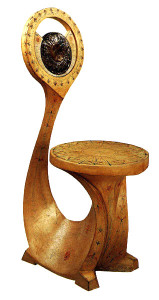
In the center of the “snail room” exhibited by Italian furniture designer Carlo Bugatti (father of the carmaker) there reside three “cobra” chairs. There is an example of one in Chicago; I’ll have to look for it the next time I pass through.
This piece is completely covered in parchment, a technique which hid all joints. Decorations are made of hammered copper, pencil and paint, and it is covered with parchment and leather.
The snail room was meant for games and conversation. The chair was shaped like a cobra, inscribed with floral and geometric motifs reminiscent of Islamic art. The chair’s open design served a practical purpose, allowing men’s coattails and women’s trains to hang down behind the seat.
It’s not really Arts and Crafts, but rather Art Nouveau, emphasizing ornament over the more self-consciously “honest” styles of the north.
Though they are sometimes lumped together, there seem to be some very important distinctions between the complex emergent styles of the late nineteenth and early twentieth century.
I opened my eyes, and now the head of the snake was close to me, facing me. How magnificent it was! The colors, glittering in the most wondrous shades, were blinding me. The most elegant ornaments were forming in front of my eyes. They curled downward to more rigidly geometrical planes, and on the lower parts of its body, where the colors turned more vulgar, the patterns became coarser and more abhorrent.
But the evil little head with the shield around the neck, which is so peculiar to the cobra, offered overwhelming richness of lines and color.
I had to look at it with an admiration close to rapture. The small eyes of the snake were glittering maliciously. They peered almost laughingly into mine. The head was rocking from time to time, sometimes shooting forward and then pulling back, and then I felt its repugnant spongy body pressing itself closer and closer to mine!
I knew that my life was not worth much by now. However, I seemed to myself triumphantly proud, felt that now I would be able to show those present what kind of man I really was.
Or was I?
Oh no, it was so thoroughly terrible, the tension was horrifying! If only the loathsome garishness would disappear! But if all turned out well, what a hero I would turn out to be! (ibid. 1-2)
It is extremely unlikely, I think, that Carl Larsson and Carlo Bugatti were familiar with each other. Nonetheless, it seems almost as if Larsson’s downright weird introduction to his autobiography might be productively be read as a critique of Art Nouveau. There’s a curious love/hate relationship with ornament across all these different threads of design.
Mackay Hugh Baillie Scott, writing in Houses and Gardens (1906) discusses two popular modes of decoration: heraldry and organic motifs. Heraldry, with its deep ties to the English manor house traditions, was old; natural motifs (decorating around some sort of common organic shape, like lotus flowers) were emerging (thanks to the pre-Raphaelites) as a plausible choice to those setting up a home.
Carl Larsson embraced Gustavian design (a situated Swedish variant of rococo), which is perhaps close to an embrace of the sort of traditional heraldic motifs gestured at by Baillie Scott. At the same time, there was a rustic naturalism to his designs. What the English and Swedish outlooks both share is a desire to ornament in such a way that connects with their national identities.
But the cobra did not release me. Now it approached my face, I felt its tongue as if it were fluttering against my lips, but I smiled and remained courageous.
Ah, but I was petrified, and so was my wide smile. Now, now, it stole its narrow, thin, thin, tongue between my lips. I felt it against my tongue. Now I could take it no longer.
I…woke up.
Fortunately it was only a dream, a nightmare.
I immediately realized it was an allegory of my life, as good as any.
You must try to decipher it yourself after reading the memories I have determined to write down.
My steadily smiling face. My hidden horror of life. I certainly was not a snake charmer. It was the snake—life—that charmed me. (ibid. 2)
Not many artists open their autobiography by spinning a tale about french-kissing a snake. I would be curious why Carl Larsson chose this dream, or why Carlo Bugatti chose the cobra as his totem, or the snail. But some things are certain.
The snail room was exhibited at Prima Esposizione Internazionale d’Arte Decorativa Moderna in Turin in 1902. It’s primary dictate: “Only original products that show a decisive tendency toward aesthetic renewal of form will be admitted. Neither mere imitations of past styles nor industrial products not inspired by an artistic sense will be accepted.”
Both Art Nouveau and Arts and Crafts stress connections, through ornament, to the lands that birthed them. Larsson had his folk styles and Gustavian ornament, Baillie Scott had heraldry and pagan naturalism, while Bugatti was more connected with Moorish traditions. All are situated in ways both intellectual and geographic.
One of the best books I’ve read in recent memory was William Coperthwaite’s A Handmade Life. In trying to figure out what made sense for me, his particular brand of “enlightened selfishness” resonated. A key component in Coperthwaite is accessibility.
In a sidebar I keep revisiting, Coperthwaite laments the accessibility of the small broad axe. I must confess that my least favorite tools are striking tools—things like hammers and axes— because they always seem to go horribly wrong for me. Wood splits (and not where you want it to) or worse still you hit yourself with them. They make loud noises and crush things, etc. However, axes are a frequent matter of discussion among green woodworkers for spoon carving and other activities which I am deeply interested in.
The hard part is that they are really designed to operate on green wood, which I don’t have easy access to. There are only small scrub bushes on my property and trashy pine trees. The only two decent trees, a maple and a pear, aren’t large enough to contribute branches of any size. Also, good axes are expensive. I bought a small swiss hatchet for splitting kindling, but I’m terrible at using it and it’s not really designed for delicately shaping wood. A good axe would cost far too much for me, given my timidity on the topic. Peter Follansbee has excellent recommendations on axes, I suspect, but I’m really not ready to go there. I was surprised that he didn’t mention Coperthwaite’s democratic axe.
Coperthwaite tells the story of searching for a decent broad axe. He carved a model from pine, and found that a blacksmith friend in Japan agreed to forge him one. After two years, the axe never materialized and he was traveling in Italy and found an old blacksmith there that would make one for him. This one was delivered, but Coperthwaite lamented:
Now, these are far from democratic tools. To get one you first have to design it and then know a smith in Japan or Italy or wherever who can—and is willing to—make an axe from your design.
It was doubtful that the axe from Japan would materialize, and the Italian smith was very old and sick and would probably not make another. A good broad hatchet for students and friends who wanted one was as elusive as ever. And though this axe adventure was exciting, and I had acquired some fine ones, we badly needed to have some inexpensive ones available. (17)
The primary difficulty in engineering and axe is the “eye” which attaches it to the handle; this can be avoided by making the blade from a flat plate of steel bolted to a handle. Then, the only technical challenge is hardening and annealing the steel once it is cut out, but a small propane torch and normal household oven can manage that. I note that John Wilson has a similar type of design for an adze, another difficult to find and expensive classic tool.
The importance of the sidebar isn’t really the design of an axe and presentation of easy to follow instructions so that anyone might accomplish it, but the philosophy behind the creation of this tool:
This experience with the broad hatchet is important for me on several levels. First it has been an exciting adventure all along the way, from learning to appreciate the variations in different forms of such a basic tool, to designing my own which others ultimately made, to ultimately making my own. Another level of the adventure is to be able to help others make their own hand axes and in the process gain the confidence that comes from making a tool. This process demonstrates how we can have adventure in a variety of ways: designing, working with the hands, and working with the mind as we carry the concept of democratic things further.
Another value this experience had for me is the breaking of mental and social barriers, which we need to be able to do if we are to solve our problems and create a society that works for all people. (18)
While I was trying to put all this together, I was a bit distracted by a podcast that Chris Schwarz linked— Looking Sideways. What fascinates me about Coperthwaite’s axe isn’t the tool itself. It’s the attitude toward toolmaking and tool sharing. Andrew Sleigh’s interview with Deb Chachra actually dovetailed nicely (stealing one of her hook phrases). She argues that we need to reassess making things in the emphasis we place on the things themselves to rebalance ourselves. Thirty minutes in, she offers the observation that “nice stuff that lasts forever is valuable, but so are the sort of day-to-day experiences that people have.” That’s similar to what Coperthwaite is arguing here. He’s championing not only the physical labor, but also the social and mental labor involved in his search for a serviceable axe.
In her Atlantic article “Why I am not a maker” (not her title, according to the podcast), she makes some really important assertions in the section that the title is misleadingly extracted from:
I am not a maker. In a framing and value system is about creating artifacts, specifically ones you can sell, I am a less valuable human. As an educator, the work I do is superficially the same, year on year. That’s because all of the actual change, the actual effects, are at the interface between me as an educator, my students, and the learning experiences I design for them. People have happily informed me that I am a maker because I use phrases like “design learning experiences,” which is mistaking what I do (teaching) for what I’m actually trying to help elicit (learning). To characterize what I do as “making” is to mistake the methods—courses, workshops, editorials—for the effects. Or, worse, if you say that I “make” other people, you are diminishing their agency and role in sense-making, as if their learning is something I do to them.
There is a quote that Coperthwaite offers up in his book that places the problem in a deeper context:
My teaching is a raft whereon men may reach the far shore.
The sad fact is that so many mistake the raft for the shore. —Buddha (53)
What is important about Coperthwaite’s democratic axe isn’t his methods—securing the the assistance of other artisans, learning how to harden and temper steel, etc.— but rather the effect of solving a difficult problem with easily sourced material, and better still, teaching anyone to solve similar problems themselves. It’s not limited to those who can afford to take a workshop, or travel miles to sit at his feet. A Handmade Life includes how to make an axe, how to bake a loaf of bread (with a recipe) and much more.
I feel incredibly blessed to live in a time where so many share so much on the Internet providing not only access to things, but methods of doing things that I really wouldn’t have invented on my own. It’s not just about having the tools, it’s knowing what you want to do and why. And it’s also important to value all forms of labor, not just the ability to make, except in the sense of making your own life.
Even in death, there’s a social impulse that insists that we must inhabit something. While a moka pot is an unusual choice for an urn, it’s somehow fitting. The choice of a utilitarian object to me is far less precious than say, a jewel encrusted sarcophagus.
Each choice, in its own way, is precious though. To dwell in the shape of your significance on earth, be it a un unusual urn or decorated monument or tomb, is motivated by a desire to make it known that to be in a place was your choice. It didn’t just happen by accident. Either you wanted it, or someone else found the need to adore and celebrate you.
That’s one of the things I found most compelling about Vincent Van Gogh’s dream of home. He didn’t want it to be precious, but he wanted it to be recognizable as his.
Van Gogh’s proclamation of “nothing precious” is the most curious demand though, for an artist who was hoping to decorate nearly every surface. What Van Gogh was striving for, in his own words, was character. Invariably, we always look to appearance to find clues.
As far as I know he didn’t follow through on it, but Van Gogh’s naked ladies adorning the bed would have been an unusual choice for the late 19th century. From what I’ve been reading, the movement was to de-sexualize the sleep chamber in most countries. Bedrooms, instead, were generally striving to look and be clean places. Though the Arts and Crafts parlors were dark and heavy woods, I was a bit surprised that even they wanted to paint the bedroom white. Habitations always tend to follow conventions and deviation is usually the proclamation of an “artistic” taste. The foundation of these conventions is not just a matter of decoration, but also of spatial placement.
Feng Shui, the Chinese science of spatial arrangement deployed for both buildings and interiors, has deep roots in the graveyard. The Zangshu, or Book of Burial is perhaps its oldest surviving text:
VIII. The Cardinal Aspects
A. The Four Aspects
1. Bury with the Cerulean Dragon to the left, the White Tiger to the right, the Vermilion Bird in front, and the Dark Turtle in back.
2. The Dark Turtle hangs its head; the Vermilion Bird hovers in dance; the Cerulean Dragon coils sinuously; the White Tiger crouches down.
3. If contours and features do not conform to this, according to the art of fengshui, there will be destruction and death.
4. Therefore the crouching tiger is said to hold the corpse in its mouth.
5. The coiled dragon is said to be jealous of life.
6. The Dark Turtle that does not droop will reject the corpse.
7. The Vermilion Bird that does not dance will soar off.
The Chinese developed the compass, not for navigation, but rather to figure out how to situate themselves and their dead in the world. The curiosity about optimal orientation by cardinal direction is persistent. In The English House from 1904, Hermann Muthesius discusses the optimal arrangements for bedrooms at length:
A south-easterly aspect is again considered best for the bedroom. The bedroom is a room in which we spend about one third of our lives in continuous periods of between seven and nine hours. Consequently its position must be a particularly healthy one, which means, most importantly, that it must be sunny by day. Yet the afternoon sun in the summer would make the room too warm. Since people like to salute the morning sun as they rise, an easterly aspect would seem to be indicated. But that room may get continuous sun for several hours after the occupant has left it, it is better that it should face south east rather than due east. (91-92)
Not quite as poetic and nuanced as the Chinese positioning literature, but consummately well reasoned as is fitting the western approach. Also predictable is the certainty of the discussions of position:
Yet there can be no doubt that the only proper position for the bed is with the head against a side wall and the plan of the room must without fail provide for this. This having been established, English opinion further requires that the left side of the bed be near the window. The reason for this is that the conjugal bedroom in England is always used as a dressing-room by the woman and the furniture that she needs for her toilette such a wash-stand, dressing-table and wardrobe stand next to a window. As we shall see, the dressing-table indeed, stands right in the window. The woman therefore takes the side of the bed nearest to her part of the room and since by ancient custom the woman sleeps on a man’s left, the bed must stand with its left-hand half on the window side. The position of all the bedroom furniture and of the doors and windows is now firmly established. The door into the man’s dressing room is in the wall nearest to the right-hand side of the bed. (92)
East or West, we expend a great deal of energy attempting to divine the best positions for ourselves, both in life and death. I hadn’t really expected a book ostensibly about architecture to discuss furniture arrangement in such detail, but it makes sense. Our habitations are essentially matters of habit.
When I first read Chris Schwarz’s The Anarchist’s Tool Chest I really wanted to like it. Instead, I found myself arguing with it constantly, not because it is filled with bad advice (it’s tremendous advice, actually) but because of its libertarian posturing. Following most of his strictures closely, one would either have to become a collector of vintage tools or a boutique consumer of specialized products. It always struck me a bit like the big Mercedes SUV’s one sees all over Ithaca with “save the whales” or “go green” stickers on the back.
I suppose I wanted to either love or hate the book, and in the end I just couldn’t. I learned from it instead. I learned a lot, though I confess to using Shinwa sliding bevels over Vesper tools.
I built the old-school joiner’s tool chest he describes. I originally thought that I’d use it to store kitchen supplies and tools in, believe it or not, because I already have several mechanic’s tool chests, including a full on rolling cabinet (not pictured here). What I found was that this tool changed the way I work, and changed the efficiency of my shop much as he described it would. I figured out that it was far too big to use in the kitchen, so I might as well use it somewhere, right? I still want to take a “workshop” approach to kitchen storage, but that’s a story for another day.
I loved using this box so much that I never bothered to take the time to paint it or finish it in any way. As you can see from the picture, the rolling tool cart and small chest next to it are a total mess. Nothing put away, crap just laid everywhere, etc. In contrast, using this chest I almost automatically put my tools away. No mean feat, when you’re as big of a slob as I am. In fact, I’ve become such a convert to traditional tool chests that my next project may be to build one of the Dutch small chests to go next to the big chest, to replace the mess here—so that I can move the mechanic’s chest and cart where it belongs, into the garage.
The trick is that the traditional chest isn’t just a box to put stuff in, it’s a jig that promotes efficient work habits. Schwarz knew that, and I suspect a lot of people who have built them have figured it out too.
Yesterday, I was remembering Matthew Crawford’s discussion of jigs and decided to revisit the book. I never took the time to do reading notes for it, and I keep wanting to do that since I read it in January. Today won’t be the day I start that; I’m still wrestling with a larger octopus. Funny how thinking and writing about kitchens and houses can send you straight back to the shop.
Crawford notes that his definition for “jig” is adapted from “The Intelligent Use of Space” by David Kirsh, and recommends it strongly. This paper, published in the journal Artificial Intelligence in 1995 makes distinct claims about the way that experts function in the world:
The agents we observe are experts, or near experts, at their tasks, despite these tasks often being everyday tasks.
Experts regularly find that enough information is available locally to make choices without having to plan on-line, using conscious analytical processes.
Experts help to ensure that they have enough information locally by partially jigging or informationally structuring the environment as they go along.
The human environments of action we shall be examining, the equipment and surfaces that comprise each workspace, are pre-structured in important ways to help compensate for limitations in processing power and memory.
Crawford doesn’t cite this directly, but using it allows him to argue that a cook in the kitchen structures his environment in such a way to facilitate the tasks he needs to perform. It’s a spatial usage of the term “jig” that is quite powerful when trying to explain how we negotiate the world as agents of change. Following Kirsh’s sources lead me to Philip Agre, who made even more explicit claims about the structure of the world implied by this mode of thought.
In his doctoral thesis from 1988, “The Dynamic Structure of Everyday Life,” Agre summarizes the historical thinking on negotiating everyday life, which he calls “the planning view,” in this way:
If an agent’s activity has a certain organization, that is solely because the agent constructs and deploys a symbolic representation of that activity, namely a plan.
Everyday activity is fundamentally planned; contingency is a marginal phenomenon.
An agent conducts its everyday activity entirely by constructing and deploying plans.
The world is fundamentally hostile. Life is a series of problems to be solved (11)
As an alternative (and a way of breaking through problems in the development in artificial intelligence) Agre proposes “the situated view” thusly:
Everyday life has an orderliness, coherence, and laws of change that are not the product of any representation of them.
Everyday activity is almost entirely routine, even when something novel is happening.
Everyday activity is fundamentally improvised; contingency is the central phenomenon.
An agent conducts its everyday activity by continually re-deciding what to do.
The world is fundamentally benign. Life is a fabric of familiar activities. (11)
In the universe Agre constructs, a plan is simply one possibility among many others in negotiating any activity. The world has an order and coherence independent, and unaffected by symbolic representations. We improvise our way through, depending on what happens. Thus, as Kirsh builds from this, jigging is introduced to control in a limited way the possibilities inherent in a given situation. Jigs either afford or constrain outcomes in any given set of contingent circumstances.
In the case of my floor tool chest, I put things back most likely because it’s simply the most direct and logical thing to do. I can’t really balance them on the surface of the chest, as I tend to do with the mechanics chest. To put things back inside drawers as you go is counter-intuitive, because drawers do not afford easy access in the same way that trays do. What seems really attractive about my future dutch tool chest plans is the way it can constrain behavior as well; one really can’t pile anything on top of the sloped lid, or its mating surfaces, the way you can in a mechanic’s chest.
Crawford uses and explains the technical terms affordance and constraint (taken from the visual theories of Jerome Gibson) admirably. From a practical standpoint, Chris Schwarz does a great job with toolboxes, workbenches, and tools in general; the only real complaint I have is the lack of a richer discussion of potential theories as to why they work the way that they do, e.g. what are the particular affordances and constraints of tools, jigs, and fixtures? To be fair, he does (like any good tool reviewer) discuss the good parts and bad parts of particular classes of tools, but he doesn’t do so in anything approaching a consistent fashion.
In the run-up to the release of The Anarchist’s Design Book, Schwarz claims to only have feelings about craft while standing at his bench, rather than when writing. I don’t see that working leads to any sort of feelings that might be symbolically represented, so I suppose he’s essentially justified in his evasion of discussing them.
I’m too busy dealing with contingencies in my shop to have anything remotely resembling feelings, theories, or plans. I do, however, develop theories regarding the best way to jig things to achieve some level of success, before I enter the workshop; I have a lot of feelings and theories in that aspect and I don’t understand why Schwarz insists on being anti-intellectual and evasive in that regard.
My favorite discovery through all this reading is the distinct possibility that “The world is fundamentally benign. Life is a fabric of familiar activities”—this sure beats the idea of a canned response to a hostile world.
Without theories of the everyday world, our understanding of intelligence (either human or machine) is impoverished, and sometimes the simplest theories are the most powerful.




 It’s difficult to tell from the poor halftone, but, these are pastoral scenes with an almost Rocco flair. I suspect this is an homage to Gustavian design.

 What is clear is that they wanted to innovate, not simply in appearance, but in manners of work:
 I had to steal this image from Urban Rancher’s blog. It’s a drawing of a cabin that became a reality, one of thousands of “tiny houses” that have been all the rage for the last decade or two. I note that this man’s plans include having a separate tool shed nearby (already built in 2010). In the future, he also wanted to add a kitchen/bathroom building with plumbing, etc. I was reminded of one of Chris Schwarz’s famous dictums (about workbenches, I think): “Invent nothing.”
 On tinyhousedesign.com, I note that some enterprising contemporary designer has come up with a “shed cluster concept”:

 The caption for this photo is translated as:




 Even in death, there’s a social impulse that insists that we must inhabit something. While a moka pot is an unusual choice for an urn, it’s somehow fitting. The choice of a utilitarian object to me is far less precious than say, a jewel encrusted sarcophagus.
