Category: Art
Masks

I stumbled on some of the typewriter artworks of Jeremy Mayer yesterday and found myself as obsessed with his artist statement as with his work. Yeah, right— Art is a a disease and a curse?
Any long-winded tirades about recycling or nostalgia for mechanical machines would be absolute bullshit, and I’m renowned for bullshitting . I was broke and bored when it all came to me. The romantic high ideals that people have about art are moronic. Art is a disease and a curse if you do it for the right reasons.
I try my best not to fill the world with more contrived and saccharine shit.
American Academy
Paraphrased from Thomas S. Cummings, Historic Annals of the National Academy of Design (1865):
In 1802 an institution was proposed under the title of “New York Academy of Fine Arts”—its charter was not granted until 1808, under the modified name “American Academy of Art.” According to Dunlap, the board contained men of every profession except professional artists—its first group of officers did add one artist, John Trumbull, as president. DeWitt Clinton was on the board of directors. Prior to the granting of the charter, the ambassador to France, Robert R. Livingston, sent a number of “casts from the antique” that were exhibited in the Custom-House on Broadway on the first of February 1804 at the admission price of $5. Apparently, this was not a success and the casts were removed to the store of Captain Farquahr in Vessey Street. The institution lay dormant until 1816 (5-6).
The Chase
Every since Helen Liggett referred to a quote regarding Lee Friedlander’s “excess of fact” I’ve been trying to chase it down. It really bugs me when people don’t follow up on their sources. The trail on this one is long and silly. It starts here (approximately), in this passage from Liggett:
Street photography is a procedure that connects daily life to representation and
thus it is characterized by what photographer Lee Friedlander calls an “excess of fact.” “It’s a generous medium, photography,” he writes (Armstrong 2005,293). In part this is a description of the type of photography he produces. But it is also an acknowledgement of how crowded the referent in un-staged photography necessarily is. Photographic space is more complex than a photographer’s interest in a single object or viewers’ tendency to think of images as being about a single subject. The complexity of any site generates a photographic space that leads to the proliferation of meaning in much the same way that urban life is not fixed, but constantly in motion. The visual
cacophony produced by street photography evokes a radical urban aesthetics by pointing to the gap between the work and an audience’s reading of it. What is radical about the excess of fact is that a space is both presented and unfinished.
The Armstrong article is an Artforum review of Lee Friedlander’s 2005 exhibition at MOMA. I drove to Minneapolis and picked that up. It lists the source of its quote as an interview with Friedlander by Peter Galassi in the exhibition catalogue. That massive tome was checked out, so I recalled it. I picked it up yesterday. It cites the source of the direct quote as an article called “excess of fact” in Friedlander’s monograph The Desert Seen. Did Friedlander even utter the phrase? I’m beginning to have my doubts. The University library doesn’t seem to have that monograph; I’ve requested it via interlibrary loan. So close, and yet so far!
Waggery
The first consequence of the retreat of art upon itself is the ban on all pathos. Art laden with “humanity” had become as weighty as life itself. It was an extremely serious affair, almost sacred. At times—in Schopenhauer and Wagner—it aspired to nothing less than to save mankind. Whereas the modern inspiration—and this is a strange fact indeed—is invariably waggish. The waggery may be more or less refined, it may run the whole gamut from open clownery to a slightly ironical twinkle, but it is always there. And it is not that the content of the work is comical—that would mean a relapse into a mode or species of the “human” style—but that, whatever the content, the art itself is jesting. To look for fiction as fiction—which we have said, modern art does—is a propositon that can cannot be executed except with one’s tongue in one’s cheek. Art is appreciated precisely because it is recognized as a farce. It is this trait more than any other that makes the works of the young so incomprehensible to serious people of less progressive taste. To them modern painting and music are sheer “farce”—in the bad sense of the word—and they will not be convinced that to be a farce may precisely be the mission and virtue of art.
José Ortega y Gasset, “The Dehumanizaton of Art” (1925)
With a deferential nod to Waggish.
Dehumanizing for profit
What is it the majority of people call aesthetic pleasure? What happens in their minds when they “like” a work of art; for instance, a theatrical performance? The answer is easy. A man likes a play when he has become interested in the human desires presented to him, when the love and hatred, the joys and sorrows of the personages so move his heart that he participates in it all as though it were happening in real life. And he calls a work “good” if it succeeds in creating the illusion necessary to make the imaginary personages appear like living persons. In poetry, he seeks the passion and pain of the man behind the poet. Paintings attract him if he finds on them figures of men or women whom it would be interesting to meet. A landscape is pronounced “pretty” if the country it represents deserves for its loveliness or grandeur to be visited on a trip.
It thus appears that to the majority of people aesthetic pleasure means a state of mind which is essentially undistinguishable from their ordinary behavior. It differs merely in accidental qualities, being perhaps less utilitarian, more intense, and free from painful consequences. . . . As they have never practiced any other attitude but the practical one in which a man’s feelings are aroused and he is emotionally involved, a work that does not invite sentimental intervention leaves them without a clue. . . .
Sloppy

Larry “Wild Man” Fischer
Watching the documentary Derailroaded last night, I was pondering the relationship between space and creativity. Bill Mumy described following Fischer around on the city streets recording him with a stereo microphone as he composed his songs. He would take them back to the studio later to create backing tracks and clean them up. One of the things I always remembered about Slim was his resistance to “cleaning things up”— Slim always wanted to leave the dirt there. It wasn’t just a matter of sloppy craft (as some people took it). It was more a matter of maintaining the genuine article rather than simulated perfection—it was a punk attitude.
Looking at this picture today, I keep thinking about the tendency of photographs to provide an “excess of fact” (a phrase from Lee Friedlander I keep trying to track down). I got it wrong when I wrote about Helen Liggett’s presentation at C&W 2007, calling it a “surplus of fact.” I do think excess is better. Surfing around looking at discussions of Friedlander, I’m amazed by the large number of people who just don’t get him. I suppose it’s a search for a simple message (like the one displayed above) rather than a complex construction that people are often drawn to. But there’s another way these questions might be framed.
Birthday

from the Washington Post
AMSTERDAM, Netherlands — Friends and fans of the Dutch filmmaker found dead with a note pinned to his chest with a knife unveiled a memorial sculpture that depicts him screaming near the spot where he was murdered by an Islamic extremist.
Mayor Job Cohen and a Dutch comedian praised the controversial Theo Van Gogh and his work as the sculpture by Jeroen Henneman was revealed Sunday to hundreds of people gathered at a park in eastern Amsterdam.
Coincidentally, Sunday was my birthday. I didn’t’ spend it screaming.
The new snoopy
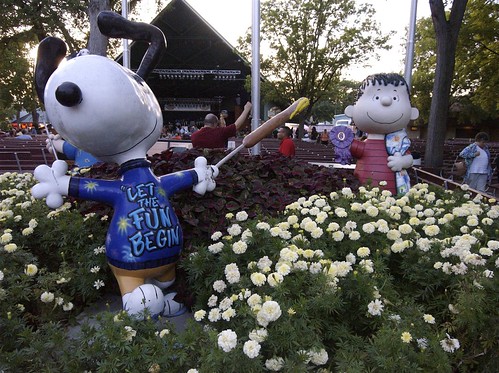
I never really got around to photographing most of the Snoopys around town
The Twin Cities have a different take on the issue of civic statuary. It will be quite a change of pace when dinosaurs outnumber the Peanuts characters. I can only hope that it remains as tasteful as the cows of Madison, Wisconsin or the psychedelic buffalo of Custer, South Dakota.
S.C.
Following the notice of the capture of the S.C.s, gambling in public printed in the Evening Standard, an anonymous member of the Sketch Club (which included Samuel Morse and William Cullen Bryant) responded in a letter to the editor:
My dear sir:— I am exceeding grieved to perceive by your paper of this morning, that you have fallen into an enormous error respecting the nature and objects of the Selebrated Cociety to which I have the honor to belong, and the existence of which is occasionally made known to the public through the press, by the apparition of its formidable initials, S.C. You appear to be somewhat alarmed at the portentous aspect of this prodigy; but, my dear friend, let me entreat you to calm your fears—there is no cause for uneasiness. We, S.C’s, are not gamblers; and we entertain as virtuous and laudable a horror of Lumber Street and its inequities as any of our fellow countrymen. How should it be otherwise? Are we not Sober Citizens, and Sincere Christians? Do we not Sleep Coundly, Sing Cheerfully, Separate Coberly, Speak Censibly, Suffer Courageously, and Sup Comfortably? You seem to think we Shuffle Cards, too; but upon the Spotless Character of an S.C., it is not so; and the main who says it utters a Scandalous Calumny.
Since you manifest so much anxiety on the subject, however, I will tell you the honest truth; we are, in fact, a Secret Combination of Sworn Conspirators; and Social Conviviality is but a Simulated Cover for the Sacred Cecrecy of our Solemn Cabal. We are Severe Colts; and our purpose is to outroot Jacksonism and the Republic together. We are pledged to the establishment of absolute monarchy, the U.S. Bank, and Anti-Masonry; and we have sworn the downfall of the Regency, the Cherokees, and the odious practice of making visits on New Year’s day. We have Seriously Concluded to have mister. Van Beuren for King, and Mr. Clay Viceroy over him; but Mr. C. must change his name to Stephen, that he may be,
Like your Sensible Correspondent,
For all intents and purposes, an
S.C.qtd in Historical Annals of the National Academy of Design, 1865